
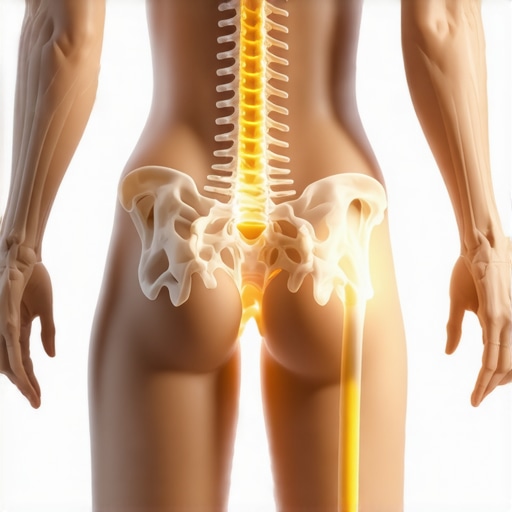
I remember the morning I tried to step out of bed and felt that searing zip down my right calf. I spent three weeks obsessively rolling out my leg with a lacrosse ball, convinced I’d just pulled something during a weekend hike. I was wrong. Dead wrong. No matter how much I tortured my muscles, the pain stayed exactly where it was. It wasn’t until I sat down with a colleague that I realized I was chasing a ghost in my leg while the real culprit was hiding in my lower back. This lightbulb moment changed everything for me, and today, I want to help you figure out if your body is playing the same trick on you. We are going to dive into the tell-tale signs that your leg ache is actually a spinal shout for help, so you can stop wasting time on the wrong stretches and finally find relief.
Stop Hammering Your Hamstrings and Look Higher Up
For the longest time, I thought that if something hurt in my leg, the problem must be in my leg. It sounds logical, right? I spent hours on the floor, and I even wrote about why your hamstring stretches are not fixing your tight legs because I lived that frustration firsthand. My early mistake was ignoring the neurological map of the body. I was treating the lightbulb when the fuse box was the issue. When a nerve in your lumbar spine gets pinched or irritated, it doesn’t always hurt at the site of the pinch. Instead, it sends a signal—a referred pain—all the way down the line. It’s like a kink in a garden hose; the dry patch of grass is at the end, but the problem is ten feet away.
Is this just another fancy way to say I have a bad back?
You might be skeptical. Maybe your back feels fine, so you assume your spine is out of the equation. Trust me, I’ve been there. But here is the kicker: you can have significant nerve irritation in your spine without a single ounce of back pain. It’s one of those weird quirks of human anatomy. If you have been struggling with a pulled muscle that never seems to heal, have you considered that the source might be higher up? Have you ever spent a fortune on calf sleeves or massage guns only to realize the pain hasn’t budged? Let me know in the comments if you’ve faced this cycle.
The Sneaky Way Your Spine Masquerades as a Leg Injury
Understanding the connection between your vertebrae and your extremities is the first step toward a real solution. Many people find that chiropractic adjustments unlock a pain-free lifestyle because they finally address the structural root rather than the symptomatic branch. According to the Cleveland Clinic, roughly 40% of people will experience sciatica at some point in their lives, and many of them will mistake the initial calf or thigh pain for a simple strain. This confusion is why so many people end up with chronic issues; they are trying to fix a mechanical spinal problem with topical leg solutions. If you’ve noticed that your knee cap tracks outward when you walk or you experience sudden electric zaps, your spine is likely trying to tell you something. Sometimes your lower back spasms suddenly as a protective mechanism for these nerves, even if the pain eventually settles in your foot. We need to look at the whole picture to get you back to moving comfortably.To stop the cycle of chasing symptoms, you need a systematic way to test your body. I remember the day I finally sat down to try this myself; I was so desperate I would have tried anything. I sat on the edge of my bed, slumped my shoulders forward, and tucked my chin to my chest. As soon as I straightened my ‘injured’ leg, that calf pain flared up like a Roman candle. That was my proof. If you can trigger your leg pain just by moving your neck or spine, your leg isn’t the problem—the nerve tension is. This is why the simple way to tell if your spine is rotating while you walk is such a critical diagnostic tool for your daily life.
Stop Stretching Muscles and Start Flossing Nerves
Think of your nerves like a long, continuous guitar string running from your lower back to your toes. If that string is snagged at the ‘tuning peg’ (your spine), pulling on the ‘bridge’ (your ankle) just creates more tension. Instead of static stretching, we use ‘nerve flossing.’ This involves moving one end of the nerve while relaxing the other, literally sliding the nerve through the tight tissues. I used to spend twenty minutes a day aggressively pulling my toes toward my face, only to feel tighter afterward. Once I switched to gentle flossing, the ‘tightness’ vanished in three days. This is often why your hamstring stretches are not fixing your tight legs; you are pulling on a nerve that needs to slide, not a muscle that needs to lengthen.
How to Use the Slump Test to Find the Culprit
Sit on a firm table or chair with your legs hanging off. Slump your mid-back, bring your chin to your chest, and slowly straighten the leg that hurts. If the pain increases, pull your toes toward your shin. Does the pain get worse? Now, lift your head and look at the ceiling while keeping the leg straight. If the pain in your leg decreases when you move your head, you have confirmed a neural tension issue rooted in your spine. This isn’t a muscle tear; it’s a structural traffic jam.
Use Your Breath to Create Internal Space
Many of us ‘chest breathe,’ which creates a constant state of tension in the mid-back and lumbar region. By shifting to diaphragmatic breathing, you create an internal pressure change that can actually decompress the lower spine from the inside out. There is a profound the hidden link between your breathing pattern and lower back stability that most people ignore. When I started focusing on expanding my lower ribs rather than my shoulders, my ‘sciatica’ flares dropped significantly because I was supporting my spine from within.
Realign Your Spine to Release the Trapped Nerve
If your vertebrae are stuck or misaligned, they act like a physical clamp on those nerves. This is where professional intervention becomes a shortcut. While exercises help maintain space, chiropractic adjustments unlock a pain-free lifestyle today by physically restoring the movement that your body cannot achieve on its own. It is like hitting a reset button on a jammed drawer. Once the joint moves freely, the nerve can finally breathe. You also need to audit your environment to keep that nerve free. For instance, knowing the best sitting position for lower back disc bulges can prevent you from re-clamping that nerve every time you sit down to work. You should even learn how to brace your spine before you sneeze to avoid those sudden, sharp setbacks that send pain shooting back down your leg.It’s about more than just avoiding the ‘big’ injuries; it’s about understanding the subtle mechanics that keep your system running smoothly. Most people believe that ‘good posture’ is a static position—a military-style chest-out, chin-tucked pose that you have to maintain through sheer willpower. In my experience, this is the quickest way to end up in my office with a rib out of place.
Why chasing a ‘straight’ spine usually backfires
The truth is that your body isn’t designed to be a statue. When you force your spine into a rigid line, you actually deactivate the small, stabilizing muscles that are meant to support you. You end up relying on your large ‘prime mover’ muscles to do a job they aren’t built for, leading to that deep, gnawing fatigue. This is why the link between mobility and posture is so vital; you need the freedom to move through various positions, not the strength to hold just one. Think of your spine like a suspension bridge, not a skyscraper. It needs to sway to absorb the stress of life. If you’ve been trying to ‘sit up straight’ for years and you’re still in pain, you’ve likely fallen into the trap of confusing stiffness with stability. Many people think mobility is simply about flexibility, but it’s actually about control. You can be the most flexible person in a yoga class and still have chronic back pain if your nervous system doesn’t trust your joints in those end-range positions. This is the ‘mobility paradox.’ We often try to ‘force’ range of motion when we should be ‘earning’ it through stability. This is exactly why chiropractic care is your secret weapon for better posture—it focuses on the quality of joint movement rather than just the quantity.
Could your jaw be the secret reason your lower back won’t stay aligned?
This is the level of detail most people miss. Your body operates on a ‘top-down’ priority system. If your jaw is tight from stress or a dental issue, your neck muscles will compensate to keep your head level. This creates a chain reaction of tension that travels all the way down to your pelvis. A study published in the Journal of Manipulative and Physiological Therapeutics suggests that sensory input from the upper cervical spine and the temporomandibular joint is critical for maintaining overall postural equilibrium. If you stop clenching your teeth to relieve your neck stress, you might find that your ‘weak’ lower back suddenly feels more stable.
Don’t mistake a protective spasm for a simple muscle knot
Here is the ‘Oops’ factor that keeps people in a cycle of chronic pain: stretching into a protective spasm. When a nerve is irritated, your brain will often command the surrounding muscles to tighten up—not because the muscles are short, but because they are acting as a biological splint. If you keep using a massage gun or a foam roller on these ‘knots,’ you are essentially trying to tear down the scaffolding while the building is still under repair. You must learn the difference between muscle soreness and joint inflammation before you reach for the roller. Instead of attacking the tightness, you should revolutionize your posture with targeted mobility exercises that signal safety to your nervous system. For example, knowing why you should stop rolling your neck to get rid of cracks is a perfect lesson in this; that ‘crack’ is often a joint reaching its end range, and forced rolling just creates hypermobility in an already unstable area. We want to build resilience, not just temporary relief. Have you ever fallen into the trap of stretching a muscle for weeks only to have it feel tighter the next day? Let me know in the comments below.If you want to move from ‘surviving’ to ‘thriving,’ you have to stop treating your body like a weekend project. I used to think a monthly massage was enough, but true maintenance is a daily conversation with your nervous system. To keep your system running, I’ve moved away from standard foam rollers—which are often too blunt to be effective—and started using targeted tools like a psoas release wedge. Revolutionize your posture with targeted mobility exercises by using tools that allow you to pin and stretch specific tissues. For me, the Pso-Rite was a game-changer because it mimics the pressure of a thumb, reaching deep into the hip flexors that typical rollers just skip over.
The Tool That Actually Reaches Your Hidden Tension
When you use a specialized tool, you aren’t just ‘smashing’ muscle; you are providing a sensory input that tells the brain to let go. This is a key part of improving posture through mobility. As Dr. Stuart McGill, a world-renowned expert in spine biomechanics, notes in his work Back Mechanic, maintaining ‘spinal hygiene’—the way you move and brace throughout the day—is more important than any single hour-long workout. I use a simple lumbar roll in my car because the one secret to pain-free car travel is keeping that natural curve without having to think about it. 
How do I maintain my spinal mobility as I get older?
Consistency beats intensity every single time. You don’t need to spend an hour a day on the floor. I’ve found that mobility hacks and simple adjustments integrated into your day are the real winners. For example, the daily move to keep your spine young takes exactly ninety seconds but prevents the ‘stiffening’ that occurs after hours of sitting. I personally set a timer on my desktop to remind me to stand up and reset my pelvis.
What the Next Decade of Posture Tech Looks Like
I predict that in the next few years, we are going to see a massive shift toward wearable biofeedback. We already have watches that track steps, but soon we’ll have haptic sensors in our shirts that gently vibrate when our shoulders round forward or our pelvis tilts too far. This will make the ultimate guide to improving mobility and posture in 2025 less about ‘remembering’ and more about real-time correction. It’s an exciting time because we are moving away from reactive care toward proactive alignment. My challenge for you today: pick one tool, whether it’s a tennis ball for your glutes or a lumbar roll for your chair, and use it for five minutes before you go to bed. See how much easier that first step out of bed feels tomorrow morning.
The Realizations That Changed How I View My Body
I spent years thinking my body was a collection of parts that broke independently, like a car with a bad tire. But the human body is more like a spiderweb; pull one thread in your lower back, and the vibration travels all the way to your big toe. One of the most profound things I’ve learned is that pain is a lagging indicator. By the time your leg starts screaming, the structural imbalance in your spine has likely been brewing for months. I also realized that ‘rest’ is often the worst thing for nerve irritation. Nerves need movement and blood flow to heal, which is why mobility boosts for posture are far more effective than just lying on the couch. Finally, I had to accept that there is no ‘magic pill’ for spinal health. It is a daily practice of mindfulness, from how you pick up your keys to how you breathe while sitting in traffic.
The Daily Gear That Keeps My Spine Happy
To maintain the progress I’ve made, I rely on a few specific tools that I trust implicitly. First, I never leave for a road trip without a high-quality lumbar support; it’s the simplest way to prevent my pelvis from tucking into a nerve-pinching position. I also highly recommend picking up a copy of Back Mechanic by Dr. Stuart McGill. It is the gold standard for understanding how to move without triggering pain. For daily maintenance, I use a firm lacrosse ball to release the fascia in my feet and glutes, which indirectly takes the pressure off my lower back. If you have kids at home, you should also be mindful of the one daily habit ruining your teenage daughters posture, as catching these issues early is much easier than fixing them decades later. Using these tools alongside how chiropractic adjustments enhance posture and mobility creates a comprehensive shield against chronic pain.
Step Into a More Resilient Version of Yourself
You don’t have to accept a life of ‘nagging’ aches and ‘mystery’ pains. Your body has an incredible capacity to heal once you stop fighting against its natural mechanics and start supporting them. Whether you are following the ultimate guide to improving mobility and posture in 2025 or simply starting with a few nerve glides in the morning, the most important step is the one you take today. Consistency is your greatest ally. When you align your spine, you aren’t just fixing a back problem; you are unlocking your entire nervous system so you can live, move, and play without restriction. Have you ever tried ‘flossing’ a nerve instead of stretching a muscle? Let me know your results in the comments below.