
It happened last Tuesday. I was three hours deep into a project, buried in my favorite velvet sectional, when I tried to turn my head to look at the door. CRACK. It wasn’t the satisfying pop of a good stretch; it was the sound of a rusted hinge being forced open. My neck was locked, my shoulders were practically touching my earlobes, and I realized I had spent the entire evening looking like a human question mark. We have all been there. You want the comfort of the cushions, but you end up with the spine of a gargoyle. I used to think the couch was just my ‘bad habit’ spot, but I was wrong. I made the massive mistake early on of thinking a soft pillow under my head would fix everything, but all it did was shove my chin into my chest and aggravate my nerves.
The Night My Neck Finally Decided to Quit
That specific moment of realization is what changed my entire approach to working from home. I am going to show you exactly how to keep your spine healthy while working from the sofa without having to move back to a stiff wooden chair. The truth is, your couch isn’t the problem; it is how you are interacting with it. When we slump, we aren’t just relaxing; we are putting incredible strain on our anatomy. According to a study published in Surgical Technology International, leaning your head forward at a 60-degree angle to look at a screen can put up to 60 pounds of pressure on your cervical spine. That is essentially like carrying a large dog around your neck while you try to type! This is why the nighttime habit that is ruining your spinal alignment usually starts the second you open your laptop on your lap. Have you ever stood up after a Netflix binge or a work session and felt like you aged twenty years in twenty minutes? I want to hear your ‘couch-to-pain’ stories in the comments.
Is lounging on the sofa actually worth the hype?
I get the skepticism. You might think that the only way to save your back is to sit like a statue at a desk. But let’s be realistic: nobody wants to do that at 8:00 PM. You don’t have to choose between comfort and a healthy spine. You just need to stop the ‘C-curve’ slump. By adjusting your setup, you can find the secret to fixing tech neck without quitting your phone or your laptop. I used to see why your teenager always slouches on the sofa and judge them, only to realize I was doing the exact same thing. Today, we are going to fix that once and for all.
Stop Treating Your Couch Like an Ergonomic Enemy
The goal today is to transform your living room into a space that supports your mobility instead of draining it. We are going to look at the ‘lap’ in laptop and why it is the biggest lie in tech history. Your lap is the worst place for your computer. I have experimented with every pillow configuration known to man, and I have finally found the setup that allows me to work for hours without that burning sensation between the shoulder blades. We are going to dive into the specifics of hip positioning and screen height so you can finally relax without the regret.
Build a Fortress of Support Instead of a Pit of Despair
To stop the slouch, you have to treat your sofa like a modular workstation. The biggest problem with a couch is that it is designed for sink-in comfort, which is the natural enemy of structural integrity. When you sink, your pelvis tilts backward, dragging your lumbar spine into a rounded shape that stretches your ligaments like a rubber band about to snap. I remember a particularly ambitious Thursday where I tried to work from a giant, overstuffed bean bag. I thought the ‘moldability’ would be a dream. Instead, within an hour, I was so deeply wedged into a ‘C’ shape that I actually had to roll onto the floor just to stand up. It was embarrassing, painful, and a masterclass in what not to do. To avoid this, you need to implement mobility hacks and simple adjustments that counteract the sofa’s soft nature.
Elevate Your Hips to Save Your Lower Back
The first rule of sofa survival is to sit on something firm. Grab a firm decorative pillow or even a yoga block and sit on the front edge of it. This creates a ‘perch’ rather than a ‘sink.’ By getting your hips slightly higher than your knees, you naturally encourage your pelvis to tilt forward, which restores the natural arch in your low back. This is the same principle behind the proper way to use a lumbar roll. If you let your knees fly up higher than your waist, you are essentially forcing your spine to carry the weight that your core should be handling. Also, stop crossing your legs; why sitting cross-legged is wrecking your hips becomes painfully obvious when you realize it rotates your entire pelvis and creates an uneven base for your spine to sit on.
Kill the ‘Lap’ in Laptop Forever
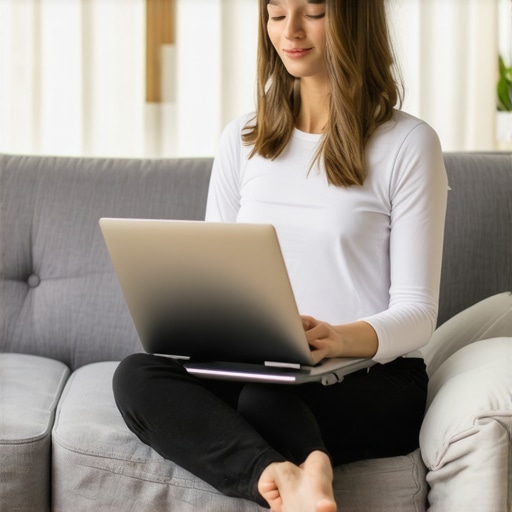
Your laptop should never actually be on your lap. When the screen is that low, your head—which weighs about as much as a bowling ball—drops forward. Think of your neck like a crane; the further the weight moves from the center, the harder the cables (your muscles) have to work. This is exactly why your head feels heavy after staring at a monitor all day. Use a dedicated laptop tray with legs or stack several large coffee table books on your lap. The goal is to bring the top of the screen to eye level so your chin stays parallel to the floor.
Support the Curve or Pay the Price Later
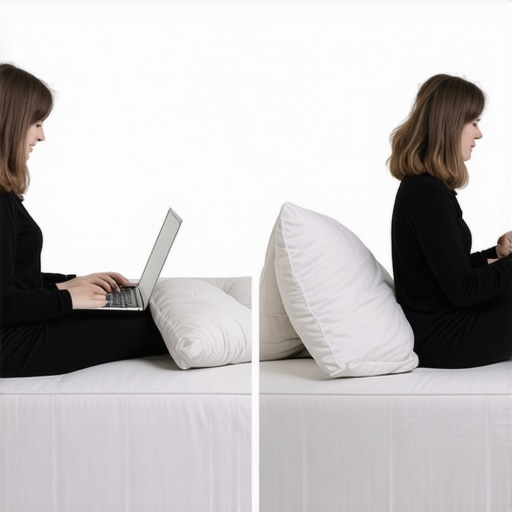
Most sofas leave a massive gap between the back of the cushions and your actual spine. If you don’t fill that gap, your muscles will stay ‘on’ all night trying to hold you up, leading to that familiar burning sensation. Take a firm pillow and wedge it vertically against the small of your back. This prevents the ‘slump’ from even starting. If you find yourself reaching for your shoulder blades every ten minutes, you might already be dealing with a pinched nerve in your shoulder blade caused by chronic rounding. Every 20 minutes, perform a ‘reset’ by squeezing your shoulder blades together and down, as if you are trying to tuck them into your back pockets. This tiny movement re-engages the postural muscles that the sofa tries to put to sleep.
Here is a hard truth that most ergonomics ‘gurus’ won’t tell you: there is no such thing as a perfect static posture. We have been conditioned to believe that if we just find that one magical angle, our pain will vanish. I spent years trying to sit like a soldier on my sofa, chest out and shoulders pinned back, only to realize why your perfect posture is actually causing muscle fatigue. When you force your body into a rigid position, you are essentially asking your postural muscles to run a marathon without a break. They eventually give out, leading to more slumping and deeper pain.
The Trap of the Posture Brace
One of the biggest ‘oops’ moments I see is people rushing to buy those elastic posture braces. It seems like a logical shortcut, right? If the brace holds you up, you don’t have to think about it. But here is the nuance: your muscles are like employees—if you give their job to someone else (the brace), they simply stop working. This is why most posture braces actually make your back weaker in the long run. You aren’t building support; you are outsourcing it, and your spine pays the price when the brace comes off. Instead of relying on a harness, you need to focus on mobility hacks and simple adjustments that encourage your muscles to do their job naturally.
Why does my back feel tight even when I am sitting correctly?
The answer lies in blood flow and ‘postural variability.’ A study published in the Journal of Physical Therapy Science indicates that prolonged static sitting—even in a technically ‘correct’ position—significantly decreases blood flow to the lumbar tissues. Your spine craves movement, not just a better chair. I often see people get frustrated and start trying to ‘self-adjust’ to find relief. I have to warn you: why you should stop cracking your own back every hour is because you are likely just hyper-mobilizing the joints above and below the actual problem area, rather than fixing the root cause. This creates a cycle of instability that keeps you glued to the sofa in pain.
Movement is the Only Real Cure
If you want to truly protect your spine while lounging, you have to adopt the ‘micro-break’ philosophy. I use the 10-second move to reset your shoulders every single time I finish an email or a chapter of a book. This breaks the static load and tells your nervous system that it’s okay to relax. This is where professional intervention makes a massive difference; why chiropractic care is your secret weapon for better posture is that it addresses the specific joint restrictions that prevent you from moving fluidly in the first place. Once those ‘stuck’ points are cleared, sitting ‘well’ doesn’t feel like a chore anymore—it feels natural. Have you ever fallen into the trap of trying to sit perfectly still only to end up in more pain? Let me know in the comments.
I have spent a small fortune on gadgets that promised to fix my back, but I have learned that the best tools are often the simplest. For me, the real game-changer was not a thousand-dollar chair; it was a twenty-dollar foldable laptop riser that attaches to the bottom of my device. It raises the screen just enough so I am not staring at my own lap while I type. Combined with a firm support, it’s a powerhouse for your alignment. If you are not sure how to position yourself, checking out the proper way to use a lumbar roll is a great first step, even if you are using it on a couch instead of a swivel chair. I also swear by a high-density lacrosse ball for my upper traps. When those shoulders start to creep up toward my ears, I spend two minutes leaning against the wall with that ball. It is far more effective for localized relief than any generic massage chair I have ever tried.
How can I maintain my spinal health over the years?
Maintenance is not about being perfect every single day; it is about mobility boosts for posture and staying consistent with small, manageable wins. I view my spine like a high-performance vehicle. You wouldn’t drive a luxury car for fifty thousand miles without an oil change, so why expect your body to run forever without a tune-up? This is exactly why chiropractic adjustments unlock a pain-free lifestyle today by keeping the mechanical parts of your frame moving as they were designed to. Dr. Kelly Starrett, a renowned physical therapist and author of Becoming a Supple Leopard, famously says that “all human beings should be able to perform basic maintenance on themselves.” I have taken that to heart. I now schedule a personal ‘spine check’ every morning. If I cannot look over my left shoulder without my whole torso turning, I know I have spent too much time in a deep sofa slump the night before and need to prioritize mobility hacks and simple adjustments to reset.

The rise of smart furniture and biofeedback
Looking ahead, the way we lounge is going to change drastically. I predict we are moving toward a world of “smart” fabrics and furniture with integrated biofeedback. In the next five years, I expect our sofas to have haptic sensors that gently vibrate when we have been stuck in a C-curve for more than twenty minutes. Until that tech becomes mainstream, we have to be our own sensors. I recommend using the ultimate guide to improving mobility and posture in 2025 to build a routine that actually adapts to your modern lifestyle rather than fighting against it. We are finally moving past the era of ‘static’ ergonomic advice and into a more dynamic, movement-based approach.
Start the “Minute Movement” habit today
My advanced tip for you today is a specific move called the “Thoracic Bridge.” Most people focus on the neck when they feel pain, but the actual stiffness usually lives in the mid-back (the thoracic spine). If the mid-back does not move, the neck is forced to overcompensate for every turn and tilt. This is a core reason how chiropractic adjustments enhance posture and mobility—they target those specific, rigid segments that you cannot reach on your own. Try doing just sixty seconds of thoracic rotations every time you close your laptop for the day. You will feel your chest open up immediately, and it actively counteracts the damage done by your favorite cushions. Give it a try tonight before you head to bed and feel the difference in your morning stiffness.
What Most Ergonomics Experts Get Wrong About Soft Surfaces
Looking back at my own journey, I realized that “comfortable” is often a mask for muscle atrophy. When we sink into a sofa, we aren’t just resting; we are teaching our bodies to be passive. My biggest lightbulb moment was discovering that fatigue isn’t just about work—it’s about how much effort it takes for your body to simply exist in space. I also learned that mobility hacks and simple adjustments are far more effective than trying to buy your way out of pain with fancy gadgets. True comfort comes from a spine that is resilient, not just a cushion that is soft. Gravity is working against you 24/7, and unless you provide a foundation, your posture will always follow the path of least resistance.
My Personal Toolkit for a Healthier Living Room
If you are serious about changing how you feel, I recommend starting with Becoming a Supple Leopard by Dr. Kelly Starrett; it is the owners manual for the human body I wish I had a decade ago. For those who can’t quit their laptops, a foldable riser is non-negotiable to keep your eye level correct and prevent that bowling ball effect on your neck. I also suggest reading the link between mobility and posture to understand why stretching alone isn’t enough to counteract hours of lounging. Finally, consistent professional care is my anchor; why chiropractic care is your secret weapon for better posture is because it handles the structural restrictions that pillows simply cannot reach.
Reclaiming Your Right to Lounge Without Pain
You don’t have to choose between a cozy evening and a healthy spine. By being intentional with how you sit and incorporating the ultimate guide to improving mobility and posture in 2025, you can enjoy your sofa without the morning-after stiffness. Your spine is the foundation of your quality of life, and every small change you make today is an investment in your future mobility. Don’t wait for that painful pop or a locked neck to remind you that your alignment matters—start your movement journey tonight. Have you ever felt that sharp ‘rusting hinge’ sensation in your neck after a long night on the couch? I’d love to hear your story in the comments below.