
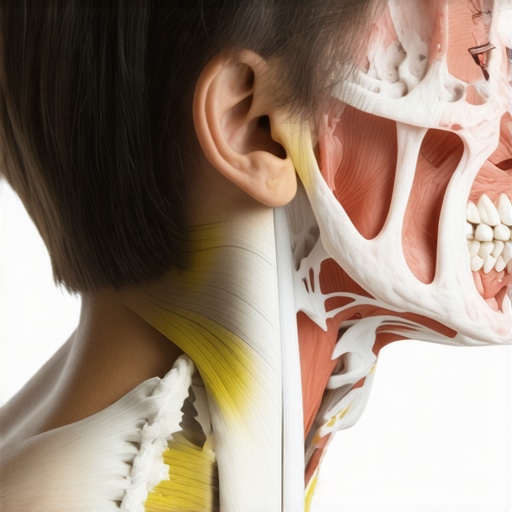
The first time I realized my neck pain wasn’t actually a neck problem, I was sitting in my car, staring at the rearview mirror, trying to rub a knot that felt like a marble embedded in my trapezius. I had spent months trying every stretch in the book, and I even bought three different ‘orthopedic’ pillows that did absolutely nothing. I was convinced I was just destined to live with a stiff spine. Then, a friend pointed out that my face looked ‘exhausted.’ I wasn’t tired; I was just clenching my teeth so hard that my entire head was vibrating with tension.
The surprising link between your bite and your upper back
It sounds a bit far-fetched at first, doesn’t it? You would think the jaw and the neck are separate entities, but they are more like roommates sharing a very small apartment. When you are stressed or focused, you might stop clenching your teeth for a moment and realize how much force you’ve been applying. That pressure doesn’t stay in the mouth. It travels. The muscles that close your jaw are some of the strongest in your body, and when they are constantly ‘on,’ they pull on the delicate structures of your upper cervical spine. I made the classic mistake of focusing only on where the pain was felt, rather than where it started. I spent a fortune on massages for my shoulders while my jaw remained a tight ball of knots. Research published in the Journal of Oral Rehabilitation confirms this connection, showing that the trigeminal nerve system, which controls your jaw, actually shares a neurological pathway with the nerves in your upper neck. This means your brain can literally confuse jaw stress for neck pain. If you’ve been wondering why your neck muscles are hard like a rock despite daily stretching, the answer might be sitting right under your nose. Today, we are going to look at how to break this cycle and finally find some relief that lasts.
Does my jaw really have that much power over my spine?
It absolutely does. When the temporomandibular joint (TMJ) is out of whack or overloaded, your neck muscles have to compensate to keep your head level. This creates a domino effect of stiffness. Have you ever found yourself subconsciously biting down hard while typing an email or driving in traffic? It’s a habit that is incredibly easy to form but tough to break. If you’ve felt a dull ache behind your ears or noticed an ache in your jaw after a dental visit that never quite went away, you’re likely dealing with this mechanical overlap. I want to help you identify these hidden triggers so you can move beyond just managing symptoms. We’re going to dive into the specific ways your jaw forces your neck into bad habits and what you can do to reset that tension tonight.
Stop fighting your neck and start relaxing your face
To break the cycle of chronic stiffness, you have to treat your jaw like a high-tension cable that needs to be slackened. The most effective way to do this isn’t through sheer willpower; it’s through a mechanical reset of your mouth’s resting position. Most people subconsciously hold their teeth together when they aren’t eating. This is a massive mistake. Your teeth should only touch when you are chewing. The rest of the time, there should be a tiny “freeway space” between your upper and lower molars. If you feel your teeth touching right now, you are draining your postural battery and tightening your cervical spine. Instead of aggressive, grinding stretches, you should stop rolling your neck in circles and do this instead: focus entirely on your tongue placement.
The secret resting spot for your tongue
Your tongue is essentially the rudder for your head and neck posture. If it is sitting at the bottom of your mouth, your jaw is likely hanging heavy and pulling on your throat muscles, which in turn pulls your head forward. Gently place the tip of your tongue on the roof of your mouth, just behind your front teeth, as if you are starting to say the letter “N.” Keep your lips closed but your teeth apart. This “N-position” acts as a natural spacer that prevents the powerful masseter muscles from firing up. I remember sitting in a three-hour board meeting once, grinding my molars until I felt a literal pulse in my temples. When I finally stood up, my neck ‘crunched’ so loud the person next to me actually winced. I realized I was bracing for impact that wasn’t there. I immediately switched to this tongue-reset technique, and within ten minutes, the fire in my traps had dimmed to a low simmer. 
How I finally killed my midday headaches
Once your jaw is relaxed, you need to address the structural fallout in your shoulders. Constant clenching usually goes hand-in-hand with a forward head lean, creating a feedback loop of pain. You can use specific mobility boosts for posture to reset the “default” setting of your spine and take the load off your jaw. One of my favorite moves is the “Chin Tuck,” which feels slightly ridiculous while you’re doing it but provides instant decompression for the upper vertebrae. Imagine a string pulling the crown of your head toward the ceiling while you gently tuck your chin back, creating a temporary double chin. This aligns your ears directly over your shoulders and takes the mechanical weight off those overworked jaw muscles. If you’ve spent years hunched over a laptop, you might need to learn how to fix the computer hunch in under two minutes to keep the tension from migrating back up to your jaw as the day progresses. It is also vital to recognize how your breathing habits are creating tightness in your scalenes, as shallow chest breathing forces the small muscles in your neck and jaw to assist in every breath, which further aggravates the very tension you are trying to escape.
Why your daily stretching might be backfiring
Most people assume that if a muscle feels tight, the only solution is to stretch it until it yields. However, this is one of the most common mistakes I see in clinical practice. When your neck muscles feel like iron cables, they are often in a state of “protective tension.” Your brain is literally tightening those muscles to stabilize a joint that it perceives as vulnerable. If you aggressively stretch a muscle that is already overextended from a forward-head posture, you are actually increasing the instability. It’s a very similar concept to why your hamstring stretches are not fixing your tight legs; you are pulling on a rope that is already at its breaking point. Instead of lengthening what is already long, we need to look at why the structure isn’t supporting itself. In my experience, the real culprit isn’t the ‘tight’ muscle in the back of the neck, but the ‘weak’ muscles in the front and the stiff joints in the mid-back.
Why do my adjustments feel like they won’t stick?
I often get asked by readers who are frustrated that their relief only lasts a few hours. This usually happens because they are treating the symptom (the stiff neck) without addressing the “regional interdependence.” According to a study published in the International Journal of Sports Physical Therapy, the body operates as a kinetic chain where the thoracic spine and the cervical spine are inextricably linked. If your mid-back is frozen from hours at a desk, your neck has to move twice as much to compensate. This is how chiropractic adjustments enhance posture and mobility—not by just ‘fixing’ one bone, but by restoring the rhythm of the entire chain. If you only focus on the neck and ignore the stiff ribs below it, the tension will return every single time. 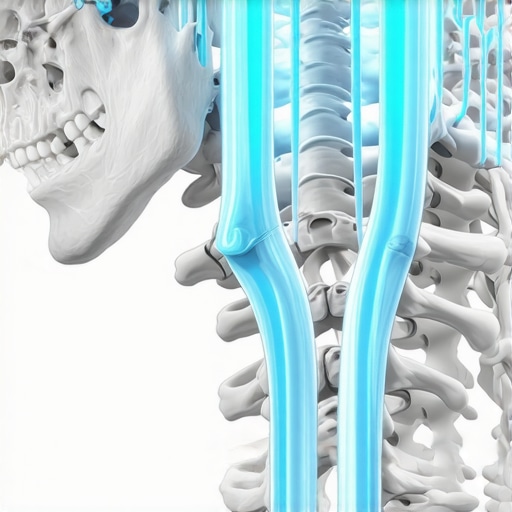
The dangerous trap of self-cracking your neck
We have all been there: your neck feels full, heavy, and stuck, so you give it a quick twist until you hear that satisfying ‘pop.’ It feels better for five minutes, and then the urge returns. This is the “Oops” factor you must avoid. When you crack your own neck, you are almost always hitting the joints that are already too loose (hypermobile), while the truly stuck joint (the hypomobile one) remains jammed. This creates a cycle of localized instability that can lead to chronic inflammation. Understanding the truth about cracking your own neck at home is vital because it explains why you feel like you need to do it ten times a day. You’re essentially scratching an itch that needs a surgical-grade solution. A professional knows how to isolate the specific segment that isn’t moving. This is a core part of what a chiropractor actually looks for during your first exam. They aren’t just looking for ‘cracks’; they are looking for the primary engine of your dysfunction. You might even find the truth about why one shoulder sits higher than the other is related to a rib subluxation you didn’t even know you had. Have you ever fallen into the trap of constant self-cracking only to find the pain gets sharper the next day? Let me know in the comments below, and let’s discuss how to break that habit for good.I’ve spent a small fortune on gadgets over the years, but the most effective tool in my kit is actually one of the cheapest: a high-density foam lumbar roll. Most people buy these fancy chairs and then wonder why your ergonomic desk chair is still giving you back aches. The reality is that no chair can perfectly account for your unique spinal curvature without help. I personally keep a roll in my car and one at my desk because it forces my pelvis into a slight anterior tilt, which naturally prevents the ‘slump’ that leads right back to jaw clenching. It’s all about improving posture through mobility by using external cues to keep your bones stacked without constant mental effort.
How can I make these spinal improvements last forever?
Maintenance isn’t about doing a grueling two-hour workout; it’s about micro-dosing movement throughout your day to keep the joints lubricated. I follow what Dr. Stuart McGill, a world-renowned spine biomechanist, calls ‘building spinal stiffness’ in his clinical work—which sounds counterintuitive but actually refers to creating the stability needed to protect your discs from shearing forces. In his landmark text Low Back Disorders, McGill emphasizes that the spine must act as a rigid pillar when we move our limbs to avoid micro-trauma. If you aren’t doing the daily work to stabilize your core, even the most precise chiropractic adjustments won’t have a solid foundation to sit on. I treat my regular clinic sessions as a ‘structural reset,’ but my personal mobility hacks are what keep the system running smoothly between those visits.  I predict that in the next few years, we are going to see a massive shift toward AI-integrated wearables that don’t just track your steps, but actually monitor the precise angle of your atlas vertebrae and alert you via haptic feedback the moment you start to ‘tech-neck.’ Until that tech is perfected, we have to rely on our own internal sensors. One of the best ways to stay ahead of the curve is to use mobility boosts for posture every single time you stand up from your workstation.
Create a posture anchor in your daily routine
An anchor is a specific, non-negotiable habit that triggers a physical reset of your nervous system. For me, it’s the ‘Wall Squeeze.’ Every time I walk to the kitchen for a glass of water, I spend exactly 30 seconds pressing my heels, glutes, and head against the wall while squeezing my shoulder blades together. It’s a 30-second wall squeeze to fix forward shoulder roll that recalibrates my brain’s map of where my body is in space. If you want to see real, lasting change, stop trying to ‘remember’ to sit up straight—you will always forget once you get busy. Instead, start building these physical anchors that force a reset. I want you to try this right now: find the nearest flat wall and perform one 30-second squeeze. Notice how much lighter your head feels on your shoulders immediately afterward? That is the feeling of your nervous system relaxing because it finally feels supported. We are building the ultimate guide to improving mobility and posture in 2025, and it starts with these tiny, repeatable wins.
The Hard Truth About My Stubborn Trapezius Knots
After years of battling recurring stiffness, I finally had a lightbulb moment: I was chasing the smoke instead of the fire. My biggest mistake was assuming that because my neck hurt, my neck was the problem. I realized that what a chiropractor actually looks for during your first exam isn’t just a tight muscle, but a breakdown in the entire kinetic chain. My jaw was the conductor of my pain orchestra, and until I silenced it, the music never stopped. Another hard lesson was that ‘relaxing’ isn’t passive; it is an active skill you have to practice. I had to learn to identify the exact moment my teeth touched during the day and realize that every second of clenching was a direct withdrawal from my spinal health bank. Finally, I learned that how chiropractic adjustments enhance posture and mobility is by resetting the nervous system’s baseline, giving you a clean slate to build better habits on.
Tools and Resources That Actually Fixed My Alignment
You don’t need a gym full of equipment to fix your posture, but you do need the right cues. My personal ‘holy grail’ was learning the proper way to use a lumbar roll in your office chair, which stabilized my base and stopped the head-forward lean that triggered my jaw clenching. I also highly recommend reading the work of Dr. Stuart McGill, particularly his insights on spinal stability. For daily maintenance, I live by the strategies in the ultimate guide to improving mobility and posture in 2025 because they prioritize consistency over intensity. Integrating small mobility hacks for a more active life, like the tongue-positioning trick we discussed earlier, has been more effective for me than any hour-long stretching session ever was.
Stop Accepting Constant Stiffness as Your Baseline
It is easy to fall into the trap of thinking that a stiff neck or a clicking jaw is just a part of getting older or a side effect of a busy job. It isn’t. Your body is designed to move without friction. When you address the root cause—whether that is your bite, your breathing, or your mid-back stiffness—you unlock a level of energy you didn’t know you were missing. Professional chiropractic adjustments can provide the structural foundation, but the daily wins come from your own awareness. Don’t wait for the pain to become unbearable before you start making these shifts. You have the tools now to reset your alignment and reclaim your comfort. Have you ever noticed that your neck pain gets worse after a stressful day of clenching your teeth? Let me know in the comments below!