
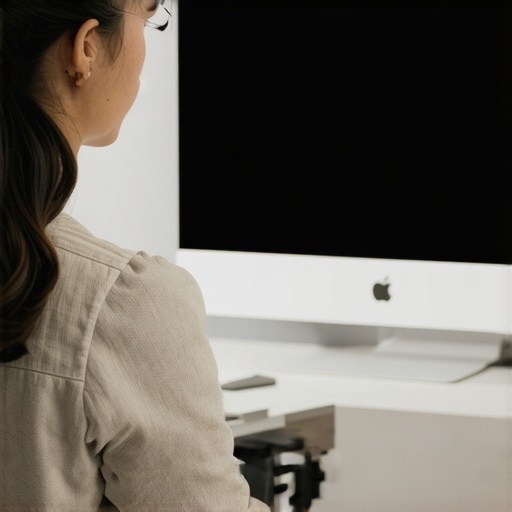
I spent three long years convinced I was just one of those people destined for daily tension headaches. I had a drawer full of ibuprofen and a dark room on standby for every Tuesday afternoon. I blamed my caffeine intake, the flickering fluorescent lights in my office, and even my own genetics. But the truth was staring me right in the face—literally. My monitor was sitting far too low on my desk, forcing my chin down and my neck muscles to work overtime just to keep my head level. It felt like a low-grade workout I never signed up for, and my skull was paying the ultimate price. I’m telling you, friend, your monitor is likely the silent thief of your focus and the primary culprit behind that throbbing behind your eyes.
Stop Looking Down at Your Digital Life
[IMAGE_PLACEHOLDER] The average human head weighs about 10 to 12 pounds. However, when you tilt it forward just 15 degrees to look at a low monitor, the effective weight on your neck jumps to about 27 pounds. By the time you are hunched over at a 60-degree angle, your neck is supporting a staggering 60 pounds of pressure. That is an incredible amount of strain to put on your upper spine just to check emails or scroll through social media. I made the classic mistake of thinking my chair was the only culprit. I spent a small fortune on a fancy lumbar support throne, but I kept my laptop sitting flat on the desk. My back felt great, but my head still felt like it was in a vice by lunch. It was not until I started looking into how your vision is forcing your neck into a forward lean that the lightbulb finally went off. Your eyes will always dictate where your head goes. If your screen is low, your head follows. This constant reaching with your chin creates a massive amount of tension in the suboccipital muscles—the tiny muscles at the base of your skull. According to a study published by the National Center for Biotechnology Information (NCBI), sustained forward head posture is directly correlated with an increase in tension-type headaches and even a decrease in respiratory muscle strength. When those muscles get angry, they trigger the exact type of wrap-around headache that ruins a productive afternoon.
Is a stack of books really enough to fix this?
You might be thinking that surely a solution this simple cannot be the answer to years of chronic pain. I was just as skeptical as you are right now. I thought I needed a complex series of chiropractic adjustments to unlock a pain-free lifestyle before I could even think about ergonomics. While those adjustments are a total game-changer for resetting your alignment, they simply will not stick if you go right back to staring at your belly button while you work. I started my journey by propping my monitor up on three thick hardcover books. It looked a bit ridiculous, but within just two days, the heavy afternoon fog in my brain finally lifted. I stopped clenching my teeth to relieve neck stress because my jaw finally had the physical space it needed to relax. If you have ever found yourself rubbing the back of your neck by 3:00 PM, you know exactly what I am talking about. Have you ever actually checked to see if the top third of your screen is at eye level? If you are currently working on a laptop, you are the most at risk for this specific pain. Laptops are an ergonomic nightmare because the keyboard and screen are joined at the hip. To fix this, you have to learn the specific way to sit at a laptop without creating a hump, which usually involves an external keyboard and raising that screen up to meet your gaze. You can actually fix the computer hunch in under two minutes once you realize that your monitor height is the literal foundation of your posture.Setting up your workstation isn’t about buying the most expensive gear; it’s about the geometry of your body relative to your tools. Think of your spine like a mast on a ship. If the sails are pulling too hard in one direction, the mast starts to bend and crack. When you look down, you’re essentially pulling your ‘sails’ forward all day. To fix this, you need to find the sweet spot for your gaze. I recommend sitting back in your chair and closing your eyes. When you open them, your pupils should land naturally on the top third of your monitor. If you’re looking at the middle or bottom, you’re already losing the battle.
Find the Sweet Spot for Your Gaze
The most common mistake is thinking ‘eye level’ means the center of the screen. It doesn’t. If the center is at eye level, you still end up tilting your head up, which pinches the nerves in the back of your neck. You want the top of the monitor to be roughly at eyebrow height. This allows your gaze to cast slightly downward without your neck following suit. I remember the first time I got this right; it felt weirdly high at first. I actually used an old shoebox because my stack of books wasn’t tall enough. It looked messy, and my cat actually knocked it over once, but the immediate relief in my traps was undeniable. It’s about creating a neutral ‘resting’ state for your cervical spine. If you can’t get the height right, you might need to look into how chiropractic adjustments enhance posture and mobility to reset the damage already done. 
Separate the Screen from the Keyboard
If you are working on a laptop, you have a physical impossibility on your hands. If the keyboard is at a comfortable height for your wrists, the screen is too low. If the screen is high enough, your arms are reaching into the air like you’re playing a piano in the clouds. You must decouple them. I once spent a whole week trying to balance my laptop on a pile of cookbooks while using the built-in trackpad. My wrists were screaming by Wednesday. The only real solution is an external keyboard and mouse. Once you have those, you can treat your laptop screen like a stand-alone monitor. This setup allows you to follow the best way to position your keyboard for shoulder relief, keeping your elbows at a 90-degree angle while your eyes stay level.
A Quick Movement Routine to Combat the Slump
Even with a perfect setup, the human body wasn’t designed to stay still for eight hours. Static load is the enemy. You need to integrate mobility hacks and simple adjustments for a more active life directly into your workflow. Every hour, I perform what I call the ‘Scapular Squeeze.’ Imagine there is a pencil between your shoulder blades and you are trying to snap it. Hold for five seconds, then release. This wakes up the rhomboids and pulls you out of that internal shoulder rotation. If you find your chest feels tight, you should learn how to revolutionize your posture with targeted mobility exercises. These micro-breaks act as a physical ‘save point’ for your posture, preventing the gradual slide into a hunch. I used to set a timer on my phone, and even though it felt annoying at first, it became the one thing that kept me from needing a nap at 2:00 PM.Most people assume that ‘good posture’ is a static goal—a frozen position where your ears are perfectly aligned over your shoulders. But I’ve found that the more you try to force yourself into a rigid ‘military’ stance, the more you’re actually inviting chronic tension into your life. The truth is, your body wasn’t built to be a statue. Everyone tells you to ‘pull your shoulders back,’ but in my experience, this just creates a different kind of dysfunction. When you pull your shoulder blades together aggressively, you’re likely flaring your ribs and overworking your middle back muscles, which eventually leads to that familiar burn between the blades.
Stop forcing that military-style posture
The ‘oops’ factor here is huge: most people substitute actual spinal alignment for sheer muscular effort. If you have to work to hold your posture, you’re doing it wrong. Real alignment comes from a neutral pelvis and a functional core, not from pinning your shoulders back like a toy soldier. This is where why chiropractic care is your secret weapon for better posture; it’s about clearing the neurological path so your body wants to sit correctly without you thinking about it. If you’re constantly fighting your own anatomy, you’re missing the link between mobility and posture that allows for effortless movement.
Is your breathing pattern sabotaging your spinal stability?
This is the hidden nuance that almost everyone misses. According to a study in the Journal of Physical Therapy Science, there is a profound correlation between diaphragmatic function and core stability. If you aren’t breathing into your belly, your ‘secondary’ breathing muscles—the ones in your neck and chest—have to take over. This is exactly how your breathing habits are creating tightness in your scalenes and traps. You can have the best monitor height in the world, but if you’re a ‘chest breather,’ your neck will stay tight forever. 
The danger of sucking in your stomach
One of the biggest traps I see people fall into is the habit of ‘sucking it in’ to look thinner or feel more supported. While it might make your waist look smaller in a mirror, it’s a disaster for your spine. When you constantly contract your upper abs, you prevent the diaphragm from dropping, which increases pressure on your lower back and pelvic floor. It’s vital to understand why you should stop sucking in your stomach for better posture if you ever want to find true relief. Instead of a hard, braced core, you want a responsive one. This is a common theme in mobility boosts for posture where we focus on relaxation as much as activation. Have you ever fallen into the trap of trying to ‘force’ your posture only to end up more sore than before? Let me know in the comments.I’ve learned the hard way that a single ‘fix’ is never enough. You can have a perfect Tuesday, but if your Wednesday involves six hours of hunched-over focus, the cycle restarts. That is why I shifted my focus from emergency repairs to a long-term maintenance system. For me, the transformation started when I finally understood the best way to transition from a sitting to a standing desk. I used to think I had to stand for eight hours straight, which actually made my lower back ache even more. Now, I use a specific tool called a ‘Topo Mat’—it’s a contoured standing mat that forces your feet to move and explore different angles, preventing that static load I mentioned earlier. If you’re just standing on a flat floor, you’re just trading one type of stiffness for another.
The three tools that saved my lower back
Beyond the desk, I rely on a ‘Pso-Rite’ for deep tissue work. Most people try to roll out their lower back, but as Dr. Stuart McGill, a world-renowned spine biomechanics expert and author of *Back Mechanic*, points out, the real culprit is often a tight psoas pulling on the lumbar vertebrae. Using a targeted tool to release that tension is far more effective than a generic foam roller. I also incorporate improving posture through mobility practical chiropractor strategies by using a simple lacrosse ball against the wall to hit those trigger points between the shoulder blades. I also swear by the 30 second wall squeeze to fix forward shoulder roll whenever I finish a long Zoom call. It resets the shoulders and opens the chest in a way that feels like an instant reset button for your nervous system. 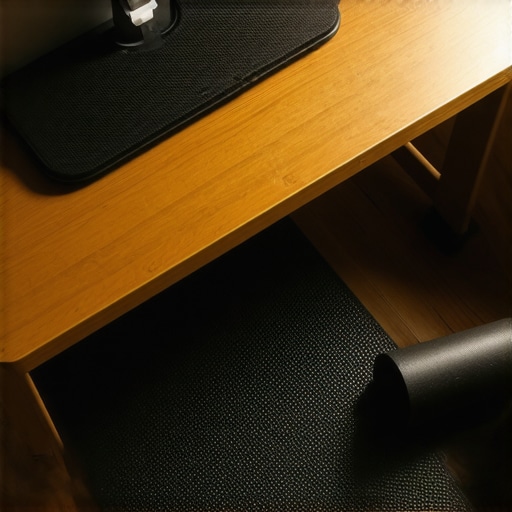
How do I maintain my spinal health over time?
Consistency beats intensity every single time. You don’t need an hour of yoga; you need five minutes of the right moves every single day. I’ve made it a non-negotiable habit to perform the daily move to keep your spine young right before I have my morning coffee. This isn’t just about stretching; it’s about signaling to your nervous system that it’s okay to let go of the ‘protective’ tension it built up overnight. Over time, these small wins stack up. If you find your progress stalling, it might be time to enhance your posture with expert chiropractic techniques in 2025 to clear out the deeper structural road-blocks that self-care can’t reach.
Why your future self will thank you for haptic feedback
Looking ahead, I’m incredibly excited about the rise of wearable haptic technology. We are moving away from passive furniture and toward active sensors that vibrate when you start to slump. I’ve been testing a small device that clips to my shirt, and the immediate awareness it creates is fascinating. In the next few years, I expect this to be integrated directly into our headphones. Imagine your music pausing or a gentle chime sounding when your head tilts too far forward. This real-time feedback is the ultimate way to build ‘proprioception’—the internal map of where your body is in space. Until that becomes standard, I want you to try one thing tonight: get on the floor and spend two minutes with a tennis ball under your glutes to release the tension in your hips. It’s the first step in mobility hacks and simple adjustments for a more active life that actually lasts.
The Realizations That Finally Stopped My Daily Brain Fog
Reflecting on my three-year struggle with tension, I’ve realized that the biggest barrier to healing was my own skepticism. I thought I needed a radical lifestyle change, but it was really about the micro-adjustments. First, I learned that your eyes are the cockpit for your entire skeletal system; if your gaze is off, your spine will bend to accommodate it every single time. Second, I discovered that effortless posture is the only sustainable kind. If you are constantly squeezing your muscles to stay upright, you’re just trading one type of pain for another. Finally, I accepted that professional help isn’t a sign of failure—it’s a shortcut to recovery. Learning why chiropractic care is your secret weapon for better posture changed my perspective from ‘fixing a break’ to ‘optimizing a machine.’
My Personal Toolkit for a Supple Spine
I don’t recommend products lightly, but these three things have become non-negotiable in my daily routine. I swear by my contoured standing mat which keeps my ankles active and prevents the dreaded static load that comes from standing still. For those stubborn knots between the shoulder blades, I always keep a lacrosse ball nearby to practice improving posture through mobility practical chiropractor strategies during phone calls. If you’re serious about long-term health, I highly suggest checking out the ultimate guide to improving mobility and posture in 2025 to see how the landscape of ergonomics is shifting toward more dynamic, movement-based solutions. These tools aren’t just gadgets; they are physical reminders for your body to stay engaged and fluid rather than locked and rigid.
Your Body is Ready to Feel Light Again
You don’t have to live in a state of ‘good enough’ when it comes to your physical comfort. That heavy, dragging sensation in your neck and the afternoon headaches are not your destiny. By simply raising your monitor and choosing to enhance your posture with expert chiropractic techniques in 2025, you are giving your nervous system the breathing room it deserves. Start today by propping up that screen—even if it’s just on a stack of books for now. Your future self is waiting for you on the other side of this tension, feeling taller, lighter, and more focused than ever before. Have you noticed your headaches getting worse after a long day of staring at a low screen? Let me know in the comments below!