

I remember standing in my kitchen a few years back, coffee in one hand and a dull, throbbing ache in my neck that just wouldn’t quit. I did exactly what most of us do when we feel that ‘stuck’ sensation: I dropped my chin to my chest and rolled my head in a massive, grinding 360-degree circle. Crunch. Pop. Snap. It felt ‘right’ for about five seconds, and then the tightness came roaring back, worse than before. I didn’t realize it then, but I was treating my cervical spine like a rusty pepper grinder. If you have ever wondered why your neck crunches when you turn to look behind you, you aren’t alone, but those big circles are likely the very thing keeping you in pain. Today, I’m going to show you why that habit is a trap and give you the specific, small movements that actually provide lasting relief.
Stop Grinding Your Joints and Start Stabilizing Your Spine
For a long time, I believed the lie that more movement—any movement—was better. I would spend my lunch breaks doing these dramatic neck rotations, thinking I was a mobility expert. In reality, I was just irritating my nerves and overstretching the ligaments that were already struggling to hold my head up. It was a classic rookie mistake. We often mistake the ‘noise’ of a joint for progress, but you should stop rolling your neck to get rid of cracks because it creates instability in the very place you need it most. We are going to swap those dangerous rolls for targeted, isometric work. By understanding the link between mobility and posture, you can finally stop the cycle of temporary fixes and start building a neck that feels light and fluid.
Will these tiny movements really fix a decade of stiffness?
It is natural to be skeptical. I certainly was. I thought that if a giant neck roll didn’t ‘pop’ the tension away, a subtle chin tuck or a side-glide certainly wouldn’t do anything. But here is the visceral truth: your neck is a delicate tower of seven small bones, and force is rarely the answer. According to research cited by Harvard Health Publishing, repetitive, forceful neck cracking or rolling can lead to hypermobility, which actually causes your surrounding muscles to seize up even harder to protect the joint. My big mistake early on was chasing the ‘pop’ instead of chasing the stability. When you see what a chiropractor actually looks for during an initial exam, it isn’t how loud your joints are; it is how well those deep stabilizer muscles are supporting your alignment. Have you ever felt like your neck was more ‘crunchy’ than a bag of chips? I’d love to hear about your own struggle with stiffness—feel free to reach out on our contact page. Let’s get into the actual mechanics of why those rolls are failing you and what the daily move to keep your spine young actually looks like.
Rebuild Your Foundation Without the Grinding
I clearly remember a rainy Tuesday when my neck felt like it was made of dry wood. I was halfway through a three-hour drive, and every time I tried to check my blind spot, a sharp jolt shot down my shoulder. My instinct was to wrench my head to the side to get that ‘crack’ of relief. Instead, I pulled over and tried something I’d just learned: a set of controlled chin tucks against the headrest. Within ninety seconds, the ‘burning’ sensation subsided. It wasn’t magic; it was simply giving my deep stabilizers a chance to do their job. When you learn how to fix the computer hunch in under two minutes, you realize that stability, not force, is the secret to a pain-free life.
Master the Art of the Reverse Drawer Movement
Think of your head as a heavy bowling ball sitting on a narrow stick. If that ball shifts even an inch forward, the muscles in the back of your neck have to work ten times harder to keep it from falling. This is why the link between mobility and posture is so critical. To perform a proper chin tuck, imagine your head is a drawer you are sliding straight back into a cabinet. Do not look down at the floor or up at the ceiling. Keep your eyes level and retract your skull until you feel a gentle stretch at the base of your head. This move activates the longus colli—the ‘abs’ of your neck—which are usually asleep during your workday. By integrating improving posture through mobility practical chiropractor strategies, you stop the compensatory grinding that ruins your joints.

Turn Your Own Hands Into Stability Tools
Once you have mastered the alignment, you need to add ‘tension’ without ‘motion.’ This is where isometrics come in. Place your palm against your forehead and gently push your head forward into your hand, but—and this is the key—don’t let your head move an inch. You are creating a stalemate. This forces the muscles to fire without shearing the joints. I used to do this while sitting in traffic, and it completely changed my relationship with my commute. It’s a core part of the daily move to keep your spine young. If you find your muscles are already too tight to even move, you might need to investigate why your neck muscles are hard like a rock before these exercises feel fluid. This isometric technique is essentially a self-applied version of why chiropractic care is your secret weapon for better posture; it creates a neurological reset that tells your brain it’s safe to let go of the tension.
Why Force Always Fails the Cervical Spine
The mistake most people make is treating their neck like a stubborn door hinge that needs a kick. Your neck is more like a precision instrument. If you are constantly forcing cracks, you are likely suffering from hypermobility in some segments and ‘locking’ in others. This uneven wear is why your neck cracks when you look over your shoulder. Instead of kicking the door, we are oiling the lock with small, rhythmic movements. When I finally stopped the ‘pepper grinder’ rolls and stuck to these micro-movements for two weeks, the chronic ‘crunch’ I’d lived with for years started to fade. It wasn’t because the joints were fixed; it was because the muscles were finally balanced enough to hold the joints in their proper tracks.
I have spent years watching people—myself included—obsessively stretch their upper traps because they feel ‘tight.’ We have been told that if it is tight, you must lengthen it. But here is the advanced nuance that most ‘fitness gurus’ miss: your brain often creates tension as a survival mechanism to guard an unstable joint. If you keep stretching a muscle that is trying to protect your spine, your brain will only tighten it further. This is exactly why your neck muscles are hard like a rock. You are not fighting a short muscle; you are fighting a neurological reflex. According to a study published in the Journal of Manipulative and Physiological Therapeutics, spinal manipulation and targeted adjustments are not just about ‘cracking’ bones; they are about restoring the proprioceptive input that tells the brain the joint is safe, allowing those protective spasms to finally melt away. 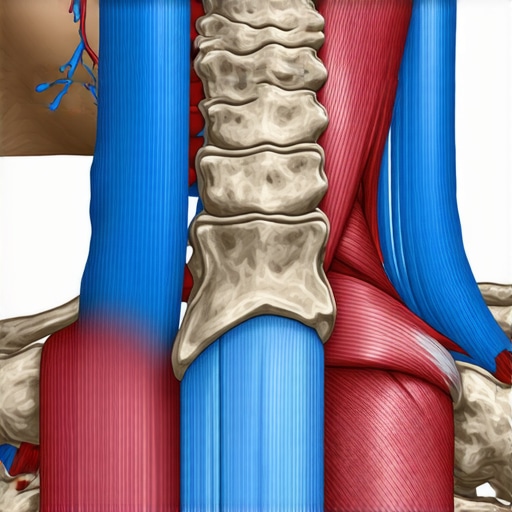
Stop Pulling on the Taut Rope
One of the biggest ‘traps’ I see is the ‘stretching marathon.’ People spend twenty minutes on their hamstrings without realizing why stretching your hamstrings might actually make your back pain worse. If your pelvis is tilted forward, those hamstrings are already over-lengthened. Stretching them is like pulling on a rope that is already taut—eventually, it is going to fray. Instead of mindlessly pulling on your limbs, you need to look at how chiropractic adjustments enhance posture and mobility by addressing the root alignment first. When the foundation is off, every ‘stretch’ you do is just a temporary bandage on a structural problem. Have you ever fallen into this trap of stretching a spot for weeks with zero lasting change? I would love to hear your story—let me know in the comments or reach out via our contact page.
How can you distinguish between ‘good’ mobility and dangerous joint hypermobility?
It is a question I get from my most dedicated readers. Real progress feels like a ‘release’ that stays with you, whereas ‘bad’ movement feels like a temporary high followed by a rebound of stiffness within an hour. If you are constantly reaching for the foam roller for the same spot every single day, you are not fixing the problem; you are just scratching a neurological itch. This is where the ultimate guide to improving mobility and posture in 2025 comes in—it is about shifting from ‘stretching’ to ‘repositioning.’ We need to stop treating the symptoms and start looking at the ‘global’ system. For instance, the connection between poor posture and digestive issues shows that a slumped spine isn’t just a neck problem—it is a whole-body health crisis. By using targeted mobility exercises, we can finally break the cycle of chronic tension and build a body that moves with genuine ease.It’s one thing to get your neck to stop crunching for an afternoon, but it’s another thing entirely to ensure that your spine doesn’t revert to a question mark the moment you sit back down at your desk. I used to be a ‘gym warrior’—I’d do my mobility work for twenty minutes and then spend eight hours slumped over a laptop, wondering why my progress stalled. What I eventually learned is that tools matter, but the application of those tools matters even more. I stopped buying every vibrating foam roller on the market and went back to basics: a standard lacrosse ball. Why? Because a foam roller is too blunt for the specific knots that develop where your neck meets your skull. You need something firm and small to pin down those tissues while you breathe. This is one of the most effective mobility hacks simple adjustments for a more active life that I’ve integrated into my evening routine.
How do I maintain my spinal alignment throughout a busy work week?
The answer isn’t a longer workout; it is higher-quality micro-movements. I am a firm believer in the ‘Movement Snack’ concept popularized by Dr. Kelly Starrett in his technical guide Becoming a Supple Leopard. He argues that staying mobile is about maintaining ‘positional integrity’ throughout the day, not just during a designated warm-up. For me, that means checking the best monitor height for preventing tension headaches every single time I sit in a new chair. If your eyes are looking down, your spine is following.  Looking ahead, I predict we are going to see a massive shift toward biofeedback wearables that do not just track steps, but measure the actual ‘shear force’ on our lumbar and cervical vertebrae in real-time. Until those become affordable, your best bet is to rely on the neurological reset provided by how chiropractic adjustments enhance posture and mobility. These professional tune-ups clear the ‘static’ in your nervous system, making the daily move to keep your spine young significantly more effective. If you haven’t yet, try the 30-second ‘wall-clock’ stretch I mentioned earlier. It is the fastest way to verify if your shoulders are actually opening up or if you are just leaning back. Give it a shot tonight and see how much easier it is to take a full, deep breath.
The Hardest Lesson My Cervical Spine Taught Me
Over years of trial and error, I realized that my neck wasn’t tight because it needed more stretching; it was tight because it was terrified of being unstable. When I stopped trying to force my joints into submission with those massive rolls, the chronic pain finally began to let go. I learned that silence in a joint is often a sign of strength, not stagnation.
If you feel like your muscles are constantly fighting you, remember that you are likely dealing with a neurological reflex, not just a physical knot. Your brain is tightening the ‘guardrails’ because the road is crumbly. This is why when you revolutionize your posture with targeted mobility exercises, you aren’t just stretching; you are retraining your nervous system to feel safe in a neutral position.
The Toolkit That Keeps My Posture From Slumping
You don’t need a gym full of equipment to maintain a healthy spine, but a few specific tools make a world of difference. First, I never travel without a lacrosse ball. It is firm enough to pin down those stubborn knots at the base of the skull that a foam roller simply cannot reach. I also highly recommend reading ‘Becoming a Supple Leopard’ by Dr. Kelly Starrett, which is essentially the owner’s manual for the human body we should have been given at birth.
Finally, integrating mobility hacks simple adjustments for a more active life, like using a small lumbar roll during long drives, prevents the ‘creep’ of poor alignment before it even starts. These small, physical reminders are far more effective than a once-a-week yoga class. #IMAGE_PLACEHOLDER_E#
A Future Without the Constant Need to Pop
The journey toward a pain-free neck isn’t about one-time fixes; it’s about shifting how you relate to your body every single day. When you stop chasing the temporary high of a self-crack and start building real stability, you will find that the constant ‘grinding’ sensation becomes a thing of the past. Trust the long-term process of the daily move to keep your spine young and give your nervous system the safety it needs to finally relax. You deserve a body that supports you without the constant noise and tension.
Have you ever felt that temporary ‘high’ after cracking your neck, only for the tightness to return ten minutes later? Let me know about your experience in the comments below!