

I stared at that dusty cardboard box like it was a personal challenge. It wasn’t even that big—just a few old college textbooks and a cast-iron skillet my grandmother passed down. I leaned over, rounded my back like a frightened cat, and tugged. That was the last time I stood up straight for a week. We’ve all been there, haven’t we? That split second where a dull ‘thud’ in your lower back tells you that you’ve just made a very expensive mistake. I spent three days crawling to the kitchen because I thought I was too ‘fit’ to worry about proper mechanics. Today, I want to make sure you never have to experience that particular brand of misery. We are going to fix your lifting form once and for all. Have you ever felt that terrifying ‘tweak’ while reaching for something simple? Tell me about your most embarrassing lifting fail in the comments below.
The Day I Met My Garage Floor Face-to-Face
Early in my journey, I made the classic mistake of thinking that ‘lifting with your legs’ was just a cliché people told old men. I relied on my brute strength and a very flexible (but very unstable) spine. If I had known how to handle a sudden back spasm back then, my recovery might have been faster, but the real lesson was in the prevention. The truth is, your spine is a series of delicate bridges, not a solid steel crane. When you round your back to pick up a heavy load, you are essentially asking those small spinal discs to hold back a tidal wave of pressure. In fact, research published by the Mayo Clinic suggests that improper lifting is a primary driver of acute disc herniations because it places uneven, massive loads on the lumbar vertebrae. By mastering the best way to lift heavy boxes, you aren’t just being careful; you’re protecting your ability to walk, play with your kids, and stay active for the next thirty years.
Is bending your knees really the only way to save your spine?
A lot of people think that if they just ‘squat down,’ they are safe. But that’s actually where I see the most mistakes. People squat down but then still reach out with their arms, creating a long lever that puts all that weight right back on the lower back. The secret isn’t just in the knees; it’s in the hips. I used to ignore my glutes entirely until I discovered the hip hinge fix that changed everything. It’s about shifting the weight to the biggest muscles in your body rather than the smallest ones in your spine. We’re going to break down why your current ‘safe’ method might still be setting you up for a trip to the chiropractor, and how a few inches of movement can make a fifty-pound box feel like a feather. Stay with me, because we’re about to rebuild your lifting foundation from the ground up.
The Blueprint for a Bulletproof Lift
Most people fail before they even touch the object because their stance is more like a flamingo than an athlete. Think of your feet as the anchors of a crane; if the anchors are loose, the crane tips. You want to feel three points of contact: your heel, the base of your big toe, and the base of your pinky toe. This creates a stable platform that prevents your knees from collapsing inward—a common culprit for why tight hip flexors can cause sudden knee pain during a heavy move.
Move Your Hips Like a Hinged Door
This is the part I messed up for years. I used to bend at my waist, which essentially turns the spine into a fragile fishing rod under the weight of a Great White shark. Instead, imagine there is a wall two feet behind you and you are trying to touch it with your glutes. This ‘hinge’ shifts the load to your strongest muscles. I remember helping a friend move a solid oak dresser; I was terrified of my back blowing out again, but by obsessively focusing on the hip hinge secret for pain-free deadlifts, I felt the weight in my legs rather than my lumbar. If you feel a sharp pull in your lower back, you probably aren’t hinging deep enough or your hamstrings are screaming for mercy. 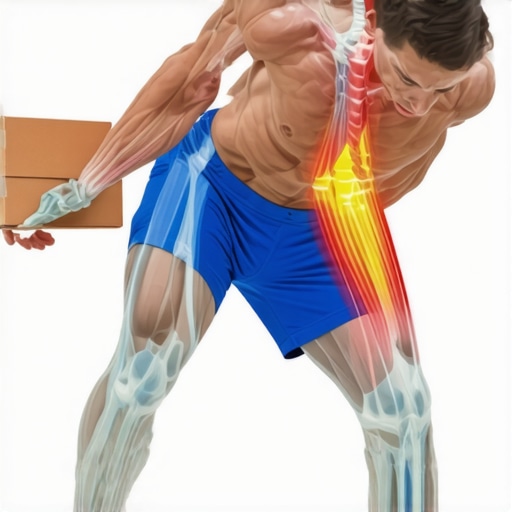
Breathe Into Your Belly for Instant Armor
You might think holding your breath makes you stronger, but it is actually about where you hold that pressure. If you breathe high into your chest, your core remains soft and vulnerable. You need to pull air deep into your stomach. This creates intra-abdominal pressure—a natural weightlifting belt that supports you from the inside out. I have found that your breathing pattern determines your lower back stability more than any fancy gym equipment ever could. When that air is locked in, your spine stays rigid, allowing the power to flow from your legs to your arms without any energy leaks in the middle.
Keep the Load Close to Your Center
Physics is a cruel mistress and distance is her favorite weapon. The further an object is from your body, the heavier it becomes for your spinal discs. When I was struggling with that old cast-iron skillet, I made the amateur mistake of reaching for it with my arms extended. I should have stepped into the box first. By keeping the object practically touching your shins and chest, you reduce the leverage acting against your vertebrae. If you find your reach is limited by stiffness, it might be time to work on opening up tight hips so you can get closer to the ground without rounding over. This simple adjustment turns a potentially dangerous lift into a routine, pain-free movement.I used to think that as long as I kept my back flat and followed the rules of leverage, I was invincible. But here is the contrarian truth that most beginners miss: searching for one single ‘perfect’ alignment can actually make you more fragile over time. When we obsess over a static position, we lose the natural adaptability our bodies crave. I have seen people meticulously follow every rule found in the link between mobility and posture and still end up in pain because they were trying to move like a rigid robot rather than a fluid human. The biggest ‘oops’ factor I see in the clinic today is not just bad lifting; it is the dangerous habit of ‘self-adjusting’ to find temporary relief from that stiffness. You might feel a quick rush of endorphins when you hear that pop, but why you should stop cracking your own back every hour becomes obvious once you realize you are likely over-stretching already loose ligaments while ignoring the truly ‘stuck’ segments.
Why does my back still feel tight even after I stretch it every day?
This is the question that frustrates almost everyone. Often, what you perceive as ‘tightness’ is actually your nervous system creating a protective splint. If you have an underlying joint restriction, your muscles will tighten up to act as a natural brace for the spine. When you force a stretch on those muscles, you are essentially fighting your own body’s defense mechanism. In fact, research published in the *Journal of Orthopaedic & Sports Physical Therapy* suggests that movement variability—moving in many different ways—is far more protective against chronic pain than trying to maintain one ‘ideal’ posture at all times. This is exactly why your gentle stretching is actually causing more inflammation in certain scenarios; you are irritating the nerve and the joint capsule rather than lengthening the muscle.  Instead of forcing a stretch that provides no lasting relief, you should be looking at how chiropractic adjustments enhance posture and mobility by restoring the actual motion of the joint. Once the joint moves correctly, the nervous system finally receives the signal that it is safe to ‘let go’ of that protective tension. Have you ever fallen into this trap where you stretched a sore spot only to have it feel ten times worse the next morning? Let me know in the comments. We need to stop viewing posture as a static ‘pose’ and realize the truth about perfect posture is that it simply does not exist. Your best posture is always your next posture—staying active, varied, and fluid is the only real way to avoid the ‘stuck’ patterns that lead to injury.If you want to move like a human and not a rusty hinge, you need to stop thinking about maintenance as something you do once a week. I spent years buying every vibrating massage gun and posture corrector brace on the market, only to realize that my most valuable tool was a simple lacrosse ball and a flat floor. The reason I swear by the lacrosse ball for targeting the psoas and glutes is its high density; it does not give way like a tennis ball, allowing you to actually reach the deeper tissues that are tugging on your pelvis. I have found that using this specific tool as part of the 3-minute evening routine for a less stiff morning is the absolute difference between waking up like a plank of wood and rolling out of bed ready to tackle the day. You are not just smashing muscles; you are sending a neurological signal to your brain to down-regulate the tension in those protective areas.
How do I keep my spine feeling this good for the long haul?
Maintenance is never about being perfect every single day; it is about consistency over intensity. Dr. Stuart McGill, a world-renowned spine biomechanics expert at the University of Waterloo, highlights in his research that spinal stability comes from building endurance in the core muscles rather than just raw power. This is exactly why I advocate for the dead bug variation that actually protects your spine as a non-negotiable daily staple. It teaches your body to move your limbs while keeping your trunk rock-solid, which is the ultimate insurance policy for your discs. When you combine these small daily habits with the way how chiropractic adjustments enhance posture and mobility, you create a powerful feedback loop of health. The adjustment clears the stuck joints that you cannot reach yourself, and your daily movement keeps them moving through their full range.  I predict that in the next five years, we are going to see a massive shift toward biofeedback wearables that do not just tell you to sit up straight, but actually track your joint-by-joint mobility in real-time using AI sensors. This will revolutionize how we recover from injuries. Until then, you are your own best sensor. If you feel that familiar hitch in your movement, do not ignore it. I have learned the hard way that why chiropractic care is your secret weapon for better posture lies in the prevention of the big blowout before it ever happens. Also, please be careful with the trendy tools you see on social media; knowing the truth about foam rolling your lower back is crucial because rolling directly on your lumbar spine can actually cause more harm than good by irritating the very nerves you are trying to soothe. My challenge to you today is simple: try that dead bug variation for just sixty seconds before you jump into bed tonight and tell me if you do not feel more connected to your core.
The Hardest Lesson I Learned About Chasing a Perfect Spine
For years, I believed that if I could just find the right ‘pose,’ my back pain would vanish forever. But the truth is much more nuanced. My first big realization was that stiffness is often a signal, not a failure. When your body locks up, it is trying to protect you from instability. If you ignore that signal and just keep stretching, you are fighting your own nervous system. Secondly, I learned that variety is your best defense. Sticking to one rigid way of moving makes you fragile in every other direction. Finally, I discovered that regular maintenance is cheaper and less painful than emergency repairs. This is exactly why the ultimate guide to improving mobility and posture in 2025 emphasizes consistent, small movements over marathon gym sessions once a month.
#IMAGE_PLACEHOLDER_E#
My Go-To Tools for Staying Supple
If you are serious about avoiding that ‘cardboard box’ disaster I described earlier, you need a toolkit that works. I personally rely on a high-density lacrosse ball for deep tissue work—it reaches the spots a foam roller simply can’t touch. I also highly recommend diving into the work of Dr. Stuart McGill; his focus on spinal endurance changed the way I look at core strength. For professional help, I’ve found that chiropractic adjustments unlock a pain-free lifestyle today by addressing the joint restrictions I can’t fix on my own. When you pair professional care with mobility boosts for posture, you stop just reacting to pain and start building a resilient body.
The Future of Your Movement Starts Today
It is easy to feel like your best days of movement are behind you, especially after a nasty tweak. But your body is incredibly adaptable. By focusing on smart mechanics and staying proactive, you can reclaim your confidence. Don’t wait for the next spasm to take action. Use enhance your posture with expert chiropractic techniques in 2025 to set a new foundation for your health. Remember, the goal isn’t just to lift heavy things; it’s to keep moving well for the rest of your life. Have you ever struggled with a specific lifting move that always seems to cause a ‘tweak’? Let me know in the comments below!