
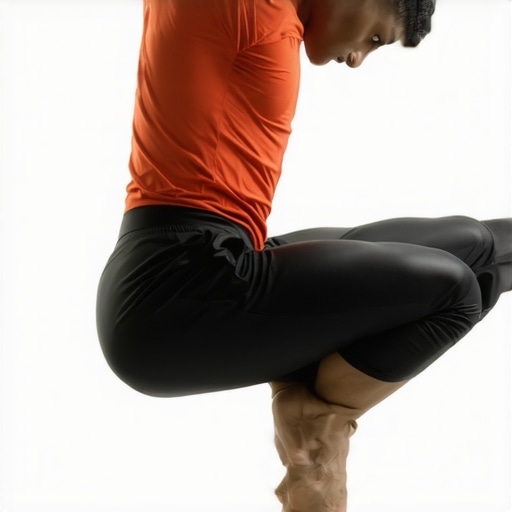
The air in my living room was dead silent when it happened. I wasn’t lifting a heavy crate or running a marathon; I was simply reaching for a stray sock. Pop. Then, the familiar, searing electricity shot across my lower back. I stood there, half-bent, sweating, and wondering why on earth my body felt like it was ninety years old when the calendar said thirty-two. For years, I told myself I just had a fragile spine. I blamed my desk chair. I blamed my shoes. I even blamed the weather. But the truth was much simpler and, frankly, a bit embarrassing: I had completely forgotten how to use my hips. [image_placeholder_1]
Stop Treating Your Spine Like a Crane
We’ve all been told to lift with your legs, but nobody actually shows you how to do it without wobbling. Most of us treat our lower back like a hinge, bending it until it reaches its breaking point. When you finally understand why your lower back hurts when you try to stand up straight, you start to see that the spine is meant to be a stabilizer, not a primary mover. The hip hinge is the secret sauce. It’s the movement pattern that transfers the load to your glutes and hamstrings—the strongest muscles in your body—instead of those tiny, sensitive discs in your lumbar.
Is a simple movement really enough to fix years of pain?
You might be skeptical. I certainly was. I used to think the only answer was more rest or more Ibuprofen. I even made the classic mistake of aggressively stretching my hamstrings every morning because they felt tight. In reality, they were screaming because they were being pulled taut by a pelvis that was out of position. It turns out that stretching your hamstrings might actually make your back pain worse if you aren’t hinging correctly. According to research from Harvard Health, most mechanical back pain is a result of poor movement patterns and weak supporting structures, not permanent structural defects. Today, we are going to fix that. I’m going to walk you through the exact drill that took me from being afraid to pick up a pencil to feeling solid and stable again. We’re moving past the band-aid solutions and getting into the mechanics of how you move through the world. Have you ever felt that sharp catch in your back during a totally normal movement? Let me know in the comments—I bet we’ve been in the exact same spot.
The One Mistake That Kept Me Broken
Early on, I thought good posture meant standing as stiff as a board. I’d arch my back and puff my chest, thinking I was doing myself a favor. I didn’t realize I was creating a massive deadlift mistake even when I wasn’t at the gym. By over-arching, I was jamming my facet joints together. Learning to hinge meant learning to keep my spine neutral while my hips did the heavy lifting. It’s a subtle shift, but the relief is anything but subtle.
Master the Wall Drill to Save Your Lumbar
To stop the cycle of pain, you have to stop thinking about your back and start thinking about your butt. Most people bend by rounding their spine because their hips are functionally locked. To fix this, I used the Wall Drill every single morning for a month. Stand about six inches away from a wall, facing away from it. With your feet shoulder-width apart and a slight bend in your knees, try to touch the wall with your tailbone without falling over. You aren’t squatting; you are sending your pelvis backward. Think of your hips like a drawer being pushed into a dresser. If you feel a stretch in your hamstrings and zero pressure in your low back, you’re doing it right. 
Stop Arching and Find Real Neutrality
One of the biggest mistakes I made was thinking a flat back meant a straight line. In reality, your spine has natural curves. When you try to force it into a rigid board, you’re often just over-extending, which is why your perfect posture is actually causing muscle fatigue. To find a true neutral position, imagine your pelvis is a bucket of water. If you tilt too far forward, water spills out the front (arching). If you tuck too far under, water spills out the back (slumping). You want the water level. Keeping that bucket level while you hinge is the key to mobility hacks that actually stick.
The Bracing Trick That Saved My Moving Day
I remember helping a friend move a massive oak desk up a flight of stairs. Normally, that would have laid me out for a week. But instead of just grabbing and pulling, I used a technique called ‘stiffening.’ Before I even touched the desk, I took a deep breath into my belly—not my chest—and braced my core like someone was about to punch me. This created internal pressure that acted like a natural back brace. This is the bracing technique that protects your spine during heavy yard work or any heavy lifting. By combining this brace with a hip hinge, I felt the weight in my legs and glutes, not my vertebrae.
Why Mobility Beats Simple Stretching Every Time
We’ve been conditioned to think that if a muscle is tight, we should pull on it. But often, that tightness is a protective reflex from your brain because your joints lack stability. When I finally understood the link between mobility and posture, I stopped doing static stretches and started moving through full ranges of motion. This is where how chiropractic adjustments enhance posture and mobility comes into play; they clear the path so your nervous system allows those muscles to relax. If you’re constantly struggling with objects on the floor, remember the proper way to carry groceries to save your lower back is simply a repeated version of that wall drill. You aren’t just ‘working out’ at the gym; you’re practicing how to pick up your kids or your laundry without a trip to the ER.
The biggest mistake I see—and I was guilty of it for years—is treating posture like a static snapshot. We’re taught to sit up straight and ‘hold it,’ but that rigid mindset is exactly why your perfect posture is actually causing muscle fatigue. Posture isn’t a destination; it is the dynamic ability to handle load. When you freeze your body in what you think is a ‘correct’ shape, you are just creating new, hidden patterns of tension. This is also why I’m a huge critic of external fixes. I see so many people buy those Velcro harnesses from social media ads, but the reality of why most posture braces actually make your back weaker is simple: they do the work your deep stabilizers should be doing. Eventually, those muscles just check out entirely. Have you ever fallen into this trap of buying a ‘quick fix’ gadget only to find your back hurts more a week later? Let me know in the comments—I’ve been there too.
Stop Chasing the Pop and Start Seeking Precision
Then there is the ‘pop’ addiction. We’ve all done it—that quick, forceful twist in the office chair to get a momentary release. But there is a massive gap between a random cavitation and a clinical adjustment. The truth about cracking your own knuckles and neck at home is that you are usually just hitting the joints that are already too loose, while the segments that are truly ‘stuck’ stay jammed. You are essentially stretching the wrong rubber band. This is where how chiropractic adjustments enhance posture and mobility differs from a DIY crack; it is about neurological specificity. A study published in the Journal of Manipulative and Physiological Therapeutics highlights that specific spinal manipulation improves the ‘rate of force development’ in surrounding muscles. It is not just about making things move; it is about making the nervous system fire correctly so your body stops guarding itself with pain.

Why does my back feel tight again just two days after an adjustment?
This is the advanced question that usually separates the frustrated from the healed. If you get adjusted but then go right back to sitting cross-legged for eight hours or hinging from your spine instead of your hips, your brain will revert to its ‘guarding’ state. Chiropractic adjustments unlock a pain-free lifestyle today by clearing the structural interference, but your daily habits are the software that runs the hardware. If the software is buggy, the hardware will eventually glitch again. It’s a partnership between the adjustment table and your living room floor. To see lasting change, you have to understand the link between mobility and posture as a living maintenance plan. When the joints move freely, your muscles no longer have to act like iron cables just to keep you upright. We aren’t just moving bones; we are retraining the way your brain perceives safety in your own body.
If the adjustment table is where we reset the clock, the tools we use at home are what keep it from ticking down again. I spent years buying every high-end gadget, only to realize that the proper way to use a lumbar roll was more critical than the chair itself. It is about maintaining that natural lordotic curve in your lower back without your muscles having to work overtime. I also swear by a simple monitor riser; the best monitor height for preventing tension headaches is one where your eyes align with the top third of the screen, preventing that destructive, perpetual chin-tuck that stresses the upper cervical spine.
How do I maintain these spinal gains over time?
Consistency always beats intensity in the world of mobility. You don’t need a two-hour gym session; you need a mobility boost for posture every sixty minutes to break the static load. Dr. Stuart McGill, a professor emeritus and world-renowned spine researcher from the University of Waterloo, emphasizes the concept of ‘spinal hygiene’—the practice of moving with a neutral spine during mundane tasks like brushing your teeth or tying your shoes. He argues that micro-trauma from poor daily movement is often what prevents long-term healing, even if you are doing everything else right.
The $20 Tool That Outperforms My Ergonomic Chair
Beyond simple supports, I have found that the best standing desk interval follows a 20:8:2 ratio: twenty minutes sitting, eight minutes standing, and two minutes of walking. This cycle prevents the ‘creep’ or deformation of spinal tissues that happens when you stay in one spot too long.  Looking ahead, I predict we will soon see smart-fabrics with built-in haptic sensors that gently vibrate when your posture deviates from its calibrated neutral. Until that tech hits the mainstream, my low-tech secret weapon is a piece of kinesiology tape applied vertically on the mid-back; as soon as you slump, the tension in the tape acts as a neurological cue to sit back up.
Build a Spine That Lasts with These Simple Habits
As we move toward improving mobility and posture in 2025, the goal is to weave practical chiropractor strategies directly into your daily workflow rather than saving them for the weekend. If you want to stop the cycle of recurring pain, try this one advanced tip today: set a recurring 30-minute timer on your phone. When it rings, stand up, perform one perfectly executed hip hinge to grab a glass of water, and take three diaphragmatic breaths. This simple reset prevents your nervous system from locking into a protective, painful state and keeps your joints moving as they were designed to.
What I Learned After 500 Hours of Hinging
Reflecting on my journey from a locked-up back to a fluid, active life, a few realizations stand out that I never found in a textbook. First, I had to stop fearing movement; I learned to tell the difference between a sore muscle and a slipped disc, which gave me the confidence to push through the initial stiffness. Second, consistency in micro-movements is far more powerful than one massive workout once a week. Even a quick 2-minute drill for better spinal rotation can reset your nervous system after a long commute. Lastly, your body is an interconnected machine. I realized the hidden reason you get a headache after a gym session often comes down to poor neck positioning while focusing on your lower body. Precision is your best friend.
The Only Tools That Stayed in My Gym Bag
I have tested dozens of gadgets, but these four are the only ones I still use daily. I highly recommend the book “Back Mechanic” by Dr. Stuart McGill for anyone wanting a deep dive into spine health. For office hours, finding the desk setup trick for people who hate standing desks changed my productivity levels entirely. I also keep a simple lacrosse ball nearby for trigger point release in the upper back. Most importantly, I rely on regular professional assessments because understanding what a chiropractor actually looks for during your first exam helped me realize that structural alignment is the foundation for everything else we do at home. [image_placeholder_1]
Take the First Step Toward a Spine That Works
You don’t have to live in fear of the next ‘pop’ or catch in your back. By integrating these small shifts into your day, chiropractic adjustments unlock a pain-free lifestyle today that actually lasts. Whether you are looking for the ultimate guide to improving mobility and posture in 2025 or just want to pick up your laundry without pain, the path forward starts with one intentional movement. Your future self will thank you for the effort you put in now. Which of these drills felt the most challenging to your hips? Drop a comment and let’s troubleshoot it together.