

I spent nearly three years trying to look like a department store mannequin. I’d seen all those office ergonomic diagrams—the ones where a bright red line perfectly bisects the ear, the shoulder, and the hip. I bought the expensive gadgets, the vibrating sensors that buzzed every time I dared to slouch, and I even spent a month wearing one of those posture braces that actually make your back weaker. But here’s the kicker: the harder I tried to be ‘perfect,’ the more my mid-back felt like it was on fire. I was stiff, I was irritable, and I was completely missing the point. I thought I was ‘fixing’ myself, but I was actually just making my body a prisoner to a concept that doesn’t exist in nature. My back didn’t need a corset or a rigid rulebook; it needed to breathe and move. I remember the day it finally clicked—I was sitting in a coffee shop, so focused on my ‘perfect’ alignment that I couldn’t even enjoy my latte. I was sacrificing my quality of life for a diagram in a textbook, and my body was screaming at me to stop.
I Tried Sitting Like a Statue and It Ruined My Back
My biggest mistake early on—and I see well-meaning people doing this every single day—was thinking that posture was a fixed destination. I genuinely believed that if I could just hold my body in that one ‘correct’ position for long enough, my chronic aches would simply vanish like magic. Instead, I ended up with what I now call ‘posture fatigue.’ Your muscles aren’t designed to be isometric statues for eight hours a day. When I finally shifted my focus to improving posture through mobility instead of forced rigidity, everything changed. We’re going to dismantle the myth of the ‘perfect’ spine today and look at why movement is the actual medicine you’ve been looking for. If you’ve been obsessing over your alignment to the point of frustration, it’s time to take a deep breath and let your shoulders drop. You aren’t broken; you’re just too still. I’ve learned that the link between mobility and posture is where the real relief lives, not in a standing desk you hate using or a chair that costs more than your first car.
Is This So-Called Perfect Posture Actually Worth the Hype?
Most of us are pretty skeptical when someone tells us to stop trying so hard. After all, we’ve been told since kindergarten to ‘sit up straight’ or we’d end up with a permanent hunch. But modern research, including significant studies highlighted by the Journal of Orthopaedic & Sports Physical Therapy, suggests there is no single ‘correct’ posture that universally prevents back pain. In fact, why your perfect posture is actually causing muscle fatigue is often because you’re overworking small stabilizer muscles that desperately need a break. Have you ever felt like you were ‘working’ just to sit still? It’s an exhausting way to live. I used to feel that way every single afternoon, wondering why my ‘perfect’ setup was leaving me with a head that felt like a bowling ball. Today, we’re going to talk about how chiropractic adjustments unlock a pain-free lifestyle not by forcing you into a mold, but by giving your joints the freedom to function as they were meant to. Have you ever spent a fortune on ergonomic chairs only to still feel like a crumpled piece of paper by 5 PM? If so, you’re in the right place to finally figure out why the search for perfection is keeping you in pain.
Ditch the Static Grind for Micro-Movement Snacks
Think of your spine like a high-performance bicycle chain. If you leave it out in the rain without ever moving it, it’s going to seize up. Your body is exactly the same. When you sit for four hours without a break, your connective tissues start to “set” like wet concrete. I used to think I needed to stand all day, but I quickly realized that standing is just another way of being still. Instead, you need to find the best standing desk interval for maximum back health—usually about 20 to 30 minutes. The goal isn’t to be a standing soldier; it’s to be a moving human. Every time you shift from sitting to standing, you’re pumping blood and nutrients back into those thirsty spinal discs.
The 30-Second Reset You Can Do Anywhere
I remember being in a board meeting three years ago, feeling that familiar, sharp pull behind my right shoulder blade. I was so stiff I couldn’t even turn my head to look at the presenter. I felt trapped by my own body. That was the day I realized that “waiting until the weekend” to stretch was a losing game. Now, I use mobility boosts for posture throughout the day. It’s not about a full yoga session in the breakroom; it’s about micro-adjustments. My favorite is a quick chest opener. If you can find a doorway, you can perform the wall stretch that fixes slumped shoulders fast. It takes thirty seconds, and it physically reverses the “closed-off” position we adopt over our phones.
Why Your Joints Need a Mechanic, Not a Map
You can read all the diagrams in the world, but if a joint is physically stuck, no amount of “sitting up straight” will fix it. This is where most people get frustrated. They try the exercises, but they feel like they’re fighting a locked door. That’s because why chiropractic care is your secret weapon for better posture is all about the “unlock.” When a chiropractor performs an adjustment, they’re restoring motion to a specific segment that has stopped moving correctly. It’s the difference between trying to force a rusty hinge and actually oiling it. I’ve seen this personally—once my mid-back was properly aligned, those “posture exercises” finally started to feel easy rather than like a chore. Understanding how chiropractic adjustments enhance posture and mobility is the missing link for anyone who feels like they’re doing everything right but still hurting. You have to clear the path before you can walk it.
Move the Foundation to Save Your Neck
Most of us focus entirely on our necks, but the foundation is always the pelvis. If your hips are tilted like a bucket spilling water out the front, your neck has to compensate by jutting forward. To stop this, you need to master a simple seated reset. While you’re at your desk, focus on rolling your hips back and forth until you find that “neutral” sweet spot. Integrating targeted mobility exercises for your hips can actually take the pressure off your neck. I used to have a head that felt like a bowling ball, and I was shocked to find out the solution started at my waistline. It’s all connected, and once you start moving the foundation, the rest of the tower starts to balance itself out naturally.
Everyone tells you that if you feel tight, you just need to stretch more. It’s the ultimate fitness cliché. But in my experience, obsessively stretching a muscle that feels ‘tight’ can actually be the fastest way to irritate your nervous system. Often, that tightness is actually a protective tension—your brain’s way of putting on the brakes because it doesn’t feel stable. If you keep pulling on a muscle that is trying to protect a joint, your body will only tighten up further. This is exactly why your hamstring stretches aren’t fixing your tightness; you’re treating the symptom of tension rather than the cause of instability. Instead of more force, we need more intelligence in how we move. Real progress happens when we stop trying to ‘lengthen’ everything and start focusing on improving mobility and posture through stability and controlled range of motion.
Stop Rolling Your Lower Back Like a Piece of Dough
Here is a massive ‘oops’ factor I see constantly: people taking a hard foam roller and grinding it directly into their lower back. It feels like it’s doing something, but you’re actually putting immense pressure on the lumbar vertebrae and the kidneys without any ribcage protection. The reality is the truth about foam rolling your lower back is that it can trigger muscle spasms rather than relaxing them. If you want to find relief, focus that roller on your mid-back (the thoracic spine) and your glutes. When the segments above and below the lower back move better, the lower back doesn’t have to work so hard. I’ve seen so many people come in with flared-up nerves because they thought ‘no pain, no gain’ applied to a piece of plastic foam. Have you ever fallen into this trap? Let me know in the comments if you’ve noticed your back feels worse after a heavy rolling session.
What if your ‘tightness’ is actually a nerve signaling for help?
This is where the nuance really lives. Sometimes what feels like a tight muscle is actually ‘neural tension.’ Your nerves need to slide and glide through your tissues like a silk thread through a needle. When they get ‘snagged’ due to inflammation or poor mechanics, your brain creates a sensation of tightness to prevent you from stretching the nerve further. A study published in the Journal of Manual & Manipulative Therapy emphasizes that movement variability and neural mobilization are often more effective for chronic tension than traditional static stretching. This is why the nerve glide that stops sciatica in the shower works so much better than just touching your toes. You aren’t just a collection of rubber bands; you are a complex electrical system. When you use mobility hacks that respect your neurology, you stop fighting your own body. This is also why chiropractic care is your secret weapon for better posture; it clears the mechanical interference so your nerves can finally relax. We have to move beyond the ‘map’ of basic stretches and start acting like a mechanic who understands how the whole engine connects.
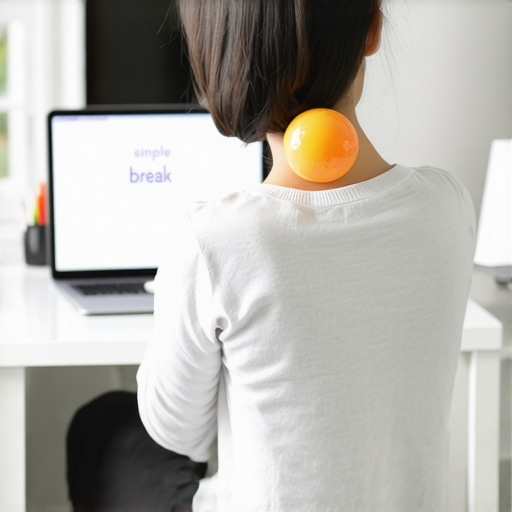
I’ve spent thousands on gadgets, but the tools that actually saved my spine cost less than a lunch at Chipotle. My absolute favorite is a simple, high-density lacrosse ball. Why? Because it allows for pinpoint pressure on the levator scapulae—the muscle that usually makes your neck feel like it’s made of rebar. I use it for mobility boosts for posture while I’m watching Netflix. If you find a ‘hot spot,’ don’t just mash it; breathe into it and move your arm through its range of motion. This active release is what separates real change from temporary relief. I also rely heavily on a digital tool called ‘Stretchly.’ It’s an open-source break timer that locks my screen every 20 minutes. It sounds annoying, but it’s the only way I actually stick to the best standing desk interval for maximum back health. Without that digital nudge, I’d be a human pretzel by 3 PM.
How do I maintain these mobility gains for the long haul?
The secret is consistency over intensity. You don’t need a 90-minute yoga session every morning; you need what Dr. Kelly Starrett, author of Becoming a Supple Leopard, calls ‘body maintenance’—small, daily investments in your tissue quality. I’ve integrated improving mobility and posture in 2025 by making it part of my environment. My kitchen counter is the perfect height for a quick hip stretch while the coffee brews. I’ve also realized that how your choice of pillow impacts your mid-back health is a massive factor in keeping the progress I make during the day. If you’re waking up stiff, you’re basically undoing all your hard work while you sleep. To stay on top of it, I schedule a monthly ‘tune-up.’ Even when I feel great, I want to enhance your posture with expert chiropractic techniques in 2025 to catch minor restrictions before they become major pains. It’s about being proactive rather than reactive.
Where the Science of Sitting is Heading
We are moving toward a future of ‘passive biofeedback.’ Imagine a chair that gently vibrates or shifts its lumbar support based on real-time muscle tension data captured by your smartwatch. While that tech is coming, you can replicate it now by being more mindful of your body’s internal signals. If you’re serious about this, you need to look at improving posture through mobility as a lifestyle, not a chore. I genuinely believe that in five years, ‘posture hygiene’ will be as common as brushing your teeth. People are finally waking up to the fact that chiropractic care is your secret weapon for better posture because it treats the body as a dynamic system rather than a static frame. If you take one thing from this, let it be the 2-minute drill. It’s the highest ROI move I know for desk workers. Go ahead and try the 2-minute drill for better spinal rotation right now—it’s the fastest way to feel like you’ve actually got some room to breathe in your own skin. Don’t wait for the pain to return to start moving again.
The Hard Lessons That Finally Stopped My Chronic Aches
I wasted years thinking my spine was a stack of bricks that needed to stay perfectly aligned. The first big ‘lightbulb moment’ was realizing that posture is a verb, not a noun. It’s about how well you transition between positions, not how long you can hold a single one. Secondly, I learned that ‘tightness’ is usually just your brain’s way of saying it doesn’t trust your stability. If you want your muscles to let go, you have to show your nervous system that you are safe in those new ranges of motion. Lastly, I realized that mobility hacks are far more effective when you stop treating them as a workout and start treating them as a way to say ‘thank you’ to your joints throughout the day.
The Simple Tools That Outperformed My $1,200 Office Chair
You don’t need a massive budget to see massive results. My ‘holy trinity’ of back health includes a high-density lacrosse ball, which is the only thing that can actually reach the deep knots in my mid-back. I also swear by ‘Becoming a Supple Leopard’ by Dr. Kelly Starrett—it’s essentially the owner’s manual for the human body that we should have been given at birth. To ensure I don’t undo my progress while I sleep, I’ve become very picky about how your choice of pillow impacts your mid-back health. These aren’t just ‘products’; they are investments in a lifestyle that prioritizes function over aesthetics. If you’re looking for a roadmap, the ultimate guide to improving mobility and posture in 2025 is the best place to start building your own personalized toolkit.
#IMAGE_PLACEHOLDER_E#
Start Reclaiming Your Freedom of Movement Today
The journey from being a rigid statue to a fluid, moving human doesn’t happen overnight, but it does happen. You aren’t ‘broken’ because you slouch sometimes, and you don’t need a perfect spine to live a life free of pain. By focusing on consistent motion and understanding why chiropractic care is your secret weapon for better posture, you can stop fighting your body and start working with it. You deserve to sit, stand, and play without that constant, nagging fire in your back. The future of your health is dynamic, so let go of the rigid rules and just keep moving. Improving mobility and posture is the greatest gift you can give your future self.
Which part of your daily routine leaves you feeling the most stiff or ‘stuck’? Let me know in the comments below!