

It is 9:00 PM on Sunday. You are curled up on the couch, watching your favorite show, but you cannot focus. There is a deep, burning ache clawing at the base of your skull. You find yourself rolling your shoulders and desperately massaging your upper traps. Here is the weird part: tomorrow is Monday, the day you actually go back to your stressful desk job, yet your neck feels significantly better when you wake up for work. I used to face this exact same frustrating cycle every single week, wondering if I was somehow allergic to weekends.
The Real Reason Your Weekend Rest Is Wreaking Havoc on Your Spine
For years, I made the classic mistake of thinking that physical rest meant sitting as still as possible. I thought my Sunday couch sessions were helping me recover from the workweek. In reality, my body was suffering from a sudden lack of movement. When we sit in a deep, soft couch, our pelvis rolls backward, our shoulders round, and we crane our neck forward to keep looking at the screen. This is a primary reason why your neck hurts more on Sunday nights than Monday mornings.
On Monday morning, even though you are sitting at a desk, you are upright, moving around, walking to meetings, and engaging your postural muscles. Sunday is often a day of static, slumped posture. A fascinating clinical observation published by the physical therapy community notes that sustained static loading on spinal ligaments can cause microvascular changes and muscle spasm faster than dynamic, active movement. Today, we are going to dive into how you can break this cycle and reclaim your weekend relaxation without the physical penalty.
Are we just doomed to choose between couch time and a pain-free neck?
I know what you are thinking. You work hard all week, and the idea of spending your Sunday doing intense mobility drills instead of relaxing sounds exhausting. Is managing your posture during your downtime really worth giving up your comfort? I used to think the only solution was to sit perfectly straight on a hard wooden chair all Sunday. But I was wrong. You can absolutely enjoy your favorite weekend activities without waking up stiff. It all comes down to minor, smart modifications rather than overhaul. Have you ever noticed your neck pain peaking right as the weekend ends? Let me know in the comments below, because you are definitely not alone in this fight.
To fix this, we need to understand how our sitting habits affect our alignment, starting with how we position ourselves during our favorite Sunday hobbies. We can make incredibly simple changes, like learning the best way to sit on a sofa to protect your discs, which keeps the spine supported while still letting you relax. Let’s look at the simple adjustments that will save your neck before Monday arrives.
How to Reprogram Your Sunday Lounge Session Without the Spine Strain
I used to treat my Sunday couch time like a competitive sport, aiming for maximum immobility. The result? By 8:00 PM, my neck felt like a rusted gate hinge. I realized I had to change the mechanics of my rest. Think of your spine as a high-performance suspension bridge. When you sit on a saggy couch without support, you are essentially cutting the cables on one side and letting the entire structure collapse. To fix this, you must introduce active support and intentional, micro-movements into your relaxation routine.
The first step is what I call the ‘Pelvic Anchor.’ Most couch stiffness starts because your pelvis rolls backward into a posterior tilt, which forces your entire upper body to slump forward. By putting a firm, rolled-up towel or a small lumbar pillow right at the base of your spine, you force your pelvis to stay neutral. This single mechanical adjustment automatically stacks your ribcage over your hips, taking the sheer stress off your delicate cervical ligaments. When I first tried this, I used a bulky throw pillow that pushed me too far forward, making me look ridiculous and feel uncomfortable. But once I swapped it for a firm, rolled-up bath towel, the relief in my upper traps was almost immediate.

Ditch the Screen Stare with the Ten-Degree Rule
Another major contributor to that Sunday night burn is the angle of your gaze. When you look down at a tablet or phone in your lap, you are multiplying the weight of your head on your neck by up to five times. To combat this, you need to lift your devices. I recommend using the the 5-second fix for rounded-shoulders while using a tablet to immediately bring your screen to eye level. If you are watching TV, elevate your chin slightly and make sure your head rest is actually supporting the curve of your neck rather than pushing your head forward. If you still find yourself reaching forward with your head, learning how to adjust your monitor to stop reaching with your chin can help you train your gaze and muscle memory for better alignment overall.
Micro-Dose Your Movement Throughout the Day
Your body thrives on dynamic motion, not static freezing. Every time a streaming episode ends, or at least once an hour, perform a simple dynamic movement to reset your joint lubrication. A great way to do this is by performing the 30-second fix for a stuck feeling in your middle back. These quick, physical interventions are like oiling a rusty squeaky door. They keep the facet joints in your thoracic spine sliding smoothly so that your neck doesn’t have to overcompensate for a frozen mid-back. If you integrate these small posture habits, you can enjoy your leisure time without paying a painful price on Monday morning.
When we talk about fixing our posture, most experts hand us the same tired advice: sit up straight, stretch your hamstrings, and buy an expensive ergonomic chair. But there is a massive difference between passive positioning and active structural integrity. If you have been trying to stretch your way out of stiffness, you might actually be making your spinal instability worse.
The Core-Stability Fallacy That Is Secretly Stiffening Your Spine
Everyone tells you to stretch when you feel tight. In my experience, however, aggressively stretching a muscle that is already under constant tension is a recipe for chronic micro-tears and protective muscle guarding. When your upper back and neck feel like concrete after a weekend on the sofa, your brain is actually tightening those muscles to protect your cervical joints from collapsing. Stretching them out just forces the brain to tighten them even harder a few hours later.
Instead of stretching a muscle that is crying out for stability, you need to address the actual joint alignment. This is where understanding the difference between a sore muscle and a misaligned joint becomes your ultimate weapon. If a joint is restricted or slightly out of its optimal tracks, no amount of foam rolling or yoga will restore its natural movement. You are essentially pulling on a knotted rope; you have to untie the knot at the joint level first.
Why Do My Joints Keep Clicking When I Try to Move Them?
Many people fall into the self-manipulation trap, constantly twisting their necks or backs until they hear a satisfying pop. A landmark clinical study published in the Journal of Manipulative and Physiological Therapeutics demonstrated that self-cracking usually targets the hypermobile joints above or below the restricted segment, leaving the actual stiff joint completely untouched. You are essentially over-stretching already loose ligaments while the primary blockage remains frozen.
This is why target interventions like professional chiropractic adjustments are so critical. A chiropractor doesn’t just crack everything; they apply a precise, high-velocity, low-amplitude thrust to the exact segment that has stopped moving. This restores the joint’s glide, which immediately signals the nervous system to relax the surrounding muscle guard. If you want to build on that newfound freedom, integrating mobility hacks into your daily routine keeps the joint from locking back up during your next resting session.

The trap most people fall into is thinking that a single treatment or a weekend stretch session will reverse years of desk slumping and couch lounging. True spinal health requires a blend of professional joint mobilization and daily neuromuscular re-education. If you only focus on one, you will find yourself in a constant loop of temporary relief followed by sudden flare-ups. Have you ever fallen into this trap of stretching a tight spot only to have it return worse the next day? Let me know in the comments, and let’s discuss how to break that cycle once and for all.
When we commit to structural health, the real work begins after we leave the clinic. We cannot rely solely on weekly clinic visits to undo 168 hours of weekly physical habits. To protect your structural integrity, you need a proactive, long-term maintenance strategy using the right physical feedback loops.
How do I maintain my mobility and posture over time?
I am often asked how to keep the body feeling loose and aligned without spending hours on therapeutic exercises every single day. The answer lies in targeted muscle memory training and micro-habits. Rather than doing exhaustive workouts, I focus on specific daily environmental cues. For example, implementing mobility boosts for posture throughout your standard workday keeps your tissues from adapting to a static, slumped position. I personally place a physical cue, like a bright sticker on the corner of my computer screen, to remind me to adjust my posture every time I look at it. This simple habit prevents me from slipping into a forward-head posture during long writing sessions.
In my personal routine, I rely on two non-negotiable tools: a high-density, sub-occipital release block and a firm lumbar roll for my office chair. I do not recommend soft, generic foam rollers because they lack the structural density required to affect deep spinal ligaments. When you use a firm sub-occipital release tool for just three minutes at night, you physically inhibit the overactive sub-occipital muscles at the base of your skull. This prepares your nervous system for deep, restorative sleep. For your lower body, knowing the daily habit that prevents recurring lower back stiffness is an absolute game-changer to stop tension from accumulating while you rest.
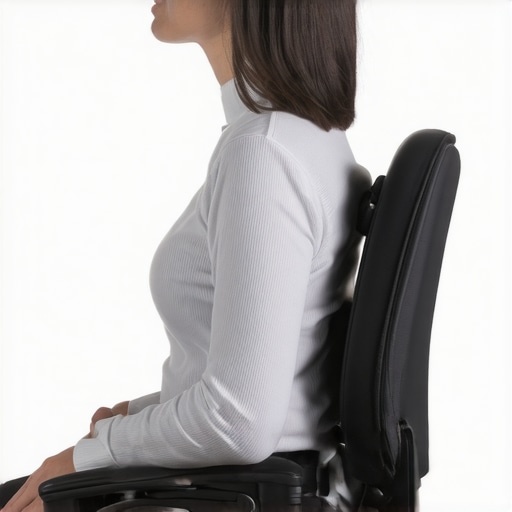
Looking toward the future, I predict we will see a massive shift toward wearable biofeedback sensors integrated directly into our clothing. Rather than relying on our own limited awareness, small, textile-integrated sensors will gently vibrate when they detect a pelvic tilt or a rounded shoulder, helping us make immediate adjustments. Until that technology becomes mainstream, we must build our own internal biofeedback loops. This is where combining professional care with home maintenance is essential; using improving posture through mobility techniques ensures that the structural space created by your chiropractor actually stays open and functional.
According to Dr. Stuart McGill, a leading expert in spine biomechanics at the University of Waterloo, building endurance in our postural stabilizing muscles is far more protective against spinal injury than building raw strength. He emphasizes that maintaining a neutral spine during daily activities is the ultimate key to preventing disc herniations and joint degradation. To put this research into practice today, try this advanced tip: the next time you sit down to relax, focus entirely on keeping your pelvis neutral using a rolled-up towel. Do not wait for your neck to start aching before you take action.
It is 9:00 PM on Sunday. You are curled up on the couch, watching your favorite show, but you cannot focus. There is a deep, burning ache clawing at the base of your skull. You find yourself rolling your shoulders and desperately massaging your upper traps. Here is the weird part: tomorrow is Monday, the day you actually go back to your stressful desk job, yet your neck feels significantly better when you wake up for work. I used to face this exact same frustrating cycle every single week, wondering if I was somehow allergic to weekends.
The Real Reason Your Weekend Rest Is Wreaking Havoc on Your Spine
For years, I made the classic mistake of thinking that physical rest meant sitting as still as possible. I thought my Sunday couch sessions were helping me recover from the workweek. In reality, my body was suffering from a sudden lack of movement. When we sit in a deep, soft couch, our pelvis rolls backward, our shoulders round, and we crane our neck forward to keep looking at the screen. This is a primary reason why your neck hurts more on Sunday nights than Monday mornings.
On Monday morning, even though you are sitting at a desk, you are upright, moving around, walking to meetings, and engaging your postural muscles. Sunday is often a day of static, slumped posture. A fascinating clinical observation published by the physical therapy community notes that sustained static loading on spinal ligaments can cause microvascular changes and muscle spasm faster than dynamic, active movement. Today, we are going to dive into how you can break this cycle and reclaim your weekend relaxation without the physical penalty.
Are we just doomed to choose between couch time and a pain-free neck?
I know what you are thinking. You work hard all week, and the idea of spending your Sunday doing intense mobility drills instead of relaxing sounds exhausting. Is managing your posture during your downtime really worth giving up your comfort? I used to think the only solution was to sit perfectly straight on a hard wooden chair all Sunday. But I was wrong. You can absolutely enjoy your favorite weekend activities without waking up stiff. It all comes down to minor, smart modifications rather than overhaul. Have you ever noticed your neck pain peaking right as the weekend ends? Let me know in the comments below, because you are definitely not alone in this fight.
To fix this, we need to understand how our sitting habits affect our alignment, starting with how we position ourselves during our favorite Sunday hobbies. We can make incredibly simple changes, like learning the best way to sit on a sofa to protect your discs, which keeps the spine supported while still letting you relax. Let’s look at the simple adjustments that will save your neck before Monday arrives.
How to Reprogram Your Sunday Lounge Session Without the Spine Strain
I used to treat my Sunday couch time like a competitive sport, aiming for maximum immobility. The result? By 8:00 PM, my neck felt like a rusted gate hinge. I realized I had to change the mechanics of my rest. Think of your spine as a high-performance suspension bridge. When you sit on a saggy couch without support, you are essentially cutting the cables on one side and letting the entire structure collapse. To fix this, you must introduce active support and intentional, micro-movements into your relaxation routine.
The first step is what I call the ‘Pelvic Anchor.’ Most couch stiffness starts because your pelvis rolls backward into a posterior tilt, which forces your entire upper body to slump forward. By putting a firm, rolled-up towel or a small lumbar pillow right at the base of your spine, you force your pelvis to stay neutral. This single mechanical adjustment automatically stacks your ribcage over your hips, taking the sheer stress off your delicate cervical ligaments. When I first tried this, I used a bulky throw pillow that pushed me too far forward, making me look ridiculous and feel uncomfortable. But once I swapped it for a firm, rolled-up bath towel, the relief in my upper traps was almost immediate.
Ditch the Screen Stare with the Ten-Degree Rule
Another major contributor to that Sunday night burn is the angle of your gaze. When you look down at a tablet or phone in your lap, you are multiplying the weight of your head on your neck by up to five times. To combat this, you need to lift your devices. I recommend using the the 5-second fix for rounded-shoulders while using a tablet to immediately bring your screen to eye level. If you are watching TV, elevate your chin slightly and make sure your head rest is actually supporting the curve of your neck rather than pushing your head forward. If you still find yourself reaching forward with your head, learning how to adjust your monitor to stop reaching with your chin can help you train your gaze and muscle memory for better alignment overall.
Micro-Dose Your Movement Throughout the Day
Your body thrives on dynamic motion, not static freezing. Every time a streaming episode ends, or at least once an hour, perform a simple dynamic movement to reset your joint lubrication. A great way to do this is by performing the 30-second fix for a stuck feeling in your middle back. These quick, physical interventions are like oiling a rusty squeaky door. They keep the facet joints in your thoracic spine sliding smoothly so that your neck doesn’t have to overcompensate for a frozen mid-back. If you integrate these small posture habits, you can enjoy your leisure time without paying a painful price on Monday morning.
When we talk about fixing our posture, most experts hand us the same tired advice: sit up straight, stretch your hamstrings, and buy an expensive ergonomic chair. But there is a massive difference between passive positioning and active structural integrity. If you have been trying to stretch your way out of stiffness, you might actually be making your spinal instability worse.
The Core-Stability Fallacy That Is Secretly Stiffening Your Spine
Everyone tells you to stretch when you feel tight. In my experience, however, aggressively stretching a muscle that is already under constant tension is a recipe for chronic micro-tears and protective muscle guarding. When your upper back and neck feel like concrete after a weekend on the sofa, your brain is actually tightening those muscles to protect your cervical joints from collapsing. Stretching them out just forces the brain to tighten them even harder a few hours later.
Instead of stretching a muscle that is crying out for stability, you need to address the actual joint alignment. This is where understanding the difference between a sore muscle and a misaligned joint becomes your ultimate weapon. If a joint is restricted or slightly out of its optimal tracks, no amount of foam rolling or yoga will restore its natural movement. You are essentially pulling on a knotted rope; you have to untie the knot at the joint level first.
Why Do My Joints Keep Clicking When I Try to Move Them?
Many people fall into the self-manipulation trap, constantly twisting their necks or backs until they hear a satisfying pop. A landmark clinical study published in the Journal of Manipulative and Physiological Therapeutics demonstrated that self-cracking usually targets the hypermobile joints above or below the restricted segment, leaving the actual stiff joint completely untouched. You are essentially over-stretching already loose ligaments while the primary blockage remains frozen.
This is why target interventions like professional chiropractic adjustments are so critical. A chiropractor doesn’t just crack everything; they apply a precise, high-velocity, low-amplitude thrust to the exact segment that has stopped moving. This restores the joint’s glide, which immediately signals the nervous system to relax the surrounding muscle guard. If you want to build on that newfound freedom, integrating mobility hacks into your daily routine keeps the joint from locking back up during your next resting session.
The trap most people fall into is thinking that a single treatment or a weekend stretch session will reverse years of desk slumping and couch lounging. True spinal health requires a blend of professional joint mobilization and daily neuromuscular re-education. If you only focus on one, you will find yourself in a constant loop of temporary relief followed by sudden flare-ups. Have you ever fallen into this trap of stretching a tight spot only to have it return worse the next day? Let me know in the comments, and let’s discuss how to break that cycle once and for all.
When we commit to structural health, the real work begins after we leave the clinic. We cannot rely solely on weekly clinic visits to undo 168 hours of weekly physical habits. To protect your structural integrity, you need a proactive, long-term maintenance strategy using the right physical feedback loops.
How do I maintain my mobility and posture over time?
I am often asked how to keep the body feeling loose and aligned without spending hours on therapeutic exercises every single day. The answer lies in targeted muscle memory training and micro-habits. Rather than doing exhaustive workouts, I focus on specific daily environmental cues. For example, implementing mobility boosts for posture throughout your standard workday keeps your tissues from adapting to a static, slumped position. I personally place a physical cue, like a bright sticker on the corner of my computer screen, to remind me to adjust my posture every time I look at it. This simple habit prevents me from slipping into a forward-head posture during long writing sessions.
In my personal routine, I rely on two non-negotiable tools: a high-density, sub-occipital release block and a firm lumbar roll for my office chair. I do not recommend soft, generic foam rollers because they lack the structural density required to affect deep spinal ligaments. When you use a firm sub-occipital release tool for just three minutes at night, you physically inhibit the overactive sub-occipital muscles at the base of your skull. This prepares your nervous system for deep, restorative sleep. For your lower body, knowing the daily habit that prevents recurring lower back stiffness is an absolute game-changer to stop tension from accumulating while you rest.
Looking toward the future, I predict we will see a massive shift toward wearable biofeedback sensors integrated directly into our clothing. Rather than relying on our own limited awareness, small, textile-integrated sensors will gently vibrate when they detect a pelvic tilt or a rounded shoulder, helping us make immediate adjustments. Until that technology becomes mainstream, we must build our own internal biofeedback loops. This is where combining professional care with home maintenance is essential; using improving posture through mobility techniques ensures that the structural space created by your chiropractor actually stays open and functional.
According to Dr. Stuart McGill, a leading expert in spine biomechanics at the University of Waterloo, building endurance in our postural stabilizing muscles is far more protective against spinal injury than building raw strength. He emphasizes that maintaining a neutral spine during daily activities is the ultimate key to preventing disc herniations and joint degradation. To put this research into practice today, try this advanced tip: the next time you sit down to relax, focus entirely on keeping your pelvis neutral using a rolled-up towel. Do not wait for your neck to start aching before you take action.
The Hardest Lesson I Learned About Chasing Spinal Relief
For a long time, I operated under the assumption that if my neck hurt, the problem was exclusively in my neck. This narrow focus kept me trapped in a loop of endless neck stretches that yielded only minutes of comfort. The biggest breakthrough came when I realized that the cervical spine is merely the end of the whip. If your pelvis is tilted and your thoracic spine is locked, your neck has to work overtime just to keep your eyes horizontal. Real relief only started when I stopped treating the symptoms and began managing the entire structural chain as a single, connected unit.
My Essential Daily Toolkit for Lasting Spinal Freedom
You do not need an entire gym dedicated to physical therapy, but investing in a few highly intentional tools can save your posture. Here are the three items I personally use and rely on every single week:
- High-Density Sub-Occipital Block: Unlike soft foam, this firm anatomical tool targets the base of the skull to release tension in the tiny muscles that cause cervicogenic headaches.
- A Firm Roll of Heavy Bath Towels: Cheap, portable, and easily adjustable, a tightly rolled towel is the absolute best lumbar support for deep couches and car seats.
- The Psoas Hook or Massage Cane: Perfect for breaking up trigger points in the upper traps and levator scapulae without putting excessive strain on your hands.
The Journey to a Pain-Free Sunday Starts Today
You don’t have to choose between relaxing on your weekend and waking up without a stiff, burning neck. By combining smart pelvic support, regular micro-movements, and professional guidance to resolve underlying joint restrictions, you can completely transform how your body feels on Monday morning. Taking charge of your alignment isn’t about rigid rules; it’s about giving your body the space and support it needs to heal itself. Focus on these small, sustainable habits to build a lasting framework for your health, and start improving posture through mobility today so your weekends can finally feel like actual recovery.
Have you ever tried using a lumbar roll or towel on your couch only to find yourself sliding back into your old posture habits? Let me know what challenges you face in the comments below!