

I still remember the crisp autumn morning I decided to reclaim my health. I laced up my brand-new sneakers, stepped out onto the driveway, and set off with grand ambitions of a brisk two-mile power walk. Within exactly three minutes, my plans shattered. A searing, tight burn crawled up the front of my lower legs, making every step feel like I was lifting lead weights. I hobbled back home, utterly defeated, wondering how a simple stroll could feel so incredibly punishing. It turns out I was experiencing a classic case of anterior shin splints, a frustratingly common roadblock that derails thousands of morning routines before they even have a chance to start. Today, we are going to unpack exactly why this fiery sensation happens and how you can reclaim your pain-free morning strides.
The Real Culprit Behind the Morning Burn
The burning sensation in your shins isn’t a sign that you are simply out of shape; it is a mechanical cry for help. When you sleep, your feet naturally drift into a downward-pointing position, which shortens your calf muscles overnight. When you suddenly demand that your ankles flex dynamically on hard pavement first thing in the morning, those tight posterior muscles resist. Your anterior tibialis—the muscle on the front of your shin—is forced to work double-time just to lift your foot, leading to rapid fatigue and that deep, burning ache. Early in my journey, I made the classic mistake of trying to push through the pain, believing I could just stretch my way out of it. However, I soon realized that why your calf muscles are always tight even after stretching often points to deeper issues, like joint restriction and poor biomechanics.
Is this burning sensation actually a permanent injury?
It is easy to panic and assume you have stress fractures when your legs are on fire, but most morning shin pain is purely functional. In fact, research published by the National Institutes of Health indicates that up to 15% of all running and walking injuries are attributed to medial tibial stress syndrome, heavily influenced by sudden changes in activity levels and poor ankle mobility. If your joints cannot move through their full range, your muscles have to absorb the shock. This is why addressing the hidden link between your ankle mobility and your lower back is so crucial; a stiff ankle disrupts the entire kinetic chain. Have you ever had to cut your favorite morning walk short because your shins felt like they were encased in concrete? Leave a comment below and let me know—I would love to hear if you are fighting this same battle right now.
How to Reset Your Ankles Before Your Feet Hit the Pavement
To stop the fire in your shins, you have to change how your ankles prepare for movement. Think of your lower leg muscles like the rigging on a sailboat. If the ropes on one side are locked tight, the sails cannot shift smoothly, and the mast takes all the strain. In this case, your tight calves are pulling your ankles out of alignment, forcing the front shin muscles to work in a constant state of mechanical disadvantage. To fix this, you need to transition from passive resting to active mobility before you take a single step outside.
During my second week of dealing with this issue, I tried to rush straight into a fast walk without preparing my joints. I ended up limping back to my driveway within five minutes, my shins throbbing so hard I could feel my pulse in my socks. That messy failure taught me that you cannot bypass joint preparation. Once I started spending just three minutes mobilizing my ankles beforehand, the deep burn subsided.

Wake up your feet with active dorsiflexion
Before you put on your shoes, sit on the edge of your bed and perform a simple active mobilization. Extend your legs and slowly draw your toes back toward your shins as far as possible, holding for two seconds, then point them away. Do this for twenty repetitions. This simple movement pumps fresh blood into the anterior tibialis and gently coaxes the tight calf muscles to release their overnight grip. This is a foundational step in revolutionize your posture with targeted mobility exercises because your movement pattern starts at the ground level. If your feet cannot flex, your entire walking stride gets thrown off.
The simple wall check for ankle range of motion
A great way to test and improve your mobility is the knee-to-wall test. Stand facing a wall with your big toe about two inches away from the baseboard. Keep your heel firmly planted on the floor and bend your knee, attempting to touch the wall. If your knee cannot touch the wall without your heel lifting, you have joint restriction that is directly causing your anterior shin splints. Gradually back your foot away over several days as your mobility improves. If you ignore this stiffness, the compensations will travel up your body, which explains the hidden link between your ankles and your chronic hip ache. When one joint refuses to move, the next joint up is forced to overwork.
Strengthen the front of your legs with toe raises
Most people only focus on stretching their tight calves, but the real secret to long-term relief is strengthening the antagonist muscle: the anterior tibialis. Stand with your back flat against a wall, heels about six inches away from the baseboard. Keep your legs straight and pull your toes up toward the ceiling, flexing the front of your shins. Hold for a second at the top, then slowly lower your feet back down. Perform three sets of fifteen repetitions. Building endurance in this muscle prevents it from fatiguing and burning during your walks. This active stabilization is just as vital as knowing the daily habit that prevents recurring lower back stiffness, as balanced muscles protect your joints from impact. By reinforcing the front of your lower legs, you distribute the forces of walking evenly, ensuring your morning walks remain a source of energy rather than pain.
The Big Mobility Misconception We All Fall For
Most of us are conditioned to believe that when a muscle feels tight, the universal solution is to stretch it. If your shins burn or your calves feel like guitar strings, you pull your toes back and hold. But here is the contrarian truth: stretching a structurally locked joint is like pulling on a knotted rope. It might feel like you are doing something productive, but you are actually just irritating the nerve endings. When you constantly stretch without addressing the underlying joint restriction, you teach your nervous system to stay in a state of high alarm, which actually increases protective muscle guarding.
Instead of endless passive stretching, real progress requires moving the joint through its active range under load. This is where the magic of targeted joint mobilizations comes in. If you are struggling with chronic stiffness, understanding improving posture through mobility practical chiropractor strategies will completely change how you view recovery. We need to stop treating the symptom—the tight muscle—and start treating the biological machinery that controls it.
Why does my shin pain return even after a thorough stretching routine?
The answer lies in joint biomechanics and nervous system feedback. When an ankle joint is restricted, the surrounding muscles lock down to protect the area from further injury. According to a study published in the Journal of Athletic Training, joint mobilization yields immediate improvements in dorsiflexion range of motion compared to static stretching alone. If you only stretch the calf muscle, you do nothing to reposition the talus bone within the ankle mortise. The joint remains jammed, the anterior tibialis continues to work at a mechanical disadvantage, and the burning pain returns the moment you speed up your walking pace.
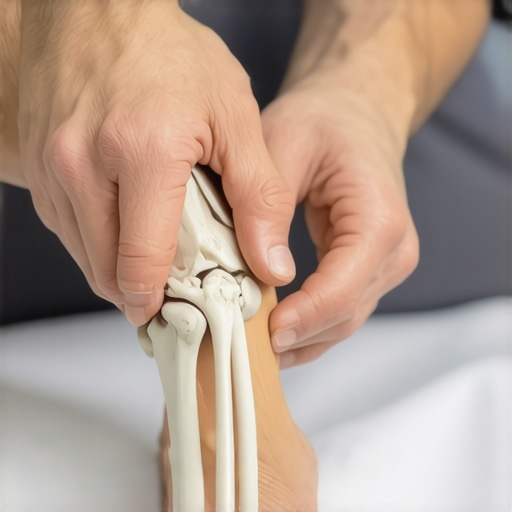
This structural gridlock is also why so many people fail to see lasting results from general fitness routines. Without proper joint alignment, your body compensates by shifting stress upward. This mechanical compensation highlights the link between mobility and posture a chiropractors guide. If your foundation—your ankles and feet—cannot move correctly, your pelvis tilts, your lower back arches, and your posture crumbles.
The Dangerous Trap of Self-Cracking for Quick Relief
When our joints feel stiff, many of us fall into the classic trap of twisting, popping, and cracking our own backs or ankles. I used to do this constantly, thinking that satisfying ‘pop’ meant I was fixing my mobility. It is a massive trap. When you crack your own joints, you are almost always mobilizing the segments that are already hypermobile—the ones that are already moving too much to compensate for the stiff segments. By forcing these loose joints to pop, you make them even more unstable, while the truly locked joints stay completely frozen.
This dangerous cycle of self-manipulation actually worsens your long-term alignment. Real correction requires specific, high-velocity, low-amplitude adjustments delivered precisely to the restricted segments. Understanding how chiropractic adjustments enhance posture and mobility is essential for breaking this cycle. A targeted adjustment coaxes the stubborn, locked joints back into motion, allowing the hypermobile areas to finally rest and stabilize. Have you ever fallen into this trap of constant self-cracking only to find the stiffness returns ten minutes later? Let me know in the comments below—I would love to hear your experience.
My Personal Toolkit for Keeping Ankles Mobile and Strong
Over the years, I have tested countless gadgets, straps, and boards promising to end lower leg pain. Most of them ended up gathering dust in my closet because they simply did not work. However, two specific tools changed my morning routine entirely: a heavy-duty slant board and a thick, voodoo floss band. I use the slant board daily at a precise 25-degree angle because it allows me to perform loaded, active dorsiflexion while keeping my heel locked down. The voodoo floss band is my secret weapon for joint shearing. By wrapping the ankle joint tightly and performing basic movements, you manually break up stubborn fascial restrictions that stretching cannot touch. This is a vital component of mobility boosts for posture expert tips for daily adjustments because it restores the natural sliding surface of your tendons.
Where is the future of lower limb mechanics heading? I predict we will see a major shift away from cushioned, supportive footwear and toward minimalist, active recovery tools. We are already seeing research, like clinical data from the biomechanics department at the University of Delaware, highlighting how excessive shoe cushioning weakens the intrinsic muscles of the foot. In the coming years, true mobility maintenance will focus on letting the foot function naturally while using targeted, precision adjustments to keep the structural joints aligned.
How do I maintain my ankle mobility over time?
Consistency beats intensity every single day. To keep your lower legs functioning beautifully, you need a daily maintenance plan that fits into your existing lifestyle. I keep my slant board right next to my bathroom sink. While I brush my teeth every morning and night, I stand on it. That simple, passive-active habit ensures my calf muscles and Achilles tendons never have the chance to tighten up overnight. Integrating small, physical anchors into your day is the absolute best way to make progress stick, which is why adopting the ultimate guide to improving mobility and posture in 2025 requires building small, non-negotiable habits. If you work at a desk, kick your shoes off and roll your arches over a lacrosse ball for two minutes every afternoon to maintain that vital brain-to-foot neural connection.
Ultimately, home tools can only take you so far if the underlying joint is structurally stuck. If you have been doing your daily exercises and still feel that deep, mechanical block, it is time to seek professional care. I highly recommend learning how to choose an Omaha chiropractor that actually listens to your wellness goals. A skilled practitioner can physically release the restricted joints in your feet and ankles, allowing your daily mobility habits to actually work. Try my favorite tip tomorrow morning: perform fifteen slow toe raises against a wall before you put your shoes on, and see how much lighter your first step feels.
The Hardest Lessons I Learned on the Road to Pain-Free Miles
When I first started trying to resolve my lower leg pain, I fell into several traps that kept me sidelined for months. Here are the shifts in perspective that finally made the difference:
- Your body is a tensegrity structure: If you feel pain in the front of your shins, the problem is rarely just the shin itself. It is almost always a compensation for a locked-up ankle joint or tight calves that pull the entire system out of alignment.
- Passivity gets passive results: Static stretching feels good in the moment, but it does not change how your nervous system coordinates movement. Active mobility drills—where you engage the opposing muscles under control—are what actually build lasting resilience.
- The alignment chain is real: Ignoring stiff ankles will eventually catch up to you. I learned this the hard way when my stubborn ankle stiffness eventually morphed into a nagging hip ache. Everything in your lower body is connected.
My Essential Toolkit for Lower Leg Restoration
If you want to speed up your recovery, stop guessing and start using tools that target joint mechanics. These are the specific items I rely on to keep my feet and ankles in peak condition:
- A 25-Degree Slant Board: This is my absolute favorite tool for restoring ankle dorsiflexion. Standing on a slant board forces your calf muscles and Achilles tendons to elongate while you actively load the joint.
- Heavy-Duty Mobility Bands: I use these for joint distraction. By looping a thick band around the ankle joint and anchoring it to a heavy table leg, you can gently pull the talus bone backward as you bend your ankle, clearing physical joint restrictions that stretching cannot reach.
- A Standard Lacrosse Ball: This is a cheap and incredibly effective way to roll out the plantar fascia under your foot. Releasing the bottom of your foot directly reduces tension up the entire back of your calf.
Step Out with Absolute Confidence Tomorrow Morning
You do not have to accept burning shins and stiff mornings as your baseline. By shifting your focus from endless passive stretching to active joint mobilization, you can restore your body’s natural biomechanics and walk as far as you want without pain. When your foundation is solid, your entire posture improves, your joints feel lubricated, and movement becomes a joy rather than a chore. If you have been struggling to make progress on your own, consider utilizing mobility hacks simple adjustments for a more active life or seek out a professional who can assess your structural alignment. Take that first step to prepare your joints before you head out tomorrow, and reclaim the active lifestyle you deserve.
Have you ever had to cut your favorite walk short because your shins felt like concrete? Let me know in the comments below—I would love to hear what has worked for you!