

I was just reaching for a half-empty coffee mug. That was it. No heavy lifting, no gym heroics, just a simple reach across the kitchen counter. Then—crack-zip-freeze. My lower back felt like it had been struck by lightning, and then it seized up tighter than a rusty engine. I stood there, bent at a miserable 45-degree angle, terrified that one wrong breath would snap me in half. The panic is usually worse than the pain itself, isn’t it? Your brain immediately goes to the worst-case scenario, imagining months of bed rest or a permanent life of shuffling. But I’ve been there, and I’ve learned the hard way that the first sixty seconds of a back spasm determine whether you’ll be back on your feet by Tuesday or stuck on the rug until Friday. We are going to get you through this without the unnecessary drama.
Stop fighting the seizure and start breathing through the panic
Early on in my journey with back issues, I made a massive mistake: I tried to ‘stretch it out’ the second the pain hit. I thought if I could just touch my toes, I could force the muscle to release. Spoiler alert: it doesn’t work that way. When your back locks up, it’s often because your brain has hit the emergency brake to protect your spine. If you try to force a stretch, your nervous system just pulls the brake harder. Instead of fighting it, you need to understand the difference between a pulled muscle and a slipped disc before you do anything drastic. My first bit of advice? Get to the floor—carefully—and find a position of comfort. For most of us, that’s lying on the back with your knees bent. Don’t even think about foam rolling your lower back right now; that’s like poking an angry bear with a stick. You need to calm the nervous system down first with slow, diaphragmatic breathing.
Is this actually going to leave me stuck on the floor forever?
It feels like it, doesn’t it? The skepticism is real. You’re lying there thinking your ‘good years’ are officially behind you. But here is a surprising fact to settle your nerves: according to Harvard Health Publishing, most acute back spasms are the result of muscle guarding and usually begin to resolve within 48 to 72 hours if you don’t aggravate them further. You aren’t broken; you’re just temporarily locked. Once you’ve stopped the initial ‘fight or flight’ response, you can start looking into mobility hacks and simple adjustments to keep this from becoming a monthly tradition. Have you ever been frozen in place by something as ridiculous as a sneeze or reaching for a dropped pencil? Tell me your most ‘humbled by a minor movement’ story in the comments—I need to know I’m not the only one who’s been taken down by a coffee mug. We’re going to talk about the ‘Ice vs. Heat’ debate and the exact micro-movements that actually help next.
Ice the fire before you try to move
When you are in the thick of a spasm, your instinct is to ‘thaw’ the muscle with heat. Don’t do it. I once spent forty minutes in a steaming hot bath thinking I was a genius, only to realize I couldn’t actually climb out of the tub because the heat had ramped up the internal swelling. My back felt like a waterlogged sponge. Ice is your sedative. Apply an ice pack for 15 minutes, then take it off for 30. This creates a natural pumping effect in the tissues without overwhelming the sensitive nerves. You want to numb the area and reduce the chemical soup of inflammation that’s keeping those muscles in a state of high alert. Once the initial ‘red alert’ pain subsides, you can start thinking about how how chiropractic adjustments enhance posture and mobility in the long run, but for right now, the ice pack is your best friend.
The tiny movement that signals safety to your spine
Once you have spent some time on the floor and the sharpest edges of the pain have dulled, you need to introduce micro-movements. This isn’t a workout; it’s a conversation with your nervous system. If you stay completely still for 24 hours, your back will set like concrete. Instead, while lying on your back with knees bent, try the pelvic tilt move. It is the most subtle motion imaginable—just gently flattening the small of your back against the floor and then releasing it. If it hurts, you’re going too far. You are simply trying to show your brain that the ’emergency brake’ can be released without the world ending. 
Stop trying to crack your way out of the problem
I know that desperate urge to twist your torso until you hear a loud ‘pop.’ You think that if you could just get that one click, everything would slide back into place. You must why you should stop cracking your own back every hour, especially during an acute flare-up. When you self-crack, you are usually just forcing movement into the segments of your spine that are already moving too much, while the segment that is actually ‘stuck’ remains protected by the spasm. You’re essentially poking an open wound. If you’re feeling the need for a real release, it’s better to look at how why chiropractic care is your secret weapon for better posture and alignment rather than performing DIY surgery on your living room rug.
Transitioning from frozen to functional
Eventually, you have to get up. The way you transition from the floor to a standing position will determine if you trigger a second wave of spasms. Use the hip hinge fix to keep your spine neutral as you move. Roll onto your side first, use your arms to push your upper body up, and keep your core braced. Avoid the temptation to go back to the truth about foam rolling your lower back immediately; your tissues are too sensitive for that kind of deep pressure right now. Focus on short, five-minute walks around the house every hour to keep the blood flowing and prevent the joints from locking up again.Once you are finally off the floor, the temptation is to become a posture vigilante. You pull your shoulders back, tuck your chin, and try to sit as straight as a board. But here is the nuance that usually gets lost in the noise: that rigid, military-style posture is often just as damaging as the slouch. In reality, why your perfect posture is actually causing muscle fatigue is because you are forcing your muscles into a static, isometric hold they weren’t designed to maintain for hours. A study published in the Journal of Physical Therapy Science highlights that ‘postural variability’—the ability to shift and move frequently—is a far better predictor of spinal health than holding a single ‘ideal’ position. If you’re trying to be a statue, you’re just waiting for the next spasm to happen.
The trap of relying on external posture supports
The most common ‘oops’ factor I see in my office is the reliance on posture braces or ‘harnesses.’ It seems like a brilliant shortcut, right? You wear a strap that pulls your shoulders back so you don’t have to think about it. However, why most posture braces actually make your back weaker is that they essentially tell your stabilizer muscles they can go on permanent vacation. When the brace does the work, your muscles stop firing. Within weeks, you have less natural support than when you started. Instead of outsourcing the job to a piece of elastic, you should revolutionize your posture with targeted mobility exercises that teach your nervous system how to hold your frame upright without the crutch.
Is your muscle tightness a physical wall or a nervous system lie?
This is the advanced question most people never ask. Sometimes your muscles feel ‘tight’ not because they are short, but because your brain is using them as ‘tie-down straps’ to stabilize a joint that feels unstable. For example, the real reason your hamstrings stay tight despite stretching is often that your pelvis is tilted, and your brain is cranking up hamstring tension to keep you from falling forward. If you keep stretching that ‘tightness,’ you are actually removing the very stability your body is desperately trying to create. This is where understanding the link between mobility and posture becomes critical; you have to fix the alignment of the joints before the muscles will ever agree to let go. 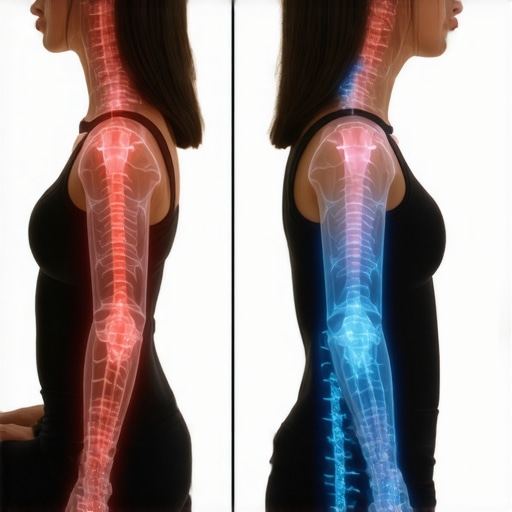
Moving beyond the ‘perfect’ pose
I spent years trying to ‘stand tall’ until my mid-back burned with fatigue, only to realize I was just creating a new kind of dysfunction. We have to stop thinking of posture as a destination and start seeing it as a movement. If you’ve been trying to force your body into a specific shape and finding that the pain just moves from your lower back to your neck, you’ve likely fallen into the static posture trap. Have you ever tried using a brace or ‘perfect’ sitting technique only to have it backfire? Let me know in the comments—I’d love to hear what finally worked for you. Next, we are going to dive into how chiropractic adjustments unlock a pain free lifestyle today by clearing the path for your body to move naturally again.
The specific gear I actually keep in my bag
I don’t believe in buying every posture gadget on Instagram, but there are three things I never travel without. First is a high-density lumbar roll. Most people use these wrong—they shove them way too low into the base of the seat. You want it right at the belt line or slightly above to maintain that natural secondary curve of the spine. It is a game-changer for those long commutes where you would normally end up in a ‘C’ shape. Understanding the proper way to use a lumbar roll in your office chair can be the difference between a productive afternoon and a week of nagging stiffness. Next, let’s talk about the foundation. I spent years in heavily cushioned running shoes only to realize they were tilting my pelvis forward and shortening my hip flexors. Transitioning to zero-drop shoes was a literal ‘ground-up’ fix for my lower back. You cannot have a stable roof if the foundation is slanted. If you are curious about making the switch, check out the best way to transition to minimalist footwear so you don’t trade back pain for calf strains. The technical side of this involves what Dr. Stuart McGill, a world-renowned spine biomechanist, calls ‘spinal hygiene.’ In his seminal work, Back Mechanic, he emphasizes that it is not just the exercises you do, but the movements you stop doing that create long-term resilience. It is about building a ‘stiffening’ capacity in the core to protect the discs during daily tasks. This is why the ultimate guide to improving mobility and posture in 2025 focuses so much on functional movement rather than just passive stretching. 
How do I keep my spine mobile for the next thirty years?
Consistency beats intensity every single time. You do not need a two-hour yoga session; you need the the 10-second move to reset your shoulders at work performed five or six times a day. Think of it like brushing your teeth—you do it to prevent decay, not to fix a cavity that is already there. Regular check-ins with a professional are part of this maintenance cycle too. Finding out how chiropractic adjustments unlock a pain free lifestyle today allows you to catch those minor ‘stuck’ segments before they turn into a full-blown spasm. Looking forward, I predict we are going to see a massive shift toward wearable biofeedback that monitors spinal shear and loading in real-time. We will move away from guessing and into data-driven mobility boosts for posture. But until that tech is in every t-shirt, you have to be your own advocate. My challenge to you today: set a timer for every 45 minutes and perform one specific ‘shoulder reset’ or ‘pelvic tilt.’ It sounds too simple to work, which is exactly why most people fail at it. Be the person who stays consistent.
The Posture Lies I Finally Stopped Believing
Over the years, I had to unlearn some pretty ingrained habits. First, I realized that stiffness isn’t the enemy; it’s often your body’s way of protecting you from a perceived threat. If you keep trying to ‘kill’ the tension with aggressive stretching, you’re just fighting your own survival instincts. Second, I learned that ‘perfect’ posture is a moving target. If you’re staying in any one position for too long—even the ‘right’ one—you’re asking for trouble. Finally, the most humbling realization was that my core wasn’t ‘weak’; it was just uncoordinated. It didn’t need more crunches; it needed better communication with my brain through mobility hacks and simple adjustments.
The Tools That Actually Saved My Sanity
You don’t need a basement full of equipment to keep your spine happy, but a few specific things make a massive difference. I swear by my high-density lumbar roll for the car, but more importantly, I stopped wearing ‘supportive’ shoes that were actually weakening my arches. Learning the best way to transition to minimalist footwear changed my entire pelvic alignment. I also highly recommend keeping a copy of Dr. Stuart McGill’s ‘Back Mechanic’ on your nightstand—it’s the gold standard for understanding spinal loading. Lastly, don’t underestimate the power of a professional who can see what you can’t; why chiropractic care is your secret weapon for better posture is because it addresses the joint mechanics that exercises alone sometimes can’t reach.
Your Spine Deserves a New Narrative
You aren’t a ‘back pain person.’ You are someone who is currently learning how to navigate the signals your body is sending. It’s easy to feel defeated when you’re staring at the ceiling from the rug, but remember that every spasm is a data point. It’s an opportunity to refine how you move, sit, and breathe. By prioritizing functional movement over static poses, you can ensure that chiropractic adjustments unlock a pain free lifestyle today and for years to come. Your body is incredibly resilient; it just needs you to stop poking the bear and start providing the right environment for healing. What’s the one ‘tiny’ movement or habit you’ve noticed makes the biggest difference for your back when it starts to feel tight? Let me know in the comments below!