

I was hunched over my phone, scrolling through a recipe, when it happened. A sharp, hot wire of pain snapped right behind my ear. I tried to shake it off, but my neck felt like it was made of rusted iron. For weeks, I walked around like a robot, unable to glance at my blind spot while driving. I tried every hack I saw online. I even bought one of those ridiculous posture harnesses that pinched my armpits. Nothing worked because I was trying to treat the symptom, not the source. I felt like I had to choose between being a functional human or staying connected to the digital world. But here’s the truth: you don’t have to delete your apps to save your spine. Today, I’m going to show you how to keep the phone and lose the pain. [IMAGE_PLACEHOLDER]
Why your head feels like a bowling ball after an hour of scrolling
When you tilt your head forward at a 60-degree angle to check a text, you aren’t just looking down. You are essentially hanging a 60-pound weight off your cervical spine. According to research published by Dr. Kenneth Hansraj in the journal Surgical Technology International, the pressure on your neck increases from 12 pounds at neutral to a staggering 60 pounds at that steep tilt. That is the weight of a medium-sized dog hanging off your neck. No wonder why your neck muscles are hard like a rock after a long scroll. One of my biggest mistakes early on was thinking I could just crack my way out of it. I’d tilt my head and force a pop, thinking I was doing myself a favor. If you’re doing the same, please stop rolling your neck in circles and do this instead. Forcing those joints to move when they are already under immense strain is a recipe for disaster. This is why why text neck is becoming a silent epidemic, affecting everyone from teenagers to retirees. It’s not just about bad posture—it’s about the literal mechanics of your life.
Is it actually possible to use a phone and not end up like a human question mark?
I get the skepticism. We’ve been told for years that technology is the enemy. But the secret isn’t quitting; it’s about subtle adjustments. I used to think I needed a standing desk and a thousand-dollar chair to survive. But I found that even with the perfect setup, why your ergonomic desk chair is still giving you back aches if you don’t address the tension in your upper back. Have you ever felt that weird, sandy crunch in your joints when you finally look up from a long session on your phone? Tell me in the comments if you have felt that electric zing yourself. We are going to fix that by learning how to fix the computer hunch in under two minutes without needing to buy a single piece of equipment.
Stop bringing your face to the screen
The most immediate change you can make doesn’t involve a gym or a chiropractor. It involves your elbows. We have this subconscious habit of letting our arms drop to our laps, which forces the neck to do all the heavy lifting. I remember sitting in a crowded airport terminal, my biceps actually shaking because I refused to let my phone drop below my chin level. People looked at me like I was filming them, but I didn’t care. That was the first day in three weeks I didn’t have a migraine by 5 PM. If you are sitting on a couch, jam a throw pillow under your elbows. This creates a literal shelf for your device, keeping your cervical spine in a neutral ‘stack’ rather than a curved ‘hook.’ This is one of the most effective mobility hacks and simple adjustments for a more active life because it prevents the tension from building in the first place. 
The “Shoulder Anchor” technique
Your neck is only as stable as the shoulders it sits on. When you hunch, your shoulder blades (the scapulae) slide out and up. This is usually why your traps are always tight even after a massage; they are working overtime to hold your head up because your mid-back has checked out. Think of your shoulder blades like anchors. You want to pull them down and back, tucked into your “back pockets.” I started doing this every time I hit a red light or waited for my coffee to brew. It felt awkward at first, almost like I was puffing my chest out too much, but it’s actually just returning your skeleton to its factory settings. You can master this by using the 30-second wall squeeze to fix forward shoulder roll, which re-engages those dormant muscles.
Resetting the “Gamer Lean” in real-time
If you’ve been scrolling for twenty minutes, your body has likely “melted” into the chair. You need a physical interrupt to break the cycle of slouching. I call this the “Breathe and Expand” reset. Every time you finish an article or a video, look up at the ceiling and take a deep breath into your upper ribs. This physical expansion forces the spine to lengthen. It’s a mini-version of how chiropractic adjustments enhance posture and mobility by restoring space between the vertebrae. It’s not just about the bones, though; it’s about the nerves. When you’re compressed, everything from your digestion to your mood can take a hit. You can even learn how to fix the computer hunch in under two minutes by combining these small breaths with a quick chin tuck. The goal isn’t to be perfect all day; it’s to stop the “creep” of bad posture before it turns into a permanent structural change.
Rigid posture is actually exhausting your muscles
Most people think the answer to a computer hunch is to sit up as straight as possible, like a soldier on parade. But here is the kicker: that ‘perfect’ posture is often a trap. When you force yourself into a rigid, static position, you are actually creating a whole new set of problems. This is exactly why your perfect posture is actually causing muscle fatigue. Your muscles are not designed to be isometric statues for eight hours a day; they thrive on micro-movements and variability. When you lock your joints into what you think is the ‘right’ spot, you cut off the natural flow of circulation and load the same small muscle groups until they scream in protest. 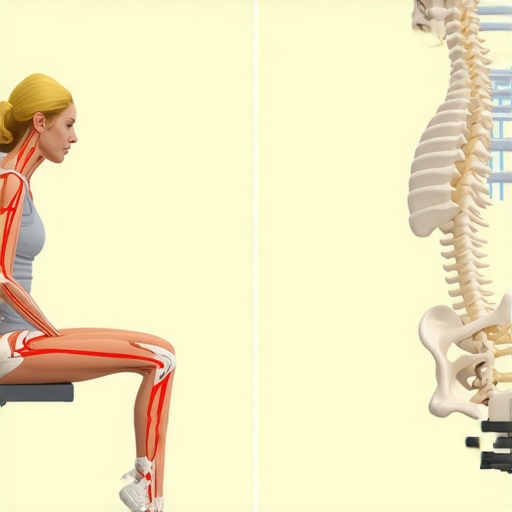
The hamstring stretch trap you need to avoid
A common ‘oops’ I see is people trying to fix their lower back or neck pain by aggressively foam rolling their lumbar spine or pulling on their legs. If you have done this, please stop immediately. The truth about foam rolling your lower back is that those vertebrae need stability, not more mobility forced into them from a hard foam cylinder. Similarly, many find that why stretching your hamstrings might actually make your back pain worse is because they are tugging on the sciatic nerve rather than the muscle itself. You should be looking at the link between mobility and posture from a more nuanced perspective—focusing on the hips and the thoracic spine (the middle of your back) to take the pressure off your neck and low back.
Why does my neck still crunch when I turn to look behind me?
You have done the stretches, you have adjusted your monitor, and yet you still hear that ‘gravel’ sound when you look for a blind spot. This usually happens because your joints are not gliding properly due to years of adaptation. Even if you feel like you are sitting better now, the micro-movements of your vertebrae might still be restricted. Research published in the Journal of Physical Therapy Science suggests that postural variability—frequently changing your sitting position—is far more effective for long-term pain management than maintaining any single ‘correct’ position. This restriction is often why your neck crunches when you turn to look behind you; it is a sign that your deep stabilizer muscles are not coordinating with your larger movement muscles. Have you ever fallen into this trap of trying to ‘stretch away’ a pain only to have it come back worse the next day? Let me know in the comments if you have struggled with that frustration. To get past the plateau, you might need to see what a chiropractor actually looks for during your first exam, as they focus on these functional glides rather than just temporary relief.Once you realize that your body isn’t broken but just adapted to a poor environment, you can stop fighting yourself. I spent years buying every ‘ergonomic’ gadget featured on my social media feed, but most of them just gathered dust. The gear that actually stayed on my desk isn’t fancy; it is functional. For me, the game-changer was finally understanding [the proper way to use a lumbar roll in your office chair]. It’s not about the cushion; it is about maintaining that natural inward curve of your low back so your neck doesn’t have to compensate. I also realized that [the best monitor height for preventing tension headaches] was much higher than I thought. If you are looking at the middle of your screen, you are already losing the battle. Your eyes should be level with the top third of the monitor. This small tweak alone cut my ‘afternoon fog’ by half because my suboccipital muscles weren’t screaming in protest by 3 PM. If you are struggling with the shift to a more active workspace, check out [the best way to transition from a sitting to a standing desk] to avoid the common leg fatigue that makes most people quit after a week.
Why your spine needs hygiene as much as your teeth
We think of posture as a moral failing or a lack of willpower, but it is actually a matter of ‘Spine Hygiene.’ This term, popularized by world-renowned spinal biomechanics expert Dr. Stuart McGill from the University of Waterloo, suggests that we have a finite capacity for spinal load each day. In his book ‘Back Mechanic,’ McGill explains that it’s the repetitive micro-movements—the constant small hunches—that delaminate the spinal discs over time. To counter this, I started treating my mobility like brushing my teeth. It isn’t a workout; it’s a reset. Integrating [mobility boosts for posture and expert tips for daily adjustments] into my morning routine meant I stopped starting my day with a ‘deficit.’ I also found that [why chiropractic care is your secret weapon for better posture] is because a professional can reset those joints that have become ‘stuck’ in a forward-leaning position, making it physically easier for your muscles to hold you upright. 
How do I maintain these mobility wins without it becoming a second job?
The secret to long-term results isn’t a grueling hour-long stretching session; it’s the 30-second ‘micro-break.’ I set a timer on my computer to go off every 45 minutes. When it dings, I don’t just stand up; I perform one ‘Wall Squeeze’ and a deep diaphragmatic breath. This serves as a neurological reset. Within [the ultimate guide to improving mobility and posture in 2025], I’ve found that consistency beats intensity every single time. I predict that in the next few years, we will see AI-powered wearables embedded in our clothing that give us a gentle haptic pulse the moment our shoulders roll forward, turning ‘Spine Hygiene’ into an automated habit. For now, we have to be our own sensors. My challenge for you today is simple: go to your desk right now and raise your monitor by two inches using a stack of books. Notice how your chin naturally tucks and your chest opens up. That one-minute adjustment is the first step toward a pain-free digital life.
Lessons Learned from the Human Question Mark Phase
The biggest shift in my journey wasn’t a piece of furniture; it was realizing that my body wasn’t ‘broken,’ just adapted. I spent months thinking my stiffness was permanent. I learned that why chiropractic care is your secret weapon for better posture is that it addresses the structural ‘stuckness’ that no amount of stretching can fix. Another revelation was that movement variety is better than ‘perfect’ stillness. I used to sit like a statue, but now I fidget on purpose to keep blood flowing. Lastly, the mental load of pain is real. When your neck is free, your focus returns. You don’t realize how much brainpower is wasted managing a headache until it’s gone.
[IMAGE_PLACEHOLDER]
My Personal Survival Kit for Digital Health
If you want to fast-track your recovery, these are the three things I genuinely use every single day. First, a simple stack of books or a laptop stand. Finding the simple change to your monitor height that kills headaches was the most cost-effective health hack I ever found. Second, I recommend everyone read ‘Back Mechanic’ by Dr. Stuart McGill; it’s the bible of spine hygiene. Finally, I never go a day without the 30-second wall squeeze to fix forward shoulder roll. It is my go-to move the moment I feel that ‘creeping’ tension between my shoulder blades.
Your Path to a Pain-Free Screen Life
Reclaiming your posture isn’t about perfection; it’s about making your environment work for you instead of against you. You don’t have to give up your digital life to feel like a functional human again. By integrating these small mobility resets and understanding that chiropractic adjustments unlock a pain-free lifestyle today, you are investing in your future self. Have you ever noticed your posture getting worse when you are stressed or tired? Let me know in the comments below.