

I remember standing in my kitchen three years ago, squinting through a haze of pain just to read the label on a soup can. My temples were throbbing, a tight band of pressure squeezing my brain like a heavy-duty vice. I had a deadline looming and a family dinner to prep for, but all I could think about was finding a dark room to crawl into. That is when it hit me. I had already taken the maximum dose of ibuprofen, yet the pain was not budging. I was stuck in a loop of popping pills that only masked the problem for an hour before that dull, heavy thud returned. I realized then that my medicine cabinet was just a band-aid, not a solution, and I was actually making things worse by ignoring the root cause.
Stop Chasing the Symptoms and Start Finding the Source
Today, I am going to share exactly how I moved away from that chemical crutch. We are going to look at how tiny shifts in your daily habits—things like choosing the best monitor height for preventing tension headaches—can actually stop the pain before it even starts. We will talk about mobility, the way you carry your stress in your jaw, and how to reclaim your life from that foggy, heavy-headed feeling. Have you ever felt like you were doing everything right, but your head still felt like it was stuck in a trash compactor? If so, you are not alone, and I promise there is a way out that does not involve a pharmacy run every Tuesday.
Can natural fixes really beat a pharmaceutical-grade pill?
I will be honest with you: early on, I made a massive mistake. I assumed that because the pain felt chemical, it absolutely needed a chemical fix. I ignored the fact that I was spending ten hours a day hunched over a laptop, which according to a study in The Journal of Headache and Pain, is a massive factor since tension-type headaches are the most common headache type worldwide. I failed to see that my body was screaming for movement, not a suppressant. I had to learn to stop clenching my teeth to relieve my neck stress before I could even hope for a day of clarity. It turns out, your secret weapon for better posture is often the missing link in stopping these flare-ups. We are going to dive into how your environment, like how your vision is forcing your neck into a forward lean, is secretly sabotaging your comfort levels.
The Real Reason Your Head Feels Like It Is in a Vice
Most of us treat tension headaches like an unpredictable storm, but they are usually more like a slow-burning fire fueled by our daily choices. When I finally stopped reaching for the bottle and started looking at my desk setup and my stress patterns, everything changed. It was not an overnight miracle, but the relief was deeper and lasted much longer than any pill ever provided. Now, let’s get into the nitty-gritty of how you can start making these adjustments today to get your life back.
Think of your head as a ten-pound bowling ball balanced on top of a thin stick. If that ball sits perfectly centered, it is easy to hold. But the second you tilt that ball forward, even by a fraction of an inch, the muscles in your neck and upper back have to work three times harder just to keep your head from falling onto your chest. This is exactly what happens when you spend your day squinting at a screen that is too low. I learned this the hard way when I tried to ‘tough out’ a week of deadlines by hunching over my laptop on a coffee table. By Wednesday, my vision was blurry and my neck felt like it was made of concrete. I eventually had to prop my laptop up on a stack of heavy cookbooks just to get through the day, and while it looked ridiculous, the pressure in my temples vanished within hours.
Align Your Tech to Match Your Spine
The first thing you need to do is evaluate your workspace with a critical eye. You cannot expect your body to heal if you are constantly forcing it into a shape it was not designed for. This starts with the simple change to your monitor height that kills headaches. Your eyes should naturally hit the top third of your screen when you are sitting tall. If you are looking down, you are inviting a tension headache to take up permanent residence in your skull. At the same time, pay attention to your arms. Most people reach too far forward, which rolls the shoulders and tightens the chest. Learning the best way to position your keyboard for shoulder relief ensures that your upper traps aren’t doing heavy lifting they weren’t meant for.

Break the Habit of the Instinctive Neck Roll
When the pain starts to creep in, our first instinct is usually to grab our head and start rolling it in wide circles to ‘crack’ the tension out. I used to do this every twenty minutes, thinking the loud pops were a sign of progress. In reality, I was just irritating the delicate joints in my cervical spine and making the inflammation worse. You need to stop rolling your neck in circles and do this instead: focus on gentle retraction and mobility. Real relief comes from controlled movement, not aggressive grinding. This is where why chiropractic care is your secret weapon for better posture becomes clear; it helps reset those joints so your mobility actually works for you rather than against you.
Your Breathing Pattern Might Be the Real Culprit
It sounds strange, but how you breathe during a stressful meeting can dictate how much your head hurts by 5:00 PM. When we are stressed, we tend to ‘chest breathe,’ using the small muscles in our neck to pull our ribs up. These muscles, called the scalenes, are not meant to be primary breathing muscles. Over time, they become rock hard and pull on your upper vertebrae. Discovering how your breathing habits are creating tightness in your scalenes was a massive turning point for me. By shifting the work back to my diaphragm, I stopped the constant tug-of-war happening at the base of my skull. Combined with revolutionize your posture with targeted mobility exercises, you can effectively disarm the physical triggers of tension headaches before they even reach the ‘vice-grip’ stage.
Your ‘Perfect’ Sitting Position is a Movement Trap
I see it all the time: people sitting like they are auditioning for a military parade, back straight as a board, shoulders pinned back. They think this is ‘perfect’ posture. In my experience, this rigid adherence to a static position is actually a recipe for chronic inflammation. Your body was built for movement, not for being a statue. When you hold a single position for hours, you are creating what experts call static loading. A study published in the Journal of Physical Therapy Science highlights that postural variability—the ability to shift and change positions—is far more important for spinal health than maintaining one ‘ideal’ shape. This is why understanding the link between mobility and posture a chiropractors guide is so vital; it’s about fluid motion, not freezing your spine in place.
Don’t Stretch a Muscle That is Already Screaming for Stability
Here is the ‘oops’ factor that traps most people: they feel tension in their upper back or neck and immediately reach for a deep stretch. But what if that muscle isn’t tight because it’s short? What if it’s tight because it’s already overstretched and weak? This is called ‘eccentric loading,’ where your brain keeps the muscle in a state of high tension to prevent it from snapping like an over-pulled rubber band. If you keep stretching a muscle that is already elongated, you are just destabilizing the joint further. This is a common mistake I see with lower body issues too, which is exactly why stretching your hamstrings might actually make your back pain worse. When you stop obsessively stretching and start building stability, the ‘tight’ feeling often vanishes because the brain finally feels safe enough to let the muscle relax.
Why Does Your Neck Still Hurt Despite All the Professional Adjustments?
If you are getting adjusted but the relief only lasts for forty-eight hours, you are missing the second half of the equation. An adjustment is like hitting the reset button on a computer, but if you go right back to running the same corrupted software—your daily habits—the system will crash again. Advanced recovery requires you to enhance your posture with expert chiropractic techniques in 2025 that focus on neuromuscular re-education. This means teaching your muscles how to support the new alignment. During a session, you should be asking what a chiropractor actually looks for during your first exam to ensure they are looking at your global movement patterns, not just one stuck vertebra. Have you ever fallen into this trap of trying to hold a ‘perfect’ posture until you were stiff as a board? Let me know in the comments.
I used to think I needed a thousand-dollar massage chair to fix my upper back, but the real breakthrough came from a two-dollar lacrosse ball. I place it right between my shoulder blade and spine, leaning against a wall to find those ‘hot spots’ that feel like iron knots. By applying pressure here, I am tackling the trigger points that fuel tension headaches. It is one of those simple mobility hacks simple adjustments for a more active life that you can do while waiting for the microwave. I also swear by the 30 second wall squeeze to fix forward shoulder roll. It is about teaching the muscles of the mid-back to actually fire again after being dormant for eight hours of typing.
How do I maintain my mobility results for the long haul?
Maintenance is not about a grueling hour-long yoga session every morning; it is about ‘movement snacks.’ I have integrated mobility boosts for posture expert tips for daily adjustments into my actual workflow. Every time I finish a phone call, I do three scapular retractions. Dr. Stuart McGill, a world-renowned expert on spine mechanics and author of Back Mechanic, emphasizes that building ‘stiffness’ in the core while maintaining mobility in the hips and shoulders is the key to a pain-free life. This balance is what keeps you out of the ‘vice-grip’ cycle. If you only focus on being flexible without being strong, your joints will eventually rebel.
Swap Your Rigid Seat for a Dynamic Base
Most of us are fighting a losing battle with our furniture. The simple change to your desk chair that ends back pain might be as easy as adding a small lumbar roll or swapping your chair for a stool that encourages active sitting. Most chairs, even ‘ergonomic’ ones, fail to support the natural curve of the lower back, causing the rest of the spine to collapse forward into a ‘C’ shape. I personally use a simple rolled-up towel at the small of my back, which forces my chest to stay open without any conscious effort. 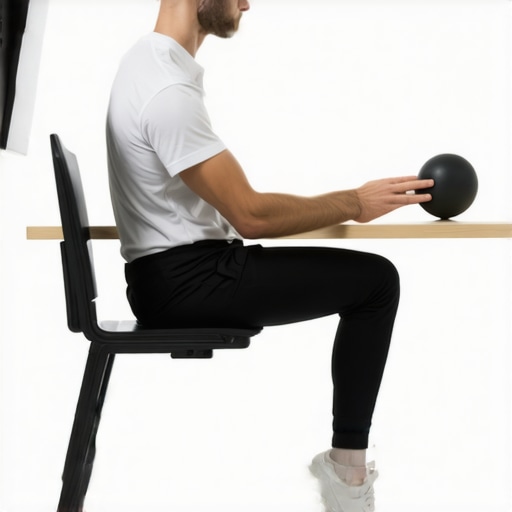
AI and the Next Frontier of Movement
I predict we are moving toward a world of ‘biofeedback wearables’ that go far beyond step counts. Imagine a shirt with embedded sensors that vibrates gently when your shoulders start to creep toward your ears, or an AI sensor on your desk that tracks your head tilt in real-time. We are going to stop guessing about our posture and start getting data-driven corrections. For now, you can mimic this by setting a ‘posture alarm’ on your phone every 50 minutes. When it goes off, check your jaw, your shoulders, and your breath. Try the ‘Wall Squeeze’ mentioned above right now—stand up, pin your shoulder blades back, and hold it for 30 seconds. Feel that burn in the mid-back? That is the feeling of your body finally waking up and taking the load off your neck.
Hard Truths I Discovered While Healing My Spine
Looking back at my journey, I realize that the biggest hurdle wasn’t the physical pain itself, but the way I thought about it. I had to unlearn the idea that a single ‘crack’ or a single pill would fix a decade of poor habits. First, I learned that consistency will always beat intensity. Doing a 30-second wall squeeze every hour is infinitely more effective than a grueling two-hour gym session once a week. Second, I realized that my body’s pain was actually a signal for help, not a nuisance to be suppressed. When I started treating my tension as data, I could finally address the root causes like how my vision was straining my neck. Finally, I found that how chiropractic adjustments enhance posture and mobility works by resetting the system so that my new habits actually had a chance to stick.
The Toolkit That Keeps Me Out of the Pharmacy
I don’t believe in expensive gadgets that gather dust under the bed. Instead, I rely on a few high-value resources that I’ve vetted through trial and error. I highly recommend Back Mechanic by Dr. Stuart McGill; it completely changed how I perceive spinal integrity and taught me that stability is often more important than flexibility. For daily maintenance, I use a pair of lacrosse balls to work out trigger points—it’s the most cost-effective way to manage mobility hacks simple adjustments for a more active life. I also suggest checking out the ultimate guide to improving mobility and posture in 2025 for a deep dive into modern ergonomics. These tools aren’t just things I use; they are the foundation of my pain-free existence.
Your Path Back to a Clear Head and a Limber Life
You don’t have to live in a state of constant, low-grade suffering. The transition from a heavy-headed fog to total clarity starts with one small choice: to move better today than you did yesterday. Whether you choose to chiropractic adjustments unlock a pain-free lifestyle today through professional care or simply commit to better breathing, you are taking control of your health. Remember, your body is incredibly resilient when you stop working against it. Focus on improving your posture, staying consistent with your mobility, and seeking expert advice when you hit a plateau. You’ve got this.
Have you ever noticed that your headaches get worse after a long day of staring at your phone or laptop? Let me know your experience in the comments below.