
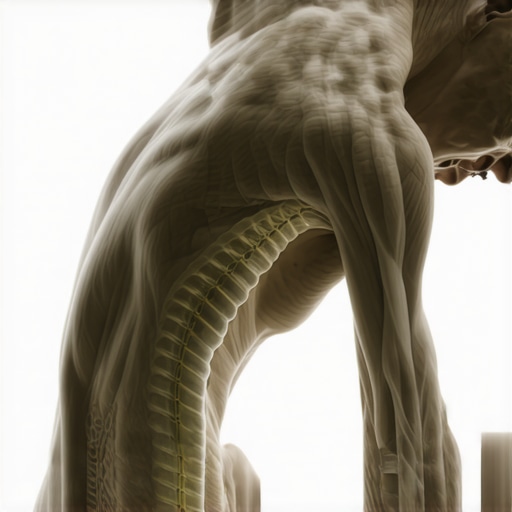
I remember sitting hunched over my laptop when the pressure in my mid-back became unbearable. I grabbed the sides of my office chair, twisted my torso like a wet rag, and pop-pop-pop—instant bliss. Or so I thought. By the time I finished typing my next email, that nagging knot was back, and it felt even deeper. I was stuck in a cycle of self-adjusting every twenty minutes just to survive the workday. It’s a habit many of us fall into, thinking we’re doing our bodies a favor, but I learned the hard way that I was actually making my spine more unstable. The feeling of that sudden release is addictive, but it’s a hollow victory.
Stop Chasing the Pop and Start Solving the Source
We often mistake the sound of gas bubbles escaping a joint—a process called cavitation—for actual structural relief. You probably think you’re realigning your vertebrae or putting something back into place, but more often than not, you’re just irritating the ligaments and overstretching the joints that are already moving too much. When you force a crack, you’re usually hitting the segments above or below the one that is actually stuck. Today, I want to show you the difference between a temporary fix and actual long-term spinal health. We will look at why that tension keeps coming back and how you can break the habit without losing your mind. It took me months of trial and error to realize that my DIY adjustments were actually the reason I felt so fragile.
Is This Habit Actually Going to Damage My Spine?
It’s the question that kept me up at night after my neck started clicking every time I looked over my shoulder. According to research from Harvard Health Publishing, while the sound itself is usually just nitrogen bubbles, habitual self-cracking can lead to joint instability or even stretched-out ligaments over time. My biggest mistake early on was ignoring the fact that my upper back was stiff as a board, so I kept forcing the same two mobile segments to pop over and over. I was essentially beating up the only parts of my back that were actually moving! If you’ve ever felt like your back is a puzzle you can’t quite solve, have you ever faced this specific problem where the relief lasts only minutes? If you have, you’re not alone, and it’s a sign your body is crying out for real stabilization.
The Real Reason Your Back Feels Like It Needs to Snap
The truth is that your brain is sending a signal of tightness because it’s trying to protect an area that lacks support. It is a protective tension. Instead of forcing a release through a violent twist, we should be looking at the reality of posture and mobility. When I finally stopped the self-adjusting and started focusing on targeted mobility work, the urge to crack simply vanished. We aren’t just looking for a loud noise; we’re looking for a body that moves fluidly without needing a manual reset every afternoon. By addressing the actual stuck segments through proper care, we stop the cycle of hyper-mobility in the healthy joints. I will walk you through how to identify those stuck points next.
Find the Real Culprit in Your Spine
To stop the urge to crack, you first have to realize that your back is like a rusted door hinge. When you twist and pop, you aren’t greasing the hinge; you’re just pulling the screws out of the wood. Most of the time, the area that feels like it *needs* to pop is actually hyper-mobile—meaning it is already moving too much. The real problem is usually a segment nearby that is completely frozen and silent. I discovered this the hard way during a high-stakes client presentation where I tried to ‘reset’ my neck with a quick twist and ended up with a sharp spasm that left me looking like a statue for an hour. If you want to break this loop, you have to test your own spinal rotation at home to see where the movement actually stops. Once you identify that ‘dead zone,’ you can stop beating up the healthy joints and focus on the ones that are actually stuck.
Stop the Habitual Snap with This Simple Test
Sit in a firm chair, cross your arms over your chest, and rotate as far as you can to each side without moving your hips. Do you feel a ‘wall’ on one side? That wall is where the work needs to happen. Instead of forcing a crack through that barrier, use the 2-minute drill for better spinal rotation to gently coax that joint into moving. #IMAGE_PLACE_HOLDER_B#
Turn Your Stiff Mid-Back into a Fluid Hinge
Once you know where the stiffness lives, the goal is to introduce movement without the ‘snap.’ Think of it like loosening a tight bolt; you don’t just hammer it—you apply steady, rhythmic pressure. This is where targeted mobility work beats a DIY adjustment every single time. When I stopped the violent twisting and started doing slow, controlled thoracic extensions over a rolled-up towel, the constant ‘itch’ to crack my back simply evaporated. It’s about teaching the joint how to move properly rather than just forcing gas bubbles to move.
Execute the Reach and Breathe Technique
Instead of twisting, try ‘breathing’ the tension away. Most people make the mistake of holding their breath when they feel stiff, but you need to breathe into your back to relieve rib tension. Inhale deeply into the area between your shoulder blades while gently reaching forward. This expands the rib cage from the inside out, providing a far more effective internal release than a physical pop ever could. If you’ve been relying on the floor to crack your back, you might be surprised to learn that most people do the cat-cow stretch wrong by focusing on the lower back rather than the middle, which only perpetuates the instability.
Build the Support Your Brain is Begging For
The urge to crack is often just a ‘stability alarm’ going off in your nervous system. Your brain thinks your spine is vulnerable, so it tenses the muscles to act as a splint. When you pop the joint, you get a temporary hit of endorphins, but the alarm remains on because the weakness is still there. To silence it, you need to prove to your brain that you are stable. Focus on building a spine that doesn’t ache through isometric holds. I remember the first week I replaced my hourly ‘back snap’ with 30 seconds of a dead bug variation; the results were messy at first and I was shaking like a leaf, but within days, that deep, gnawing knot in my shoulder blade disappeared. Your body doesn’t need more noise; it needs more control.
The common mistake I see is people trying to ‘stretch’ out this protective tension. We’ve been told since grade school that if a muscle feels tight, you should pull on it until it lets go. But here is the contrarian truth: most of the time, your muscles aren’t actually ‘short’—they are just ‘on.’ When your brain senses instability in your spine, it dials up the neurological tone of your muscles to act as a brace. If you try to force a stretch into that protective guard, you’re essentially trying to pick a lock that the brain is actively holding shut. This is exactly why your gentle stretching is actually causing more inflammation rather than relief. I spent years lengthening my hamstrings only to find them tighter the next morning because I wasn’t addressing the underlying pelvic instability.
Stop Treating Your Muscles Like Rubber Bands
When you understand that mobility is a neurological ‘green light’ from your brain, everything changes. Advanced movers know that you don’t find range of motion by pulling; you find it by relaxing the nervous system. If you’ve been aggressively pulling on your traps, you might be why stretching your neck is making your headaches worse. The ‘Oops’ factor here is a big one: if you stretch a muscle that is tight because it’s protecting an irritated nerve, you will actually increase the nerve’s sensitivity. It’s like pulling on a live wire. Instead of mindless stretching, you should be looking at the ultimate guide to improving mobility and posture in 2025 to learn how to integrate movement properly.
#IMAGE_PLACE_HOLDER_C#
Why Does My Mobility Disappear After Only One Hour of Sitting?
This is the question I get from people who are already doing the work but aren’t seeing it stick. The reason is ‘creep’—not the weird kind, but the physical phenomenon where your ligaments and fascia slowly deform under constant, low-level pressure. When you sit, your brain stops receiving the ‘stability signals’ it gets from standing and moving, so it reverts to its default setting: tightness. Research published in the Journal of Manipulative and Physiological Therapeutics highlights that spinal manipulation can immediately influence the nervous system’s ‘tone,’ which is something a simple hamstring stretch can never achieve. This is why chiropractic care is your secret weapon for better posture; it provides the specific high-velocity, low-amplitude input that resets the ‘stability alarm’ in a way that generalized exercise cannot.
How Real Adjustments Reset Your Internal Alarm
The nuance that most people miss is that a professional adjustment isn’t just about moving bone; it’s about input into the mechanoreceptors—the tiny sensors in your joints that tell your brain where you are in space. When a chiropractor targets a specific frozen segment, they are essentially ‘rebooting’ the software of your spine. This is how chiropractic adjustments enhance posture and mobility at a level deeper than any foam roller can reach. By clearing the interference at the stuck joint, the surrounding muscles finally get the signal that they can stand down. Have you ever fallen into this trap of stretching for hours only to feel tighter the next day? Let me know in the comments. It’s time to stop fighting your body’s protective mechanisms and start working with them.
I used to think that a standard foam roller was the holy grail, but I quickly realized it’s too blunt of an instrument for the delicate joints of the upper back. Now, I exclusively use a ‘peanut’—essentially two lacrosse balls taped together—because it allows the spinous processes to sit in the gap while the balls apply pressure exactly where the ribs meet the spine. This kind of precision is why I recommend specific mobility boosts for posture rather than generic gym stretches. If you aren’t hitting the right spot, you’re just wasting time. I also swear by the humble lumbar roll. Learning how to use a lumbar roll correctly in an office chair was the turning point for my mid-day fatigue. It’s not about cushion; it’s about maintaining that natural curve so your muscles don’t have to work overtime just to keep you upright. #IMAGE_PLACE_HOLDER_D#
How do I maintain my spinal mobility over the long haul?
Maintenance isn’t about doing a 60-minute yoga flow every morning; it’s about micro-dosing movement. My personal rule is the ’10-minute rule.’ If I can’t give my spine ten minutes of the best exercises for building a spine that doesn’t ache, I’m not prioritizing my health. As Dr. Stuart McGill, a leading expert in spine biomechanics, emphasizes in his research, building ‘spine hygiene’ through stiffening the core is far more valuable than searching for more flexibility. This is where I see the biggest long-term wins. When you stop chasing the ‘pop’ and start chasing stability, your body rewards you with a silence that is far more satisfying than any cavitation sound. It’s about creating a lifestyle where you no longer feel the need to ‘reset’ because you never let the ‘creep’ set in.
Wearable Tech is Coming for Your Slouch
Looking ahead, the next frontier isn’t just better chairs or more professional adjustments. I predict a rise in AI-driven posture coaching that uses your webcam or smart glasses to analyze your alignment in real-time, providing the kind of ultimate guide to improving mobility and posture in 2025 that lives right on your desktop. We are moving away from passive treatments and toward active, tech-assisted awareness. The goal is a body that self-corrects before the pain signal even reaches your brain. If you’re still reaching for your own neck to crack it today, I challenge you to ditch the twist and try a 30-second wall slide instead. It’s harder and it’s quieter, but the relief actually stays with you through the next three meetings.
The Hard Truth About My Morning ‘Snap, Crackle, and Pop’ Routine
Looking back, I realized that my addiction to the ‘pop’ was actually a distraction from my body’s real needs. One of the biggest shifts in my perspective was learning that noise does not equal progress. When I finally prioritized expert chiropractic techniques over my own uneducated twists, the chronic tension finally started to lift. I also learned that if a joint is moving too much, it is usually because another one nearby is acting like a stubborn rusted bolt. Finally, I understood that posture isn’t about sitting like a statue; it is about movement variability and giving your brain the stability it craves.
The Tiny Toolkit I Use to Keep the Knots Away
I don’t believe in expensive gadgets, but a few specific tools made all the difference in my recovery. First, I stopped using a regular foam roller for my mid-back and switched to a ‘peanut’ (two lacrosse balls taped together). This allows me to target the joints where the ribs meet the spine without putting direct pressure on the bones. I also keep a lumbar roll in my office chair to prevent the ‘slump’ that triggers that evening urge to crack. For daily maintenance, I swear by the 2-minute drill for better spinal rotation to ensure my vertebrae are actually gliding, not just grinding. #IMAGE_PLACE_HOLDER_E#
Your Spine Deserves More Than a Quick Fix
Breaking the habit of self-adjusting is a mental game, but your nervous system will thank you for the silence. You aren’t just a collection of bones that need to be snapped back into place; you are a complex system that thrives on stability and controlled movement. By choosing practical chiropractor strategies over DIY guesses, you are investing in a future where you can sit, stand, and move without the constant distraction of spinal ‘itch.’ Don’t be afraid to trade that loud, temporary pop for the quiet, lasting strength of a well-supported spine. What is the one area of your back that always feels like it needs to pop? Let me know in the comments below!