

It was a rainy Tuesday afternoon when I walked past the dining room and saw my son, Leo, looking like a human question mark. His chin was almost touching the table, and his shoulders were hiked up to his ears while he struggled with a math worksheet. It was a visceral gut punch. Here I am, someone who obsesses over the link between mobility and posture, and I was letting my own kid’s spine be molded by a kitchen chair that was four sizes too big for him. I realized then that while we obsess over whether they eat their greens, we completely ignore the eight hours a day they spend anchored to a workstation that doesn’t fit. Have you ever caught your child looking more like a gargoyle than a student and wondered if it was just ‘laziness’? Spoiler: It’s usually the furniture. Today, I’m going to show you exactly how to eye-ball the perfect desk height and why a few inches of adjustment can prevent a lifetime of chronic aches.
Your Dining Room Table is Quietly Hurting Your Kids
When Leo started complaining about ‘growing pains’ in his neck, I made a classic mistake. I figured he’d just grow into the desk, or maybe he just needed to ‘sit up straight.’ I was wrong. Putting a child at a standard-height adult desk is like asking them to drive a bus; they have to strain every muscle just to reach the controls. If the desk is too high, their traps stay permanently engaged to lift their arms, which is a fast track to the same tension we see when shoulders burn after a long zoom call. If it’s too low, they collapse into themselves. This isn’t just about temporary discomfort. Research from the International Journal of Environmental Research and Public Health indicates that prolonged poor sitting posture in school-aged children is significantly correlated with the early development of musculoskeletal disorders that persist into adulthood. We are literally training their spines to be crooked before they even hit puberty. I felt terrible realizing my ‘convenient’ setup was the culprit, but the fix is easier than you think. It starts with understanding that we can’t just apply adult rules to growing bones.
Is an expensive ‘ergonomic’ desk actually worth the money?
You might be skeptical, thinking this is just another way for furniture companies to prey on parental guilt. I felt the same way until I saw the difference a proper setup made. You don’t necessarily need a $500 motorized desk, but you do need to understand why most standing desks are set at the wrong height and how that applies to your child’s seated position. We often worry about external factors like how to tell if your child’s backpack is too heavy, yet the silent stress of a bad desk setup does more long-term damage because of the sheer volume of time spent there. It’s also why your teenager always slouches on the sofa; their bodies are searching for the comfort they can’t find at their poorly-fitted desk. In the next few minutes, I’ll walk you through the ’90-90-90′ rule and some ‘Helpful Neighbor’ hacks to fix what you already have without breaking the bank. We’re going to apply the secret to fixing tech neck directly to your child’s study space so they can focus on their grades instead of their back pain.To get Leo’s setup right, I had to stop looking at the desk and start looking at his joints. Think of your child’s body like a series of hinges; if one hinge is pulled too tight or left hanging, the whole structure starts to warp. This is where we apply the 90-90-90 rule. Ideally, your child’s ankles, knees, and hips should all be at 90-degree angles. When Leo sat at our dining table, his feet were dangling like wind chimes, which pulled his pelvis forward and forced his lower back into a deep, painful arch. This is why sitting cross-legged is wrecking your hips and theirs—the body is desperately trying to find stability where there is none.
Master the 90-90-90 Rule Without Buying New Furniture
To fix this, I grabbed a stack of old National Geographic magazines and taped them together to make a makeshift footrest. The moment Leo’s feet hit a solid surface, his shoulders dropped two inches. If their feet don’t touch the floor, their core muscles never turn off, leading to the same kind of fatigue you feel when your posture collapses when you get tired at the gym. By supporting the feet, you allow the larger muscles to relax. 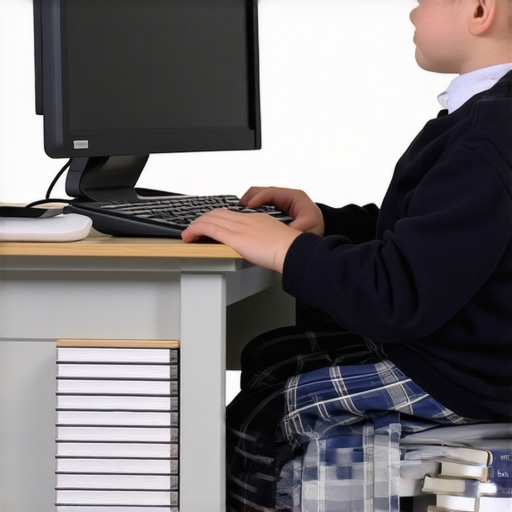
Stop the Dangling Feet and Support the Lumbar
Next, look at the depth of the chair. Most adult chairs are too deep for kids, meaning their backs don’t touch the rest unless they slump. I used a firm decorative pillow—not a soft, mushy one—to bridge the gap between Leo’s mid-back and the chair. This acts as a manual version of the proper way to use a lumbar roll. It keeps the spine in a neutral ‘S’ curve rather than a ‘C’ shape. When the lower back is supported, the neck doesn’t have to work as hard to keep the head upright, which is a major factor in why your head feels heavy after staring at a monitor.
Get That Screen Up to Eye Level
The biggest culprit for ‘tech neck’ is the laptop. Laptops are ergonomic disasters because the keyboard and screen are joined. If the keyboard is at the right height for the arms, the screen is too low for the eyes. I put Leo’s laptop on a box of printer paper and plugged in a $15 external keyboard. Now, his eyes are level with the top third of the screen. This simple height adjustment prevents the forward head lean that leads to long-term nerve damage. From a chiropractor’s perspective, this is the single most important change you can make to reduce tension in the upper traps.
Use Mobility Breaks to Reset the Clock
Even a perfect desk setup can’t save a child who sits still for four hours. I set a timer for Leo: every 25 minutes, he has to do ‘The Airplane.’ He stands up, extends his arms, and rotates his torso. This is one of those mobility boosts for posture that keeps the joints lubricated. Kids are naturally mobile, but static sitting acts like glue on their fascia. By implementing small mobility hacks throughout the day, you ensure that the progress you make with their desk setup actually sticks.But here’s the thing that most parents—and even many health ‘gurus’—get completely wrong: there is no such thing as a single, static ‘perfect’ posture. If you’ve been telling your child to ‘sit up straight’ like they have a rod through their spine, you might actually be doing more harm than good. In my years of practice, I’ve seen that the most rigid sitters are often the ones in the most pain. This is because static posture is a myth. Your body was designed to move, and when we force a child to maintain a military-straight back, we create isometric tension that leads to the exact same fatigue we’re trying to avoid. In fact, why your perfect posture is actually causing muscle fatigue is a topic I find myself explaining to almost every patient. When you hold a position too long, your blood flow restricts, and those stabilizer muscles start to scream. The ‘best’ posture is actually your next posture.
The Posture Brace Trap Most Parents Fall Into
If you’ve ever been tempted to buy one of those ‘posture correction’ harnesses you see on social media, please, put the credit card down. I call this the ‘Oops Factor’ of modern ergonomics. These braces are the ultimate shortcut that leads to a dead end. They do the work for the muscles, which sounds great in theory, but in practice, it causes the core and paraspinal muscles to atrophy. This is why most posture braces actually make your back weaker over time. You’re effectively putting your child’s spine in a cast; when you take the cast off, the underlying structure is even more fragile than before. Instead of external support, we need to focus on internal stability. Research published in the Journal of Physical Therapy Science highlights that active postural control—where the muscles are engaged but not rigid—is far superior for reducing musculoskeletal pain than any passive device. We want to build a body that can support itself, not one that relies on a velcro strap. 
Why does your child still slump even after you bought that expensive chair?
It’s incredibly frustrating when you spend hundreds on a high-end ergonomic chair only to find your teenager still curled up like a shrimp. The hidden nuance here is proprioception—the body’s ability to sense its position in space. If a child has poor mobility and posture, their brain literally thinks the slump is ‘normal.’ Their internal level is off. This is why improving posture through mobility is so much more effective than just buying new furniture. We have to recalibrate the nervous system. Sometimes, chiropractic adjustments unlock a pain-free lifestyle by resetting those joint receptors, making it easier for the child to find that neutral ‘S’ curve without thinking about it. Have you ever fallen into the trap of thinking a piece of equipment would solve a movement problem? Let me know in the comments. We need to stop looking for external fixes for what is fundamentally an internal, movement-based challenge. By focusing on mobility boosts for posture, you give their body the tools to find comfort naturally, rather than forcing it into a shape it isn’t ready to hold.Once you’ve fixed the physical furniture, the real challenge begins: preventing the ‘slow slide’ back into old habits. I use a simple tool in my office that I recommend to every patient who struggles with mid-back stiffness: the ‘Peanut.’ It’s literally just two lacrosse balls taped together. I use it because it creates targeted pressure on the joints of the thoracic spine while leaving space for the bony spinous processes to sit in the gap. This isn’t just about ‘feeling good’; it’s about mechanical leverage. According to the ANSI/HFES 100-2007 Human Factors Engineering of Computer Workstations standard, maintaining a neutral spine requires consistent support that adapts to the user’s movements, and the peanut acts as a manual reset button for those ‘stuck’ segments.
The DIY tool that saves my thoracic spine daily
I personally spend about three minutes every evening rolling my mid-back on this tool. It’s one of those mobility boosts for posture that takes almost zero effort but yields massive dividends. If you don’t address the stiffness in the mid-back, your neck will always overcompensate, leading to that heavy-head feeling we talked about earlier. This is the core of improving posture through mobility—you have to give the joints the room they need to move before you can expect them to sit correctly. 
How can you keep these changes from disappearing overnight?
Maintenance is where most people fail because they treat posture like a destination rather than a habit. I’m a big fan of using ‘pacing software’ like Stretchly or even just a simple recurring phone alarm. These digital nudges remind you to perform mobility hacks before your muscles lock up. Over time, these micro-adjustments become second nature. You’re essentially training your brain to recognize the ‘drift’ before it becomes a full-blown slump. In my clinical experience, why chiropractic care is your secret weapon for better posture is largely due to how it ‘clears the line’ for these signals to reach the brain. When the joints move freely, the brain gets better data, and maintenance becomes effortless.
Why AI might be your next posture coach
Looking ahead to the ultimate guide to improving mobility and posture in 2025, I predict we’re going to see a massive shift toward AI-integrated webcams. We’re already seeing software that uses your computer’s camera to map your shoulder height and head tilt in real-time, giving you a gentle blur on your screen if you slouch too far. It’s the ultimate evolution of the link between mobility and posture—real-time biofeedback that removes the guesswork. Until that’s standard, I want you to try this: tomorrow, set a timer for every 45 minutes and commit to just 30 seconds of the ‘Peanut’ drill or a doorway stretch. You’ll be amazed at how much better you feel by 5:00 PM. Don’t wait for the pain to return; manage the movement today.
The Hardest Lesson I Learned While Watching Leo Grow
The most profound realization I had during this journey wasn’t about the furniture itself; it was about the psychological weight we put on our kids to ‘fix’ themselves. I spent years thinking Leo was just being lazy, but I finally understood that his body was simply responding to the environment I provided. Posture is a survival mechanism, not a choice. If the environment is hostile, the spine will adapt to survive it. Another lightbulb moment was realizing that improving posture through mobility is far more effective than barked commands to ‘sit up straight.’ When we clear the path for movement, the body finds its way back to center naturally. Lastly, I learned that small, incremental changes—like adding a footrest or raising a monitor—have a compounding effect. You don’t need a total home office renovation to see a massive reduction in your child’s neck tension.
The Handful of Tools I Actually Use Every Day
You don’t need a garage full of gear to make a difference. My essential toolkit is surprisingly low-tech. First, I swear by the ‘Peanut’ (those two lacrosse balls taped together) for breaking up mid-back stiffness before bed. Second, I always recommend a simple laptop stand and an external keyboard; this is the quickest way to end the ‘head-forward’ lean that causes so much trouble. For those looking for a comprehensive roadmap, I highly recommend checking out the ultimate guide to improving mobility and posture in 2025. It bridges the gap between old-school ergonomics and modern tech habits. Finally, I use a basic interval timer to ensure Leo and I are performing mobility hacks every hour. These tools aren’t fancy, but they are effective because they remove the friction from being healthy.
Give Them a Body That Moves Without Effort
At the end of the day, our goal isn’t just to have a kid who looks good in a chair. We want to give them a body that doesn’t hold them back as they chase their dreams. By focusing on the link between mobility and posture now, you are preventing the ‘permanent slump’ that so many of us struggle with in our thirties and forties. It’s about more than just avoiding pain; it’s about ensuring their physical foundation is as strong as their education. Remember, why chiropractic care is your secret weapon for better posture often comes down to the simple fact that a body in motion stays in motion. Start with one small adjustment today—maybe just a stack of books under their feet—and watch how their energy shifts. Have you found a creative DIY way to boost your child’s study space? I’d love to hear your ‘neighborhood hacks’ in the comments below!