
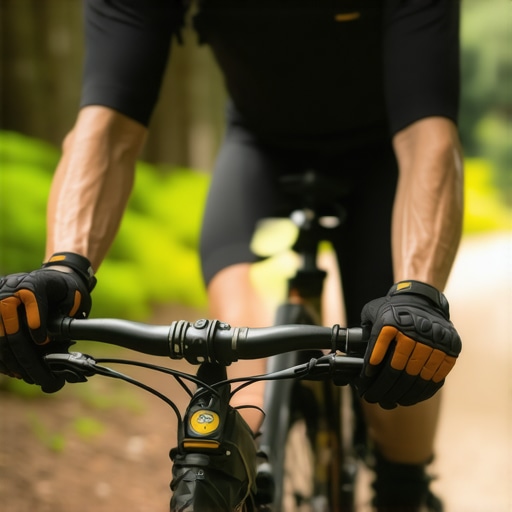
I was three miles into a rocky, technical descent when it happened again. My hands transformed into useless, wooden blocks. I reached for the brakes, but my index finger just wouldn’t respond. It is a terrifying feeling when your body simply stops communicating with your bike mid-trail. For years, I assumed I just needed to ‘tough it out’ or buy thicker gloves. I was wrong. That ‘claw’ hand you get after a long ride isn’t a badge of honor; it is a signal that your setup is fighting your anatomy. Today, we are going to fix that. I will show you how to stop the tingle for good by looking at everything from your brake lever angle to how you carry your head. Have you ever had to pull over mid-descent just to shake some life back into your fingers? It is frustrating, and frankly, it is dangerous. Let’s get into how we can keep your hands feeling fresh from the trailhead to the tailgate.
Stop Gritting Your Teeth Through the Hand Pain
When I first started riding, I made the classic mistake of thinking my grip strength was the problem. I spent weeks trying to strengthen my grip, thinking a tighter hold would give me more control over the chatter. In reality, that extra tension was just strangling my ulnar nerve. The wrist is often just the messenger. Sometimes, the real culprit is hiding further up the chain in your shoulders or even your cervical spine. According to a study in the Journal of Clinical Medicine, prolonged pressure on the palms during cycling can lead to ‘Cyclist’s Palsy,’ a condition caused by ulnar nerve compression that can take weeks to resolve if you ignore the warning signs. I eventually learned that the hidden connection between wrist pain and your neck is often the missing piece of the puzzle. If your neck is jammed up from a poor riding position, the nerves traveling down to your hands are already under stress before you even hit the first rock garden.
Is a Professional Bike Fit Actually Necessary?
You might be wondering if you really need to drop several hundred dollars at a shop just to stop a little tingling. I used to be a skeptic too. I figured I could just ‘eyeball’ my saddle height and bar reach and be fine. But after a season of waking up with numb pinkies, I realized that even a five-degree shift in my brake lever sweep made a world of difference. It is not about buying the most expensive gear; it is about the geometry of your body relative to the machine. We are also going to look at how to fix your neck angle while cycling long distances, because if you are staring at your front tire with a ‘kinked’ neck, you are essentially cutting off the power supply to your arms and hands. Trust me, your wrists will thank you for the adjustment.
Align Your Levers with Your Forearms
Most riders set their brake levers too high, forcing their wrists into an upward ‘cocked’ position. Think of your arm like a garden hose; if you kink it at the wrist, the ‘flow’ of nerve signals to your fingers gets throttled. I remember my first trip to a technical downhill park where I had my levers nearly horizontal. By the third lap, my palms felt like they were being pierced by needles. I stopped, took a 4mm hex key, and rotated the levers down until they formed a perfectly straight line from my elbow through my knuckles while in my active riding stance. The change was immediate. You want your fingers to rest naturally on the blades without having to reach ‘up’ or ‘over’ the bar. Don’t just eyeball it while sitting in the driveway; have a friend hold the bike while you stand in your ‘attack position’ to ensure your wrist remains neutral, not bent like you are trying to push a heavy door open.
Shorten the Reach to Save Your Ulnar Nerve
If you feel like you are stretching to reach your bars, you are putting a massive amount of weight directly onto the heel of your hand. This is where the ulnar nerve lives, and it does not like being a weight-bearing structure. You can often fix this by sliding your saddle forward or swapping to a shorter stem. When you how to adjust your bike seat for lower-back comfort, you also shift your center of gravity, which takes the literal pressure off your palms. If your cockpit is too long, you are basically doing a plank for three hours, and your hands will always be the first thing to give out. Your arms should act as active shock absorbers, not rigid kickstands that pass every vibration from the trail straight into the small bones of your wrist.
Address the Mid-Back Stiffness That Chokes Your Nerves
We often blame the handlebars, but the problem frequently starts at the spine. If your thoracic spine is locked up, your shoulders will round forward, creating a bottleneck for the nerves traveling to your arms. This is why your wrist hurting might be a mid-back problem rather than a glove problem. Your mid-back acts as the anchor point for your entire upper body. If that anchor is tilted too far forward, your head becomes a heavy weight pulling on the delicate nerves in your neck. This tension radiates down through the brachial plexus—the network of nerves in your shoulder—and ends up as that ‘fizzing’ sensation in your fingers. To test this, try to pinch your shoulder blades together while riding. If it feels impossible or painful, your mid-back is likely the culprit.
Integrate Professional Adjustments for Long-Term Relief
Sometimes, no amount of hex-key turning can fix a physiological blockage. If your vertebrae are misaligned, your nervous system is already operating at a deficit before you even clip into your pedals. This is where you can enhance your posture with expert chiropractic techniques in 2025 to ensure your foundation is solid. I found that a combination of mobility work and targeted adjustments was the only way to stop the ‘claw’ from returning on high-mileage days. Using how chiropractic adjustments enhance posture and mobility can reset your baseline, making all those bike tweaks actually effective. Without addressing the underlying mobility, you are just putting a band-aid on a structural issue that will eventually resurface on the next big climb.
Let’s stop talking about ‘perfect’ alignment as if it is a static destination. The biggest mistake I see—and one I lived through for years—is the obsession with holding a rigid, upright position. We have been told to ‘sit up straight’ since grade school, but in the context of high-performance cycling or even long-term office work, the truth about perfect posture and why it doesn’t exist is that the best posture is your next posture. A study published in the Journal of Orthopaedic & Sports Physical Therapy (JOSPT) highlights that there is no single ‘correct’ posture that prevents pain; rather, it is the lack of movement variability that leads to tissue fatigue and nerve compression. If you are forcing yourself into a stiff, ‘ideal’ shape, you are actually creating more tension than you are solving.
This leads to what I call the ‘Support Trap.’ When riders feel their back or wrists failing, they often reach for posture braces or extra-padded gloves. This is a massive mistake. Using these crutches actually trains your stabilizer muscles to switch off. I have found that why most posture braces actually make your back weaker is because they bypass the very strength you need to maintain a neutral spine under load. You are not fixing the problem; you are just outsourcing your stability to a piece of elastic, which inevitably leads to a bigger collapse once the brace comes off or the fatigue truly sets in.
Why Your Hamstring Stretches Might Be Making Things Worse
Here is the nuance most people miss: tightness is not always a muscle length problem; it is often a protective neural response. I spent months cranking on my hamstrings to ‘loosen up’ my lower back, only to realize I was actually irritating my sciatic nerve. If you feel a sharp, ‘electric’ pull instead of a dull muscle ache, stop immediately. You need to understand why your hamstring stretches aren’t fixing your tightness—it is likely your nervous system putting the brakes on because your spine feels unstable. Stretching a nerve that is already under tension is like pulling both ends of a frayed rope.
This is where the ultimate guide to improving mobility and posture in 2025 comes into play. Real progress is about moving through ranges of motion with control, not just holding static positions until your muscles go numb. Integrating targeted adjustments can reset the ‘communication’ between your brain and your joints, but you must follow it up with intentional movement to make the change stick. Have you ever fallen into this trap of trying to ‘force’ a stretch that just wouldn’t give? Let me know in the comments below; I would love to hear how you broke through that plateau.
I used to think that a fancy carbon handlebar was the only way to dampen the vibration that was killing my wrists. I was wrong. The real breakthrough came when I started using a simple lacrosse ball and a specific forearm roller. I don’t just ‘roll out’ randomly; I target the insertion point of the pectoralis minor. When this muscle is tight, it pulls your shoulders forward and down, which essentially clamps the nerves in your armpit. By spending two minutes a day on this, I found that targeted mobility exercises did more for my hand comfort than a $300 bar ever could. I also swear by using a ‘peanut’—two lacrosse balls taped together—to mobilize my thoracic spine. If your mid-back can’t extend, your neck has to crane up, which leads right back to that tingling sensation in your fingers.
The Tools That Actually Stay in My Gear Bag
Forget the vibrating massage guns for a moment. If you want to stop the ‘claw’ hand, you need to address the fascia in your forearms. I use a tool called a ‘Rolflex’ because it allows me to apply leverage to the flexor muscles of my forearm without tiring out my other hand. It is about specificity. If you are just rubbing your skin, you aren’t doing anything. You need to pin the muscle and then move your wrist through its full range of motion. This active release technique is why chiropractic adjustments unlock a pain-free lifestyle today by ensuring the joints those muscles attach to are actually moving correctly. According to research in the International Journal of Sports Physical Therapy, cyclists who incorporate regular thoracic spine mobilization see a significant decrease in upper-extremity nerve tension. I’ve made this a non-negotiable part of my post-ride ritual, and the results have been night and day for my grip endurance.
How do I maintain my spinal alignment long-term?
Maintenance isn’t about one big session; it is about micro-adjustments throughout the week. I treat my body like I treat my bike’s drivetrain—if it starts squeaking, you’ve already waited too long to lube it. I use expert tips for daily adjustments to keep my hips and spine fluid. This means doing a 2-minute ‘couch stretch’ for my hip flexors and a few ‘cat-camels’ before I even put on my riding shoes. When your hips are open, your lower back doesn’t have to compensate, which keeps your chest from collapsing over the bars. You also need to understand the link between mobility and posture as a dynamic relationship. If you spend eight hours a day at a desk and then jump straight onto a mountain bike, you are asking for a structural collapse. I recommend a ‘stand-up-and-reach’ break every 30 minutes during work to keep the neural pathways open.
The Next Frontier of Cycling Biofeedback
I predict that within the next five years, we will see ‘smart’ gloves that monitor ulnar and median nerve pressure in real-time, syncing with your bike computer to tell you when your posture is failing. We are already seeing the beginning of this with pressure-mapping saddles. Until then, you have to be your own sensor. Pay attention to the very first sign of a ‘fizzy’ feeling in your pinky finger. That is not a sign to push harder; it is a sign to drop your shoulders and tuck your chin. I want you to try one thing on your next ride: every time you hit a flat section, take your left hand off the bar, reach behind your back, and try to touch your right shoulder blade. If you can’t do it easily, your chest is too tight, and your hands are paying the price. Go home, find a lacrosse ball, and get to work on those pecs. Trust me, the difference in your next technical descent will be staggering.
Hard Truths I Discovered After Thousands of Miles
One thing I wish someone told me earlier is that your hands are basically sensors for your neck health. If you feel that zing, it is not a gear failure; it is a structural warning. I spent years buying the newest ‘vibration damping’ carbon bars only to realize that my mid-back was so stiff it was pulling my nerves tight like piano strings. I also learned that why most people do the cat-cow stretch wrong matters because that spinal flow is what keeps your nerves gliding smoothly during a long descent. Don’t let your ego tell you that pain is just part of the sport; it is actually a signal that you are losing power and control.
My Ride-Saving Toolkit for Spinal Longevity
I do not leave for a bike trip without a few specific tools. First, a simple lacrosse ball. It is the most effective way to pin down those tight chest muscles that pull your shoulders forward and compress the brachial plexus. Second, I have integrated mobility hacks and simple adjustments for a more active life because these small movements at the office prevent the ‘stiff-neck’ syndrome before I even hit the trailhead. Finally, I trust regular professional care. I have found why chiropractic care is your secret weapon for better posture is that it resets the joints I cannot reach with a foam roller, giving my body the neutral starting point it needs to handle the chatter of a rocky trail.
Take Back the Trail Without the Tingle
You do not have to accept hand numbness as the price of admission for mountain biking. By prioritizing your posture, adjustments, chiropractic, and mobility, you are investing in decades of more comfortable riding. Imagine finishing a four-hour epic and being able to actually open your car door without waiting for your fingers to wake up. That is the freedom that comes when you stop fighting your anatomy and start working with it. Your bike is a tool, but your body is the engine—make sure the engine’s wiring is not pinched and your alignment is sound.
Have you ever tried a specific bike adjustment that instantly solved your hand pain? Let me know in the comments below!