

I’ll never forget the sound of my hip joints literally popping as I tried to stand up after a four-hour drive from Omaha to Kansas City. It wasn’t a satisfying “good” pop; it was the sound of a body that had been folded into a cramped origami shape for too long. I stood there, clutching the roof of my sedan in a crowded gas station parking lot, waiting for the blood to return to my feet and the “pins and needles” to stop. My wife just looked at me and asked if I needed a walker. That was my lightbulb moment. I realized that if I didn’t change how I was sitting, I was going to spend every future vacation in a state of physical recovery rather than enjoyment. If you’ve been searching for the best way to sit in a car for a 4-hour trip, you aren’t just looking for a simple tip; you’re looking for your life back. Today, I’m going to share the exact setup that finally stopped my back from feeling like a pile of dry sticks after a long haul.
Reset Your Pelvis Before You Turn the Key
Most of us just jump in, buckle up, and go. That’s the first mistake. We settle into whatever position the seat was in from our last trip to the grocery store. But a long trip requires a deliberate postural strategy. When you sit for hours, your hamstrings and hip flexors are in a constant state of tension, which pulls on your pelvis and creates that dreaded lower back ache. I used to think the secret was just reclining the seat to “relax,” but that only made it worse. I ended up with a rounded mid-back and a neck that felt like it was carrying a heavy bowling ball. I learned the hard way that why your middle back stiffens up every time you drive over an hour often comes down to the relationship between your tailbone and your shoulder blades. You need to ensure your pelvis is “neutral”—neither tucked under nor arched too far. Early in my journey, I tried to overcorrect by sitting perfectly upright like a soldier, but that just led to muscle fatigue. Now, I advocate for a slight recline—about 100 to 110 degrees—to take the pressure off those spinal discs.
Is expensive lumbar equipment actually worth the hype?
It’s easy to get sucked into the world of $100 memory foam cushions and vibrating seat covers. I’ve bought them all. Early on, I even tried one of those beaded covers that supposedly massages you. It didn’t. It just made me feel like I was sitting on a bag of marbles. The truth is, you don’t need a fancy gadget to fix your drive. You need to understand the proper way to use a lumbar roll or even a simple rolled-up towel to support the natural curve of your spine. According to the Mayo Clinic, the vibrations of a car can actually aggravate the discs in your spine, making them more susceptible to injury if you aren’t supported correctly. This is why getting your setup right is non-negotiable for anyone over the age of thirty. Have you ever felt that sharp, hot flash of pain in your leg while trying to press the brake? That’s your body screaming for help. If you ignore it, you’re looking at a much bigger problem. Learning the specific way to sit in a car for long commutes to avoid sciatica is the difference between arriving ready for a hike and arriving ready for a nap. Beyond just the seat, long-term health is about how your body handles these stresses. This is where things like how chiropractic adjustments enhance posture and mobility come into play, giving your spine the “buffer” it needs to handle a 4-hour stretch of road. Have you ever had to do that awkward ‘old man shuffle’ across a parking lot because your back was too locked up to walk normally? If so, you’re not alone, and we’re going to fix it right now.
Fix Your Seat Distance to Save Your Hips
I remember a drive to a wedding in Des Moines where I had my seat pushed back so far I was reaching for the gas pedal with the tips of my toes. I thought the extra legroom was a luxury, but by mile 40, my right hip felt like it was being twisted by a rusty wrench. I ended up missing the first half of the cocktail hour because I was doing frantic lunges in the grass by the parking lot. Now, I follow the ‘soft knee’ rule. When you push the brake or clutch all the way to the floor, your knee should still have a 20 to 30-degree bend. If your leg is locked straight, you’re turning your leg into a solid rod that sends every bump and vibration from the road directly into your hip socket and lower spine. This simple adjustment is often the missing piece for those wondering how to fix the feeling of a locked si joint after a long haul.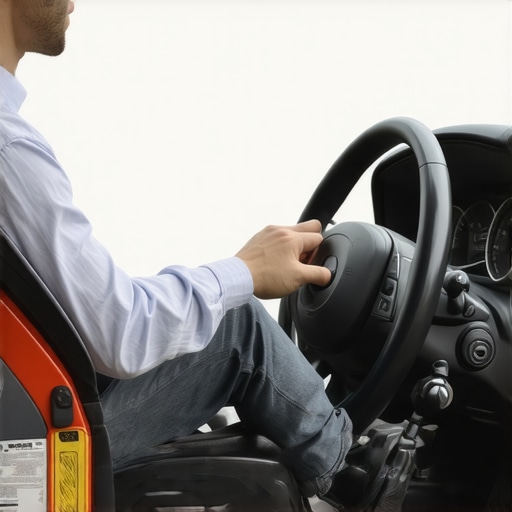
Ditch the 10 and 2 Grip to Relax Your Shoulders
We were all taught to keep our hands at 10 and 2 o’clock, but for a four-hour trip, that’s a recipe for disaster. Holding your hands that high forces your shoulder blades to ‘shrug’ up toward your ears. Within an hour, your upper traps will be screaming. I’ve found that moving my hands to the 4 and 8 o’clock positions—the ‘Dead Hang’—is a total game-changer. It allows your elbows to rest on the armrests or your lap, effectively taking the weight of your arms off your neck. If you don’t do this, you’ll experience that same localized fatigue that explains why your shoulders burn after a long zoom call. When your shoulders are relaxed, you also prevent the mechanical strain that leads to why your shoulder clicks every time you reach for the seatbelt.
Stop the Turtle Neck with a Headrest Reset
If your head isn’t actually touching the headrest, your neck muscles are working 24/7 to hold up a 10-pound weight while the car jolts and sways. I once spent an entire drive to Lincoln with my chin jutted out like a turtle, trying to focus on the horizon. The resulting tension headache was so bad I couldn’t even look at a menu that night. Your headrest should be adjusted so the middle of the pad is level with the top of your ears. Lean back. Let the seat do the work. This prevents the forward-leaning strain that mirrors why your head feels heavy after staring at a monitor. It’s about creating a ‘stack’ where your ears are over your shoulders, not two inches in front of them.
Small Moves that Prevent the Parking Lot Shuffle
Static posture is the enemy. Even the ‘perfect’ position will eventually cut off circulation if you stay in it too long. Every 20 minutes, I perform a series of ‘micro-adjustments.’ Start with a pelvic tilt: gently arch your lower back away from the seat, then flatten it back down. This acts like a manual pump for the fluid in your spinal discs. Surprisingly, the pelvic tilt move for instant pregnancy back relief is just as effective for stiff drivers. Follow this by shrugging your shoulders once and letting them drop. You can even try the move that instantly relieves tension in your lower ribs while stopped at a red light. These tiny movements stop your fascia from ‘gluing’ together, ensuring you can actually stand up straight the moment you reach your destination without the ‘old man shuffle.’ Incorporating the 2-minute drill for better spinal rotation during a quick gas station stretch will keep your spine mobile enough to handle the next leg of the trip.
While the micro-adjustments I mentioned earlier are a great start, let’s dig deeper into the mechanics of why so many people still fail to find relief. Most drivers think that if they just find the ‘perfect’ static position, the pain will vanish. In my experience, this is the biggest lie in ergonomics. You aren’t a statue, and your spine wasn’t designed to be a fixed pillar. In fact, why your perfect posture is actually causing muscle fatigue often comes down to the fact that you’re forcing muscles to hold a rigid shape against the constant G-force of a moving vehicle. This is why you feel exhausted even if you weren’t the one doing the heavy lifting.
Ditch the Stretching Myth Before You Hit the Highway
Here is a contrarian take that might surprise you: stop aggressively stretching your hamstrings before a long drive. Everyone tells you to touch your toes to ‘loosen up,’ but if you already have lower back tension, you might be making it worse. I’ve seen countless drivers fall into the trap of why your hamstring stretches aren’t fixing your tightness. When your pelvis is out of alignment, your hamstrings often feel tight because they are ‘protecting’ your back. Stretching them into oblivion just removes that protection, leaving your spinal discs vulnerable to the vibrations of the road. This is one reason why stretching your hamstrings might actually make your back pain worse if you have an underlying disc issue. Instead of long, static holds, focus on mobility drills that wake up the glutes and core.

How much ‘core bracing’ do you really need while driving?
A sophisticated question I often get is whether one should constantly ‘clench’ their core to protect the spine. The answer is a resounding no. Over-bracing creates a rigid system that can’t absorb road shock. Dr. Stuart McGill, a world-renowned spine biomechanics expert, argues that ‘spinal hygiene’ isn’t about frozen perfection, but about managing cumulative load. You need ‘spare capacity,’ not constant tension. If you try to maintain a the bracing technique that protects your spine during heavy yard work while sitting for four hours, you’ll end up with massive rib cage tension and shallow breathing. This shallow breathing then leads to the hidden link between your breathing pattern and lower back stability being completely disrupted.
The Hidden Danger of Using Posture Braces in the Car
The ‘Oops’ factor for many travelers is the reliance on posture braces. I see them everywhere in airport shops and gas stations. It seems like a shortcut to a pain-free back, but it’s a dangerous trap. When a brace holds you up, your internal stabilizer muscles go on vacation. This is exactly why most posture braces actually make your back weaker over time. You want your body to be its own brace. If you are struggling with a specific ‘kink’ that won’t go away, it’s better to understand what a chiropractor actually looks for during your first exam rather than masking the issue with a $20 neoprene strap. Similarly, be wary of the truth about foam rolling your lower back right before a trip; you might be tenderizing an already inflamed area. Have you ever fallen into this trap and used a gadget that actually made your pain worse? Let me know in the comments below.
After years of trial and error, I’ve realized that maintenance is the most underrated word in the traveler’s vocabulary. If you only think about your back when it hurts, you’ve already lost the battle. I personally use an inflatable lumbar air bladder instead of those bulky memory foam blocks. Why? Because memory foam is a fickle friend; it’s temperature-sensitive. On a cold morning in Omaha, it’s as hard as a brick, and by a humid afternoon, it’s collapsed into a pancake. An air bladder allows me to manually adjust the pressure throughout the drive, preventing the stagnation that leads to stiffness. This is one of those mobility hacks simple adjustments for a more active life that turns a grueling drive into a manageable commute.
My Personal Toolkit for the 200-Mile Mark
Beyond the seat itself, I carry a small mobility kit in my glove box. It isn’t filled with gadgets, but with a specific plan. Dr. Alan Hedge, a renowned ergonomics expert at Cornell University, has long advocated for dynamic sitting, noting that the best posture is always the next posture. This is why I change my seat angle by just one degree every hour. It sounds obsessive, but it shifts the load between different muscle groups, preventing any single tissue from becoming the victim of constant pressure. I’ve found this works far better than any vibrating seat cover. It’s also crucial to look at the ultimate guide to improving mobility and posture in 2025 to see how these small behavioral shifts outlast any expensive equipment.

How do I maintain my spinal health between long trips?
Maintaining the gains you make on the road requires a proactive approach when you’re back on solid ground. I treat my body like a high-performance vehicle that needs regular tune-ups. This is why chiropractic care is your secret weapon for better posture. You can’t expect your spine to handle a 400-mile round trip if it’s already carrying structural imbalances from your desk job. Regular how chiropractic adjustments enhance posture and mobility ensure that your vertebrae aren’t locked in a way that makes sitting even more agonizing. It’s about building resilience so that a four-hour drive is a minor event rather than a physical trauma that ruins your weekend.
The Future of Smart Seating Technology
Looking at where the industry is headed, I predict that within the next few years, AI-integrated car seats will become the standard for luxury and eventually family vehicles. These seats will use biometric sensors to detect when your pelvic floor is fatiguing and will automatically adjust the lumbar support or seat tilt to keep your circulation flowing. We are moving toward an era where the car cares for your spine as much as you do. Until that technology is in every sedan, you have to be your own advocate. Don’t wait until you’re hobbling across a parking lot. I challenge you to try the 15-minute flow to open up sticky hips before your next long haul. It sets the tone for your entire nervous system and makes every ergonomic adjustment we’ve discussed ten times more effective.
The Brutal Lessons My Spine Taught Me Between Omaha and KC
Reflecting on those years of painful arrivals, I’ve realized that the ‘perfect’ setup is less about a single position and more about the ability to adapt. One of the biggest lightbulb moments for me was realizing that why stretching your hamstrings might actually make your back pain worse if you aren’t addressing the pelvis first. I spent years trying to ‘loosen up’ only to arrive more unstable than before.
Another hard lesson? Your car’s cruise control is actually a tool for your back, not just your feet. By using it, you can shift your foot position and prevent the asymmetrical hip strain that leads to that one-sided ache. I also learned that the best way to sit in a car for a 4-hour trip isn’t just about the seat—it’s about the state of your nervous system before you even open the car door.
#IMAGE_PLACEHOLDER_FINAL#
The Gear That Actually Earned a Permanent Spot in My Glovebox
I don’t believe in cluttering your car with gadgets, but three things have changed my life. First, the Inflatable Air Bladder. Unlike memory foam, it doesn’t lose its shape in the heat or turn into a rock in the winter. It allows for those micro-adjustments that keep the spine happy. Second, I swear by the 15-minute flow to open up sticky hips which I perform at every rest stop. It’s like hitting a ‘reset’ button on your lower body.
Finally, I trust the long-term structural support that comes from regular maintenance. I’ve found why chiropractic care is your secret weapon for better posture because it fixes the underlying kinks that a car seat would otherwise amplify. These aren’t just ‘tools’; they are the foundation for staying active as you age.
Reclaiming Your Arrival Without the Aches
You don’t have to accept the ‘parking lot shuffle’ as an inevitable part of traveling. By taking control of your seat distance, hand position, and spinal support, you are choosing to arrive as the best version of yourself. Remember, the best way to sit in a car for a 4-hour trip is the one that keeps you moving once the engine is off. Take these mobility hacks simple adjustments for a more active life and put them into practice on your very next drive. Your body will thank you the moment you step onto the pavement.
What’s the one thing that always starts to ache first on your long drives—your neck, your hips, or your lower back? Let me know in the comments below!