
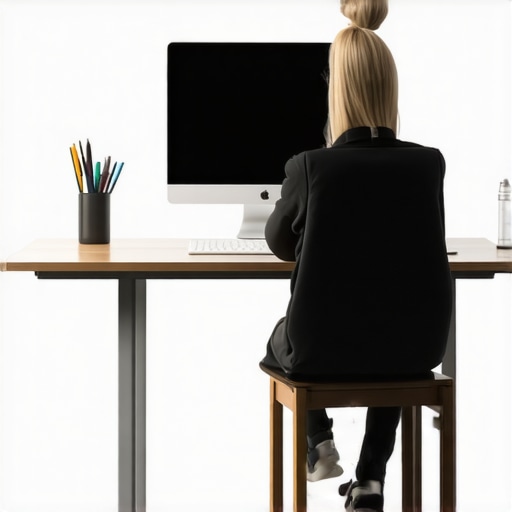
I’ll never forget the afternoon I nearly took out my dual-monitor setup because I sneezed while perched on a giant, sapphire-blue yoga ball. There I was, bouncing gently like a toddler at nap time, thinking I was ‘optimizing my core’ while answering emails. I had fallen hook, line, and sinker for the idea that a standard office chair was the enemy. I wanted that effortless, athletic posture we see in stock photos. Instead, by 3:00 PM, my lower back felt like it was being squeezed in a vise, and my neck was so stiff I couldn’t look over my shoulder to see who was laughing at my wobbly desk setup. It was a visceral lesson in how ‘better’ isn’t always ‘simpler.’ I was trying to fix a problem I didn’t fully understand, and in the process, I was creating a whole new set of aches that made me realize why your head feels heavy after staring at a monitor for too long without proper support.
My Spine Actually Hated the Rubber Sphere
We’ve all been there. You see a coworker or a fitness influencer looking graceful on a ball, and suddenly your high-end ergonomic chair feels like a relic of the industrial revolution. I jumped into the trend without a second thought, ditching my lumbar support for a piece of gym equipment. My biggest mistake? I assumed that because my core was ‘active,’ I didn’t need to worry about the basics of ergonomics. I ignored the desk setup trick for people who hate standing desks and just replaced my seat with a rubber sphere. Within a week, the constant micro-adjustments my body had to make led to massive muscle fatigue. I was actually slouching more because my muscles were too tired to hold me up. It turns out that while ‘active sitting’ sounds great on paper, your spine still needs a consistent base of support. Much like how most posture braces actually make your back weaker by doing the work for you, the ball was making me work so hard I eventually just collapsed into a slump. Have you ever tried the ball-chair life and ended up feeling like you’d run a marathon by 2 PM? It’s an exhausting way to spend a workday. I’ll be honest: I felt like a total failure until I looked at the actual science behind spinal loading. Today, I’m going to share exactly how to navigate these ‘mobility hacks’ without ending up in a heap on your office floor.
Does Active Sitting Live Up to the Marketing?
Here is the reality that the fitness magazines don’t usually mention: human bodies aren’t designed to balance on a round surface for eight hours while also trying to hit a deadline. There is a huge difference between using a ball for 20 minutes of core work and using it as a furniture replacement. A study published in the journal Applied Ergonomics found that sitting on an exercise ball does not significantly change the magnitude of muscle activation in the trunk, yet it significantly increases discomfort. I found this out the hard way. I thought I was ‘toning,’ but I was actually just irritating my SI joint and causing my hip flexors to go into overdrive. Before you toss your chair, you might want to look into the proper way to use a lumbar roll in your office chair first. It’s a lot less glamorous than a gym ball, but your vertebrae will thank you. I spent months trying to roll out the tension, eventually realizing that the truth about foam rolling your lower back is that it won’t fix a problem caused by poor postural endurance. If you really want to change things, you need a strategy like the one in the ultimate guide to improving mobility and posture in 2025, which focuses on sustainable movement rather than just balancing acts. Today, I want to show you exactly why the ball fails most people and how you can actually improve your workstation without the constant threat of rolling away into your trash can.
Swap the Sphere for a Strategy That Actually Works
The first thing I did when I finally rolled my blue ball into the garage was go back to basics. I had to admit that ‘active sitting’ was just a fancy way of saying I was exhausting my postural muscles before lunch. If you really want to feel better, you don’t need to balance on a toy; you need to master the art of the micro-break and structural alignment. I remember one specific Tuesday where I spent four hours tinkering with my monitor height, convinced it was the reason my neck was clicking like a Geiger counter. I looked like a mad scientist, stacking books and adjusting knobs, only to realize I was sitting too low, forcing my shoulders into my ears. It’s no wonder why your traps are always tight even after a massage—you’re basically asking them to hold up your entire upper body while you type.
Dial in Your Chair Height to Save Your Hips
Forget the ball and get your feet flat on the floor. Your knees and hips should be at a 90-degree angle, or even slightly higher at the hips to encourage a natural lumbar curve. When I finally used a measuring tape instead of just ‘winging it,’ the change was almost immediate. Most people fail here because why most standing desks are set at the wrong height applies to sitting desks too. If your desk is too high, you’ll hunch; if it’s too low, you’ll slump. You want your elbows to graze the armrests comfortably, not reach for them like you’re trying to take flight. This creates a stable base that allows your joints to stack correctly, which is the cornerstone of the ultimate guide to improving mobility and posture in 2025. Once your foundation is solid, you can stop focusing on balancing and start focusing on your work.
Lean on Professional Adjustments When Your Muscles Give Up
Even with a perfect setup, your body can get stuck in old patterns. I used to think I could stretch my way out of every ache, but sometimes the ‘software’ of your nervous system needs a reboot. This is where I learned how chiropractic adjustments enhance posture and mobility. When a joint is restricted, no amount of ‘core engagement’ on a yoga ball will fix the underlying lack of motion. I’ve seen this personally: after a long week of deadlines, my mid-back felt like a solid block of wood. A targeted adjustment did more for my comfort than three weeks of ‘active sitting’ ever could. It’s about creating space for movement. You can further enhance your posture with expert chiropractic techniques in 2025 by pairing those adjustments with functional movement patterns. It’s the difference between forcing a door open and simply greasing the hinges.
Reset Your Spine in Under Two Minutes
Since we aren’t built to be statues, you need a ‘reset’ button. Instead of bouncing on a ball, I started using the 2-minute drill for better spinal rotation every single hour. I set a timer on my phone, and when it goes off, I stand up and move. This simple habit, combined with mobility hacks simple adjustments for a more active life, keeps the blood flowing and prevents the ‘stiffening’ effect of long-term sitting. I also found that practicing the the hip hinge fix for chronic lower back aches when I stand up or sit down keeps my spine protected. It’s these small, intentional movements that build true postural endurance, rather than a gimmicky piece of gym equipment that just leaves you tired and sore.
I used to think that if a muscle felt tight, I just needed to yank on it longer. This is the biggest lie in the fitness world. In my experience, most ‘tightness’ is actually a defensive mechanism rather than a physical length issue. Your brain is essentially putting the brakes on because it doesn’t trust your joints to handle the range of motion. For instance, the real reason your hamstrings stay tight despite stretching is often because your pelvis is out of alignment, causing the nervous system to keep the muscle in a state of high tension for protection. If you keep pulling without addressing the pelvic tilt, why your hamstring stretch is actually irritating your sciatic nerve becomes painfully clear. It’s a nuance that separates those who get results from those who just get injured.
Stop Being Your Own Chiropractor
Then there’s the self-adjuster. We all know that person who twists their neck or leans over a chair until it sounds like a bowl of Rice Krispies. I was that person for years, thinking I was ‘saving money’ on appointments. But the reason why you should stop cracking your own back every hour is simple: you are almost always hitting the segments that are already hypermobile (too loose), while the truly ‘stuck’ segments stay frozen. This creates a dangerous cycle of temporary endorphin relief followed by long-term joint instability. By chasing that ‘pop’ yourself, you’re essentially picking a scab that never gets a chance to heal properly.
What happens when your mobility routine ignores stability?
The most sophisticated trap in the world of posture is the obsession with ‘flexibility’ at the expense of ‘control.’ Dr. Stuart McGill, a world-renowned expert in spine biomechanics, has often highlighted that spinal stability is more important than range of motion for long-term back health. If you have the mobility to move like a gymnast but the stability of a wet noodle, your discs are going to pay the price. Understanding the link between mobility and posture: a chiropractor’s guide means recognizing that movement must be earned through strength. Once you stop forcing movement and start building structural integrity, you’ll see why chiropractic care is your secret weapon for better posture—it’s about the neurological reset of the joint, not just the physical movement. You can then revolutionize your posture with targeted mobility exercises that focus on keeping the spine quiet while the hips and shoulders do the work. Have you ever fallen into the ‘perpetual stretching’ trap where you feel tighter the more you work at it? Let me know in the comments below!
Maintaining the win is often harder than the initial fix. Once I stopped trying to reinvent the wheel with giant rubber balls, I realized that long-term success is about building a sustainable system of movement rather than just buying new gear. In my own journey, the goal shifted from ‘fixing a back ache’ to scaling my capacity for movement. I started looking at my spine as a piece of high-performance machinery that needs daily calibration. This is where improving posture through mobility practical chiropractor strategies became my actual roadmap. I stopped looking for a magic bullet and started looking for high-leverage habits that fit into a busy workday without making me look like I was training for the Olympics in my cubicle.
The Tech and Tools That Actually Earned a Spot on My Desk
I’ve tested dozens of gadgets, from vibrating posture sensors to expensive back braces that felt like Victorian corsets. Most of them ended up in the junk drawer within two weeks. However, a few items changed the game for me. The first is a simple high-density cork ball. Unlike the yoga ball, this is for targeted tissue work. I use it to hit the ‘trigger points’ in my upper back that flare up after long writing sessions. It’s a low-tech solution that supports the work done during chiropractic adjustments unlock a pain-free lifestyle today. I also swear by a laptop riser combined with a separate keyboard. It sounds basic, but as Kelly Starrett, DPT and author of Becoming a Supple Leopard, argues, ‘Your environment is the primary driver of your movement patterns.’ If your screen is low, you are going to slump, period. No amount of willpower can overcome bad geometry for eight hours straight.
How do I maintain my spinal health over time?
Consistency is the only metric that matters. I’ve found that the ‘all-or-nothing’ approach leads to burnout and injury. Instead, I focus on mobility boosts for posture expert tips for daily adjustments that take less than five minutes. I predict that the future of this field isn’t in more complex furniture, but in ‘passive feedback’ tech—think invisible sensors built into your clothing that nudge your nervous system rather than forcing your muscles. Until that becomes mainstream, I rely on the ’20-20-20 rule’ not just for my eyes, but for my hips and spine. Every twenty minutes, I stand up for twenty seconds and move through a full range of motion. Combining these mobility hacks simple adjustments for a more active life with regular professional care ensures that minor stiffness doesn’t turn into a chronic injury. If you’re feeling stuck, I challenge you to try one specific advanced tip: the ‘Bracing Sequence.’ Before you sit down, squeeze your glutes, set your ribcage over your pelvis, and then sit. It sounds minor, but it pre-loads your spine for stability. Try doing this for every single sit-down tomorrow and notice how much less ‘heavy’ your torso feels by 5:00 PM.
Why Your Body Craves Support Over Constant Effort
Looking back, my obsession with the yoga ball was really just a search for a shortcut. I thought I could outsource my spinal health to a piece of plastic. The biggest lightbulb moment for me was realizing that posture isn’t about working harder; it’s about stacking smarter. When you understand the link between mobility and posture: a chiropractor’s guide, you see that your muscles need a break, not a perpetual workout. I learned that my ‘tightness’ was actually my body begging for stability, and that trying to be ‘active’ for eight hours straight is as exhausting as it sounds. True progress started when I stopped fighting my chair and started working with my anatomy.
Tools That Survived My Workspace Purge
After the great blue ball eviction, I narrowed my office gear down to a few essentials that actually provide value. I highly recommend Becoming a Supple Leopard by Dr. Kelly Starrett; it completely changed how I move outside of my desk hours. For the desk itself, a simple laptop riser is non-negotiable for eye-level alignment. I also rely on mobility boosts for posture expert tips for daily adjustments to keep my joints lubricated during long calls. Finally, I trust professional care—seeing why chiropractic care is your secret weapon for better posture made me realize that some structural issues can’t be fixed by gear alone.
#IMAGE_PLACEHOLDER_E#
Reclaiming Your Spine from the Desk Slump
You don’t need a total office renovation to start feeling better today. Begin with the small things: level your screen, put your feet flat, and commit to one or two revolutionize your posture with targeted mobility exercises during your lunch break. Your body is remarkably resilient when you stop asking it to perform gymnastics while you’re just trying to answer emails. Focus on sustainable habits that support your posture and you’ll find that ‘heavy’ feeling starts to lift. Have you ever tried a ‘health hack’ like the yoga ball chair that ended up making your back feel worse? Let me know in the comments below!