
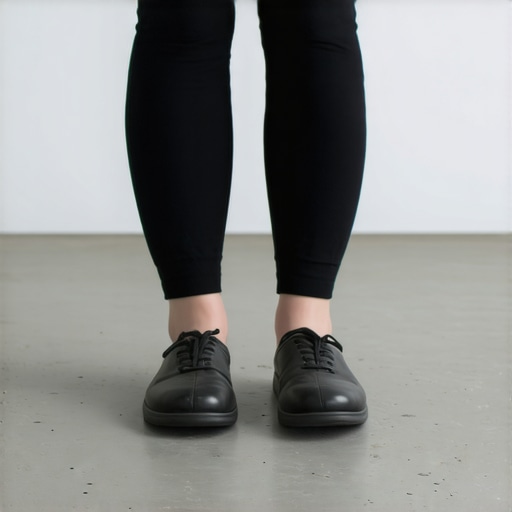
I remember limping toward my kitchen counter, clutching my lower back like I’d just survived a wrestling match, all because I spent the day in my favorite “extra-cushioned” lifestyle sneakers. It felt like a total betrayal; I thought I was being kind to my feet by choosing something soft, but that marshmallow-like sole was actually a stability nightmare that traveled straight up my legs and parked itself in my lumbar spine. I couldn’t even reach down to brush my teeth without a sharp twinge. This is a classic example of why your lower back hurts when you try to stand up straight. Early on, I made the huge mistake of thinking “expensive” and “squishy” were synonyms for “healthy.” I spent a fortune on high-end trainers that were so unstable they forced my hip stabilizers to work triple overtime just to keep me from toppling. Today, we are going to peel back the layers on your footwear and figure out if your favorite shoes are the silent saboteurs of your spinal health. We aren’t just talking about sky-high heels; we’re talking about the everyday sneakers and boots you trust for your morning commute. [image]
That “Cloud-Like” Feeling Is Actually a Trap
I used to be the person who looked for the thickest foam available in the store. I was wrong. When your foot is encased in inches of foam, it can’t feel the ground properly. Your brain loses its vital “map” of where your body is in space, leading to constant micro-adjustments that fatigue your core and back muscles before the day is even half over. This often explains the hidden connection between flat feet and chronic hip pain that so many of us struggle with. If your foundation is wobbly, everything built on top of it—your knees, your hips, and especially your spine—is going to suffer. We live in an era where we walk almost exclusively on hard, flat concrete, and without a stable base, our posture collapses the moment we get tired.
Is more cushioning actually worth the hype?
Most of us are sold on the marketing of “maximum shock absorption,” but research from the American Podiatric Medical Association suggests that improper footwear is a primary contributor to secondary musculoskeletal pain in over 70% of adults. Too much cushion can actually cause you to strike the ground harder because your body is subconsciously searching for the stability it can’t find. This impact doesn’t just disappear; it travels up the kinetic chain. If you’ve ever looked into the best way to transition to zero-drop shoes safely, you’ve likely realized that a flatter, more responsive base is often what the spine actually needs to stay neutral. We’ve become so disconnected from the ground that our backs are paying the price in chronic tension and “mystery” aches that no amount of ibuprofen seems to fix. Have you ever noticed your back only starts screaming at you after an hour in those specific work boots or those “cute” flats you bought for the office? I’d love to hear if you have a pair of shoes sitting in your closet right now that you’re suddenly looking at with a heavy dose of suspicion.
Flip Your Shoes Over and Look at the Heels
To start fixing your back, you need to play detective with your own closet. Take your most-worn pair of shoes and look at the bottom. If you see that the rubber is ground down significantly more on the outer edge or the inner edge, you’ve found your smoking gun. This uneven wear is like a car with a bad alignment; it forces your knees to rotate and your pelvis to tilt, which is often the real reason your hamstrings stay tight despite stretching. I remember taking a pair of my old work boots to a podiatrist once, and he didn’t even look at my feet—he just pointed at the shredded outer heel and told me my lower back pain was inevitable. That was the day I realized my ‘comfy’ boots were actually a structural liability. 
The One-Minute Fix for Your Sleeping Arch
Most of us have ‘lazy’ feet because our shoes do all the work. To counteract this, you need to perform what I call the ‘Short Foot’ drill. Stand barefoot and try to pull the ball of your foot toward your heel without curling your toes. You’re essentially trying to make your foot shorter and narrower by lifting the arch. I did this every morning while brushing my teeth for a month, and the difference in my stability was night and day. It’s one of those mobility hacks simple adjustments for a more active life that costs nothing but provides a massive ROI for your lumbar spine. When your arch is active, it acts as a shock absorber; when it’s collapsed, that shock hits your lower back like a hammer.
Ditch the Squish for Something Solid
If your sneakers feel like you’re walking on marshmallows, they might be the culprit. While a little cushion is great for concrete, too much foam creates a ‘sensory deprivation tank’ for your feet. Your brain needs to know exactly how your foot is hitting the floor to stabilize your core. If you feel wobbly, it might be why your ankles feel weak when you run on uneven ground. I switched to a firmer, more responsive sole for my daily walks, and the ‘mystery’ ache in my SI joint vanished within ten days. It wasn’t about the price of the shoe; it was about the feedback the shoe gave my nervous system.
Why Your Spine Needs a Pro When the Foundation Shifts
Sometimes, simply changing your shoes isn’t enough because your body has already ‘locked in’ the bad patterns. If you’ve been walking on skewed soles for years, your pelvis has likely compensated by rotating or tilting. This is exactly how chiropractic adjustments enhance posture and mobility. An adjustment resets the joint mechanics that your bad shoes threw out of whack, giving you a ‘clean slate’ to start your new footwear journey. You can also revolutionize your posture with targeted mobility exercises that focus specifically on the hips and ankles to ensure that your new, better shoes actually have a straight frame to support. I found that combining better shoes with regular spinal checks was the only way to break the cycle of ‘two steps forward, one step back’ with my chronic tension.People often tell me they are ‘trying’ to have perfect posture, but that very effort is usually what’s keeping them in pain. We’ve been conditioned to think that standing like a soldier—shoulders pinned back, chest puffed out—is the gold standard. In reality, this rigidity creates a massive amount of isometric tension that your muscles weren’t designed to hold for hours. This is why your perfect posture is actually causing muscle fatigue. The truth is that the ‘best’ posture is your next posture. Our spines crave movement, not a fixed position that looks good in a mirror but feels like a structural straitjacket.
Standing Like a Statue Is Actually Ruining Your Spine
I fell into the trap of ‘correcting’ my slump so aggressively that I ended up with flared ribs and a tight mid-back. When you force a position, you’re often just masking a lack of mobility with sheer willpower. This is where most people get it wrong: they try to use muscles to fix a joint problem. If your segments aren’t moving correctly, no amount of ‘sitting up straight’ will fix the root cause. This is a huge part of improving posture through mobility practical chiropractor strategies. Instead of fighting your body, you need to unlock the joints so they actually want to stay in a neutral position without conscious effort.
Why does my back still hurt even after I bought the world’s best ergonomic chair?
It’s because the chair is doing the stabilizing for you, which allows your deep core muscles to effectively ‘go to sleep.’ According to research published in the Journal of Physical Therapy Science, prolonged sitting—regardless of the chair quality—leads to significant decreases in spinal disc hydration and increased muscle stiffness. You can spend two thousand dollars on a seat, but if you don’t move, you’re still just a stationary object accumulating stress. This is exactly why your ergonomic desk chair is still giving you back aches. I tell my clients to think of the chair as a tool for rest, not a cure for poor spinal mechanics. #IMAGE_PLACE_HOLDER_C#
The Dangerous Trap of Over-Stretching Your Hamstrings
Here is a controversial take: stop stretching your hamstrings every time your back feels tight. I see so many people doubled over trying to touch their toes, thinking they are helping their lower back. But if your pelvis is tilted forward because of your shoes or your sitting habits, your hamstrings are already stretched to their limit—they are ‘taut’ like a guitar string, not ‘short.’ Pulling on them further just irritates the attachment points and makes the instability worse. This is why stretching your hamstrings might actually make your back pain worse. You’d be much better off focusing on hip flexor releases and glute activation to bring your pelvis back to neutral.
The Hidden Nuance Your Body is Screaming About
When a chiropractor looks at you, we aren’t just looking for ‘bones out of place.’ That’s a common oversimplification. We are looking at the neurological communication between your brain and your joints. If a joint is stuck, the brain stops getting accurate data about that area, and it compensates by tightening everything around it. It’s a protective mechanism, not a mistake. Understanding what a chiropractor actually looks for during your first exam helps you realize that an adjustment is a ‘reset’ for your nervous system, not just a mechanical crunch. Have you ever fallen into this trap of trying to ‘force’ your posture or over-stretching a sore spot only to have it backfire? Let me know in the comments, because I’ve definitely been there myself.
Stop Rolling Your Spine Like Pizza Dough
I see it every single day at the gym: someone draped over a massive foam roller, frantically rocking back and forth on their lower back. If you are doing this, please stop immediately. Your lumbar spine is designed for stability, not massive amounts of extension over a plastic cylinder. This is one of those cases where the truth about foam rolling your lower back reveals that you might be shearing your vertebrae rather than fixing them. Instead of the ‘rolling’ approach, I personally swear by the ‘tack and stretch’ method using a standard lacrosse ball. By placing the ball into the soft tissue of the glutes or the upper traps—avoiding the bone entirely—you can create a localized pressure point that allows the nervous system to let go of its protective grip. This is much more effective than the shotgun approach of a large roller.
How do I maintain these mobility gains over time?
Consistency is the only thing that beats gravity. I’ve found that a ‘micro-dose’ approach to movement is far superior to a single ninety-minute yoga session once a week. My daily non-negotiables involve a five-minute sequence that mimics the mobility boosts for posture expert tips for daily adjustments I’ve shared before. This isn’t about getting a workout; it’s about signaling to your brain that these ranges of motion are safe to keep. If you don’t use the range, the body will literally deposit collagen fibers to ‘glue’ the joint shut to prevent injury. We are essentially fighting the biological ‘rusting’ process that happens every time we sit still for more than twenty minutes. 
My Personal Toolkit for a Bulletproof Back
Beyond the lacrosse ball, I recommend investing in a firm, lumbar support roll if you have a long commute. But the real game-changer for me was adopting the Stuart McGill ‘Big 3’ routine. Dr. Stuart McGill, a world-renowned expert on spine biomechanics at the University of Waterloo, argues in his technical work that spinal ‘stiffness’ is actually a good thing when it comes to the core—it protects the discs from micro-movements that cause wear and tear. I use these exercises to build a natural corset of muscle that holds my adjustments in place longer. This is exactly how chiropractic adjustments enhance posture and mobility over the long haul—the adjustment clears the path, and the strength exercises lock it in. You can’t have one without the other.
The Future of Posture Is Real-Time Biofeedback
Looking ahead, I suspect we are moving away from passive furniture and toward active, wearable biofeedback. We are already seeing the rise of smart sensors that vibrate when your mid-back crosses a certain threshold of slouching. While I’m usually a fan of mobility hacks simple adjustments for a more active life that don’t require tech, the reality is that our digital lives are incredibly distracting. Having a tactile reminder to ‘reset’ is going to be the standard in the next five years. To get ahead of the curve, I want you to try this one advanced tip: the next time you are on a long call, stand on one leg. It sounds silly, but it forces your pelvic stabilizers to engage and prevents you from ‘hanging’ on your lower back ligaments. It’s a tiny move that yields massive results for your overall spinal integrity. If you’re serious about this, you should also check out the ultimate guide to improving mobility and posture in 2025 to see the full roadmap of where this is going.
Why Comfortable Shoes Are Usually Anything But
Looking back at my years of struggle, I realized that my obsession with padding was actually a form of sensory deprivation for my feet. When you spend all day in max-cushion trainers, your brain stops talking to your ankles and hips. It was a hard pill to swallow that my expensive orthopedic sneakers were the very things keeping my SI joint locked up. I also learned that you cannot stretch your way out of a stability problem—sometimes the answer isn’t to loosen up, but to tighten the core and wake up the feet to provide a stable foundation for the spine.
Tools I Use to Keep My Spine in Check
I do not believe in a closet full of gadgets, but three things have never let me down. First, a simple lacrosse ball is the gold standard for breaking up tissue knots that foam rollers are too bulky to reach, especially in the glutes and upper back. Second, I highly recommend the work of Dr. Stuart McGill for understanding the mechanical nature of back pain. Finally, I never drive without a firm lumbar support to keep my pelvis from tucking during long commutes. These small investments, combined with how chiropractic adjustments enhance posture and mobility, have become the foundation of my daily routine.
A New Foundation for Your Future Self
Your journey toward a healthier spine does not have to happen overnight. It starts with small, conscious choices—like picking a firmer shoe or trying the short-foot drill while you wait for your morning coffee. You will find that when you stop treating your body like a collection of isolated parts and start seeing it as a connected system, everything changes. Whether you decide to chiropractic adjustments unlock a pain-free lifestyle today or just commit to more consistent movement, the important thing is to stop settling for chronic stiffness. Don’t be afraid to challenge the marketing of big shoe brands and listen to what your own lower back is telling you. If you want a deep dive into the next few years of spinal health trends, check out the ultimate guide to improving mobility and posture in 2025 for a full roadmap. Have you ever noticed your back pain flares up only when you wear a specific pair of shoes? Let me know in the comments—I would love to help you troubleshoot your closet.