

I was hunched over my laptop, squinting so hard my forehead actually hurt, when I realized my chin was jutting out like a turtle reaching for a snack. It wasn’t just a bad habit; it was a survival tactic because my vision had slipped just enough to make the screen blurry. I spent hundreds on a fancy ergonomic chair, but the real problem was sitting right on the bridge of my nose. We often think of posture as a “back problem,” but for many of us, it’s actually a “vision problem” in disguise. When your eyes can’t quite lock onto what you’re looking at, your brain forces your neck to move closer to the target. This subtle shift wreaks havoc on your spine over time. [Image Placeholder]
That nagging neck pain might start in your eyes
I made the massive mistake of ignoring the signs for months. I thought I just needed to “strengthen my core” or maybe try some mobility hacks for my stiff shoulders. But no matter how many chiropractic adjustments I got, the tension came right back every Monday morning. Why? Because I was still reaching with my chin to compensate for a weak prescription. My body was literally reshaping itself to help me see better. This is a huge reason why your eyes might be the hidden cause of your neck pain. It’s a vicious cycle where your eyes demand focus and your spine pays the price.
Is a new lens really going to fix my slouch?
You might be skeptical. It feels too simple, right? But the connection is scientific. Our visual system and our balance system are hardwired together. According to the American Optometric Association, uncorrected vision issues are a primary driver of Computer Vision Syndrome, which includes significant neck and shoulder pain. If you’re constantly tilting your head back to see through the bottom of your bifocals or leaning forward to clear up a blur, you’re fighting a losing battle against gravity. I’ve found that even the truth about perfect posture doesn’t matter if your eyes are leading you astray. Have you ever noticed yourself leaning closer to the screen by the end of the day, even when you try to sit back? I’d love to hear if you’ve felt that same “magnetic pull” toward your monitor. Understanding this link is the first step toward a pain-free workday, and it’s about more than just getting a new pair of frames.
Stop reaching for your screen and start bringing it to you
The first thing I had to change wasn’t my chair—it was my screen height. Your neck functions like a crane, and your head is the heavy wrecking ball at the end. When your eyes can’t clearly see the text, that crane leans forward, putting massive pressure on the base of your skull. I learned the hard way that you need to adjust your monitor to stop reaching with your chin. If you’re on a laptop, you’re already at a disadvantage because the keyboard and screen are fused. Buy a separate keyboard and prop that laptop up. Your eye level should be about two inches below the top of the monitor frame. This forces your head to stay over your shoulders rather than drifting into the ‘turtle’ position. 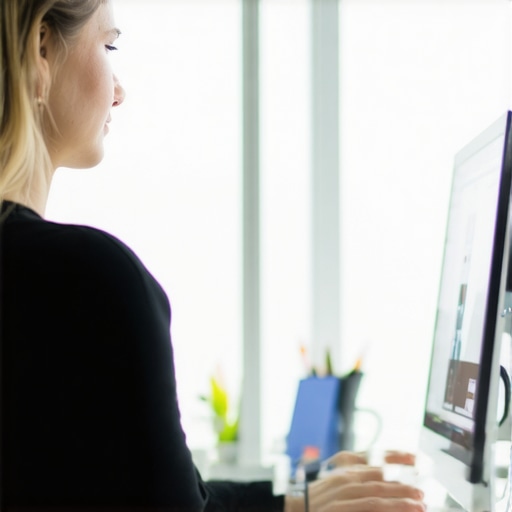
The board game stack experiment that saved my spine
I remember one Tuesday where the tension was so bad I felt a migraine coming on. I didn’t have a fancy riser, so I grabbed a stack of old board games—Monopoly, Risk, and Catan—and shoved them under my monitor. Within twenty minutes, the ‘magnetic pull’ to lean forward vanished because the information was finally meeting my eyes where they naturally rested. If you’re working remotely, you can even apply this to more relaxed settings by learning how to fix your posture while using your laptop on the couch. It’s not about having the perfect gear; it’s about the geometry of your sightline.
Reset your visual focal point every twenty minutes
Your eyes have tiny muscles that get exhausted just like your hamstrings or glutes. When these muscles fatigue, they stop communicating clearly with your brain, and your neck tries to ‘help’ by moving you closer. Use the 20-20-20 rule: every 20 minutes, look at something 20 feet away for 20 seconds. This is a non-negotiable step because your eyes might be the hidden cause of your neck pain. Think of it like a micro-stretch for your internal hardware. If you find yourself squinting even after these breaks, it’s a massive red flag that your prescription is outdated.
When stretching just isn’t enough to break the cycle
Sometimes the habit of leaning forward becomes ‘locked’ into your physical structure. You might find that even when you move the monitor, your shoulders stay rolled forward. This is where chiropractic adjustments enhance posture and mobility by resetting the joints that have been held in a stressed position for too long. I’ve found that combining these vision-based office tweaks with mobility hacks creates a ‘top-down’ approach to healing. You stop the eyes from pulling you forward, and then you use the link between mobility and posture to ensure your spine can actually stay in that new, healthy position without it feeling like a chore.I’ve spent years thinking that if a muscle felt ‘tight,’ it needed to be pulled and lengthened until it submitted. This is one of the most common myths in the wellness world. In reality, why stretching your neck is making your headaches worse often comes down to the fact that those muscles are already at their limit. They aren’t short; they’re overstretched and screaming for stability. When you’re stuck in ‘tech neck,’ your back muscles are like a rubber band pulled to its breaking point. Pulling it more doesn’t provide relief—it provides more trauma. This is where most people fail: they try to stretch a muscle that is actually begging for strength.
Why your tightest muscles might actually be too weak to stretch
If you’ve ever wondered why stretching your hamstrings wont fix your tight back, it’s because the body uses ‘tightness’ as a protective mechanism. If your core or your spine is unstable, your nervous system will lock down the surrounding muscles to prevent injury. This is a nuanced distinction that even some seasoned gym-goers miss. You can’t stretch your way out of a stability problem. Instead, you need to look at the link between mobility and posture through the lens of control. I’ve found that a the 30-second fix for a stuck feeling in your middle back is often about activation, not just relaxation.
The dangerous trap of self-adjusting for temporary relief
Then there’s the ‘crack addict’ habit. I used to be the person who would twist my neck until I heard a loud pop just to get through a meeting. It feels like a release, but it’s a trap. You’re usually just moving the joints that are already too loose (hypermobile), while the truly ‘stuck’ joints stay frozen. This is exactly why the truth about cracking your own back for relief is so complicated. You’re providing a temporary neurological distraction rather than fixing the mechanical issue. A real professional uses expert chiropractic techniques to target the segments that aren’t moving, which is something you simply can’t do to yourself safely. 
Why does my body feel lopsided even when I’m sitting straight?
Many of my readers ask why one side of their body feels like it belongs to a different person. This often leads to a rabbit hole where you realize why your dominant side always feels tighter than the other. It’s not just about usage; it’s about how your brain maps your body in space. A study published in the Journal of Manipulative and Physiological Therapeutics (JMPT) found that spinal manipulation doesn’t just ‘align’ things—it actually improves the brain’s ability to perceive where the body is, a concept known as proprioception. This is why chiropractic care is your secret weapon for better posture. It’s a neurological reboot. If you ignore this and just keep pulling on your muscles, you’re only treating the symptom, not the software. Have you ever fallen into this trap of over-stretching or self-cracking? Let me know in the comments; I’d love to hear how you broke the cycle.The board games were a great temporary fix, but my desk eventually looked like a messy garage sale. To make this sustainable, I invested in a high-quality gas-spring monitor arm. I personally recommend something like the Ergotron LX. It’s not about the brand, though; it’s about the ‘micro-adjustment’ capability. I find that as I get tired around 3 PM, my torso naturally sinks about half an inch. Having an arm that lets me pull the screen down and toward me in seconds means I never have to ‘reach’ with my chin to see clearly. This is a vital part of the ultimate guide to improving mobility and posture in 2025. You aren’t just setting your desk once; you’re adjusting it to your body’s changing energy levels throughout the day. I also stopped wasting money on those massive ‘ergonomic’ memory foam backrests. They usually shove your entire ribcage forward, creating a weird tension in the mid-back. Instead, I learned how to use a lumbar roll correctly in an office chair. A slim, firm roll placed right at your belt line supports the natural inward curve of your spine without forcing your shoulders into a slump. It’s a low-tech tool that offers high-tech results. When I travel, I just roll up a hand towel—it works exactly the same way and keeps my spine neutral even in a stiff airplane seat. For the physical maintenance, I’ve leaned heavily into the work of Dr. Stuart McGill, a legendary spine biomechanics expert from the University of Waterloo. His ‘Big Three’ exercises—the modified curl-up, the side bridge, and the bird-dog—are designed to build endurance in the core muscles that protect the spine. These aren’t meant to give you a six-pack; they are meant to act as a physical ‘internal brace.’ I’ve found that integrating these with targeted mobility exercises gives my body the foundation it needs to stay upright without feeling like I’m constantly fighting gravity. #IMAGE_PLACE_HOLDER_D#
How can I maintain my spinal health when life gets incredibly busy?
The secret is what I call ‘posture snacking.’ Instead of one hour-long session at the gym once a week, I sprinkle mobility boosts for posture throughout my day. Every time I hit ‘send’ on an email, I do one shoulder blade squeeze. Every time I get a phone call, I stand up. This habit-stacking ensures that the adjustments my chiropractor makes actually stick. Speaking of professionals, if you’re in the Midwest, knowing how to choose an Omaha chiropractor that actually listens to your wellness goals is essential for that long-term maintenance. Looking ahead, I think we are moving toward a world of ‘active furniture.’ Imagine a desk that senses your slouch and slowly changes height to encourage you to move, or AI-integrated webcams that give you a gentle nudge on your screen when your head drifts too far forward. Until then, the best tool you have is your own awareness. I challenge you to try the ‘monitor arm’ logic today: don’t move your head to the screen; move the screen to your head.
What My Body Finally Taught Me About Persistent Neck Knots
I spent years thinking I had a bad back when I actually had a tired vision system. One huge lightbulb moment was realizing that my eyes were the hidden cause of my neck pain. If your eyes are straining, your neck muscles will reflexively tighten to stabilize your head, leading to that permanent hunch. Another hard truth I discovered is that stretching a muscle that is already overextended is like pulling on a fraying rope. This is exactly why stretching your neck is making your headaches worse in many cases. Real relief comes from changing the visual environment first, then reinforcing the body with chiropractic support.
The Toolkit That Saved My Sanity
If you want to move beyond stacking board games under your monitor, there are three things I swear by. First, I recommend reading the work of Dr. Stuart McGill—his approach to spinal stability is the gold standard for anyone dealing with chronic issues. Second, a simple firm lumbar roll is indispensable; once I learned how to use a lumbar roll correctly in an office chair, my sitting endurance doubled. Third, a high-quality gas-spring monitor arm is the best investment you can make for your mobility because it allows the screen to follow your eyes, rather than your neck following the screen.
Why Small Wins Lead to a Resilient Spine
You do not need to overhaul your entire life by tomorrow morning. Start with the screen height today. Moving your monitor up just two inches can be more effective for your long-term health than a dozen random massage sessions. When you combine these environmental shifts with mobility hacks, you finally stop fighting a losing battle against gravity. Remember that chiropractic care is your secret weapon for better posture because it helps reset the nervous system that your eyes have been overtaxing for years. You deserve a workday that does not end in physical exhaustion. Take that first step today and bring your world up to eye level. Have you ever tried the 20-20-20 rule or adjusted your monitor height? I would love to hear if it actually made your neck feel lighter by the end of the day—let me know in the comments below!