

I remember sitting at my desk, hand throbbing, convinced that my career as a writer was over because I’d finally developed carpal tunnel syndrome. I’d buy every gadget—vertical mice, gel pads, you name it. But the numbness kept coming back like a bad sequel. It wasn’t until I finally looked at my own habits that I realized the ‘pain’ wasn’t starting where I felt it. My wrist was actually fine; it was just the messenger for a disaster happening in my neck and shoulders.
Stop Blaming Your Wrist for Problems Starting in Your Neck
For the longest time, I made the classic mistake of treating the symptom instead of the source. I spent hundreds on ‘ergonomic’ gear, yet I was still hunching my shoulders up every time I got a stressful email. That tension travels. Most people assume wrist pain equals carpal tunnel, but there is a massive hidden connection between wrist pain and your neck that often gets overlooked. When the nerves in your cervical spine get compressed—usually from that ‘tech neck’ we all have—it sends signals all the way down to your fingertips. According to medical experts at the Mayo Clinic, cervical radiculopathy can mimic carpal tunnel symptoms so closely that people often seek treatment for their wrists when the real issue is a pinched nerve in the neck. Today, we’re going to peel back the layers on why your grip is failing and how chiropractic adjustments might be the missing piece to your puzzle. [image_placeholder_1]
Is this just another posture lecture you can ignore?
I get it. You’ve heard ‘sit up straight’ a thousand times. You’re probably skeptical that your neck could possibly be causing that sharp zing in your thumb. But think about it: have you ever tried the best stretches for gamers and still felt like your hand was stuck in a vice? That’s because stretching a muscle doesn’t fix a compressed nerve. If your foundation is off, everything else is just a band-aid. Have you ever felt like you’ve tried every brace on the market with zero relief? If so, you aren’t alone, and you aren’t crazy. We’re going to look at why your mobility habits are failing you and how to actually fix the root cause so you can get back to living without that constant, annoying ache.
Why Your Wrist Braces Fail When the Problem is Your Neck
Think of your nervous system like a garden hose. If you have a kink in the hose at the faucet (your neck) and another kink further down where the hose turns a corner (your wrist), you’re barely going to get a trickle of water. This is what experts call ‘Double Crush Syndrome.’ Even a minor irritation in your cervical spine makes the nerves in your arm much more sensitive to pressure at the carpal tunnel. I wasted months wearing braces that only addressed the second kink while the primary blockage at my neck was still active. Understanding the difference between nerve pain and muscle soreness is the first step toward stopping gap measures and finding real solutions. 
Test Your Range of Motion Before You Buy More Gear
Before you order another ergonomic mouse, perform a simple self-assessment. While sitting tall, slowly turn your head to the left and then the right. Does one side feel significantly tighter? Does turning your head trigger that familiar tingling in your fingers? If so, your wrist pain is likely a secondary symptom. You can learn how to test your own spinal rotation at home to see if your neck’s lack of mobility is actually the gatekeeper of your hand health. When I first did this, I realized I could barely look over my left shoulder without my thumb going numb—a clear sign that my ‘tech neck’ was the real villain.
Move Your Monitor to Save Your Hands
We often ignore the micro-habits that keep our nerves under siege. If your screen is too low, you’re forced into a forward-head posture that puts up to 60 pounds of extra pressure on your cervical discs. This leads to the truth about text neck and long-term nerve damage. Instead of focusing on your grip strength, focus on your eye level. Raise your monitor so the top third of the screen is at eye level. This simple change forces your shoulders to stack over your hips, taking the tension off the nerves that feed your hands. I once spent a whole afternoon propping my laptop up on a stack of old textbooks, and the reduction in my daily forearm fatigue was almost immediate.
Master the Mechanics of Real Alignment
Specific movements can help ‘floss’ the nerves and release the tension that builds up during a workday. Incorporating mobility hacks and simple adjustments into your routine allows the nerves to glide freely through the surrounding tissues instead of getting snagged. This is where professional intervention becomes a game-changer. While stretches help, how chiropractic adjustments enhance posture and mobility specifically targets the joint restrictions that no amount of foam rolling can reach. It is about clearing the path from the source so your body can actually use the relief you are trying to give it.
Give Up the Myth of the Perfect S-Curve
Everyone tells you to pull your shoulders back and tuck your chin until you look like a military recruit, but in my experience, rigidity is the enemy of recovery. I used to think that if I could just find the correct position, my pain would vanish. But here is the contrarian truth: the truth about perfect posture and why it doesn’t exist is that your best posture is always your next posture. When you force yourself into a static perfect position, you actually create new points of tension and restrict blood flow. Your body is designed for variability, not to be a statue at a desk. By trying to stay perfectly still, you are essentially asking your muscles to perform an isometric hold for eight hours a day, which is an recipe for exhaustion.
Why does your neck still feel off even after a successful adjustment?
This is where things get nuanced for the advanced reader. You might get an adjustment and feel great for an hour, only for that click or heaviness to return. This often happens because your brain has mapped your crooked posture as the new safe baseline. A study published in the Journal of Manipulative and Physiological Therapeutics (JMPT) suggests that chronic spinal issues actually alter your proprioception—your brain’s ability to know where your body is in space. Without addressing improving posture through mobility, you are just resetting a clock that is already programmed to run fast. Real progress requires retraining the nervous system and the sensorimotor loop, not just popping a joint back into place.

Avoid the Stretching Trap That Keeps You Inflamed
One of the biggest oops factors I see is people trying to stretch out a sharp pinch in their neck or shoulder. If you have a compressed nerve, pulling on it is like tugging on both ends of a frayed electrical cord. You aren’t loosening a muscle; you are irritating a live wire. This is why your gentle stretching is actually causing more inflammation rather than providing relief. Instead of traditional static holds, you need mobility boosts for posture that focus on active ranges where your muscles are engaged and protecting the joint. I have seen so many people buy into the no pain, no gain mentality when it comes to their neck and wrists, only to end up with more tingling than when they started. Have you ever fallen into this trap? Let me know in the comments. It is often the subtle shifts in how we view why chiropractic care is your secret weapon for better posture that lead to the biggest breakthroughs. It is not about being fixed in one session; it is about refining your mobility hacks and simple adjustments until your body remembers how to move without defense mechanisms. Digging into the mechanics of how chiropractic adjustments enhance posture and mobility reveals that we aren’t just moving bone; we are updating your internal software for long-term stability. Retraining your brain to recognize a neutral spine is much harder than simply buying a new chair, but using the ultimate guide to improving mobility and posture in 2025 will give you the tools to recalibrate your internal map correctly.
Maintenance isn’t about doing a grueling hour-long routine; it is about building a ‘movement snack’ habit that prevents the return of the dreaded tech neck. Once you have cleared the initial hurdles with chiropractic adjustments, the goal shifts to keeping that nerve pathway open. I have found that the most successful way to scale your progress is to integrate mobility boosts for posture into your existing workflow rather than trying to carve out new time. If you do not have a system, you will default back to the slump within three weeks.
The One Tool That Saved My Career from a Relapse
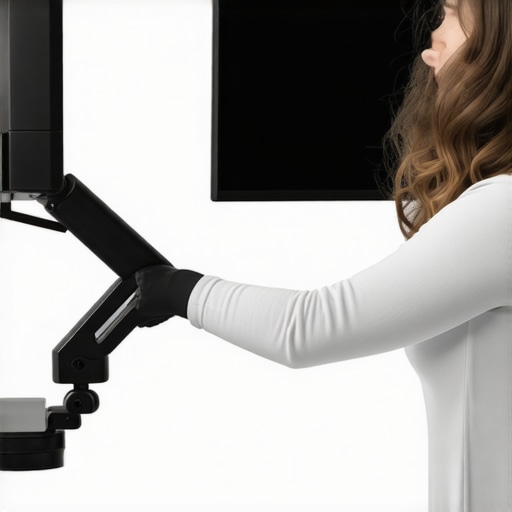
If you take nothing else from this, get a gas-spring monitor arm. I am not talking about a cheap plastic stand. I use the Ergotron LX because it allows for fluid, three-dimensional movement. Why does this matter? Because why your dual monitor setup is twisting your neck is often due to the static nature of the screens. By being able to pull the monitor toward me or tilt it upward throughout the day, I change my visual focal point, which forces my cervical spine to micro-adjust. This prevents the ‘freezing’ effect that leads to that familiar clunk or the reason your neck clicks when you look over your shoulder. It is about creating a dynamic environment where your body has no choice but to stay mobile.
How do I keep my spine in check when I am too busy to think about it?
The secret is ‘Spinal Hygiene.’ Dr. Stuart McGill, a leading expert in spine biomechanics and author of Back Mechanic, suggests that we need to treat our spine like our teeth—daily maintenance is non-negotiable. I personally use a simple interval timer on my desktop that blurs the screen for 20 seconds every 30 minutes. During that window, I perform targeted mobility exercises like chin tucks or scapular retractions. This breaks the neurological ‘holding pattern’ that glues your shoulders to your ears. This small investment of time is why why chiropractic care is your secret weapon for better posture—it works best when supported by these consistent, low-friction habits at home.
The Future of Your Spine is Wearable and Predictive
I predict that within the next few years, we will move away from generic lumbar pillows and toward AI-driven wearable sensors that track our spinal curvature in real-time. We are already seeing the early stages of this with haptic feedback shirts. Instead of waiting for pain to tell you that your neck is compressed, your smartwatch will likely alert you to a ‘nerve tension trend’ before you even feel the first zing in your wrist. This proactive approach is the core of the ultimate guide to improving mobility and posture in 2025. We are shifting from a ‘fix it when it breaks’ model to a continuous calibration model. For now, the most advanced tip I can give you is this: try the 20-20-20 rule for your neck—every 20 minutes, look 20 feet away, and perform a 20-degree neck rotation to each side. It sounds simple, but it is the literal difference between a decade of desk work and a decade of desk-induced disability.
Hard Lessons from My Own Tech Neck Battle
Reflecting on my journey from chronic pain to recovery, I’ve realized that I couldn’t stretch my way out of a nerve compression. If the ‘exit’ from your neck is physically blocked by misaligned vertebrae, no amount of wrist circles will provide lasting relief. I also learned that improving posture through mobility is as much a mental game as it is physical; you have to retrain your brain to recognize where a neutral spine actually is. Most importantly, consistency beats intensity every time. I would much rather see you perform ten seconds of movement every hour than spend an hour in a yoga class once a week only to return to a slumped position for the rest of the day.
The Gear and Experts I Trust with My Spine
I have spent thousands testing tools, but only a few made the cut. I swear by high-quality gas-spring monitor arms like the Ergotron LX because they keep your environment dynamic, which is the only way to avoid ‘freezing’ in a bad position. For education, I highly recommend Dr. Stuart McGill’s book, Back Mechanic, which provides the gold standard for spine biomechanics. Furthermore, I’ve found that chiropractic adjustments are the most efficient way to reset joint restrictions that you simply cannot reach with self-stretching. Relying on professional expertise is part of a smart strategy to maintain mobility boosts for posture that actually stick long-term.
[image_placeholder_5]
Take the First Step Toward Long-Term Relief
It is easy to feel defeated when pain persists, but your body is usually just sending a signal that your alignment is off. By focusing on the link between mobility and posture, you can stop reacting to every ache and start building a resilient foundation. Reclaiming your comfort isn’t about finding a single ‘magic’ chair; it’s about a commitment to moving better and utilizing the ultimate guide to improving mobility and posture in 2025 as your roadmap. You deserve to work and live without that constant, distracting throb in your hands. Have you ever noticed that your wrist pain flares up specifically after a high-stress day of hunching over your desk? Let me know your experience in the comments below.