
I remember the exact moment I realized I’d messed up. I was standing in line at the grocery store, shifting my weight from one foot to the other, trying to find a position that didn’t make my right glute feel like a bruised peach. It wasn’t a sharp, stabbing pain—the kind that makes you gasp. It was just a quiet, persistent throb. I told myself it was just a tight muscle. I’ll just stretch it out tonight, I thought. But after weeks of stretching and finding that stretching your hamstrings won’t fix your tight back, I ended up flat on my back, unable to tie my own shoes. I’d ignored the warning light on my body’s dashboard for too long. Today, I want to help you avoid that same trap. We’re going to talk about why that minor ache is actually a signal that your posture and mobility are in a tailspin, and how a few simple shifts can save you months of misery.
Why that quiet throb in your hip is actually a loud warning
When you feel a dull ache deep in your backside, your first instinct is probably the same as mine: I must be getting old, or I just sat too long today. We treat our bodies like old cars, assuming a little rattling is just part of the experience. But here’s the thing—your glutes are the powerhouse of your entire posture. When they start complaining, it’s rarely just about the muscle itself. It’s usually a sign that your pelvic alignment is off or that you’ve been sitting on a thick wallet or a tilted chair for far too long. According to research from Harvard Health, weak or inhibited glutes can force your lower back to take over the heavy lifting, leading to a cascade of injuries that have nothing to do with your gym routine and everything to do with how you move through your day. I made the mistake of thinking I could just power through it. I ignored the fact that my glutes were failing to activate during lunges and simple daily movements.
Is this really worth a trip to the specialist?
You might be skeptical. You might think it’s just soreness from a weekend hike. But have you ever noticed how that ache seems to get worse the more you try to ignore it? That’s because your body is compensating. Every time you limp slightly or lean to one side to avoid the pressure, you’re throwing your spine out of whack. It’s vital to learn the difference between nerve pain and muscle soreness before you end up with a full-blown sciatica flare-up. Have you ever felt that nagging pull while you’re just trying to enjoy a meal or drive to work? It is a frustrating feeling that many of us try to push through, but you do not have to. We’re going to dive into how to fix this, but first, we have to stop the bleeding—figuratively speaking—by acknowledging that the ache is a message, not a nuisance.
Rebuild your foundation from the ground up
Fixing your posture isn’t about standing like a soldier with your shoulders pinned back; it’s about balancing the tension in your body like a well-tuned instrument. If one string is too tight, the whole melody goes sour. For me, that “sour note” was a persistent hip ache that made sitting through a movie feel like an endurance sport. I finally realized that my body wasn’t broken, it was just misaligned. To get back on track, you have to look at the daily triggers you probably overlook every single morning.
Check your pockets before you check your posture
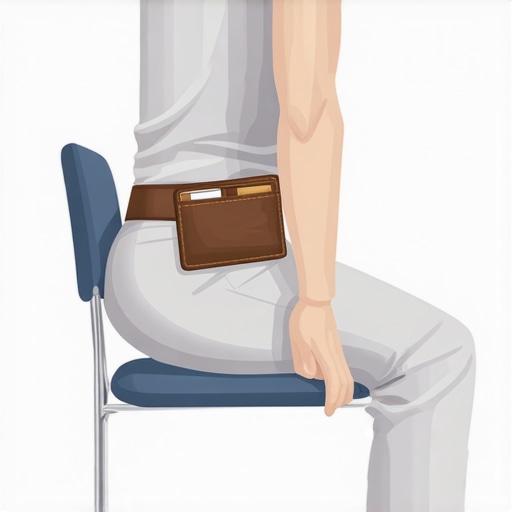
The first thing I had to do—and it felt ridiculous at the time—was empty my pockets. I used to carry a thick leather wallet in my right back pocket. Think of your pelvis as the foundation of a house. When you sit on a wallet, it’s like building one side of your house on a brick and the other on dirt. Your spine has to curve just to keep your head level. This habit is how your wallet in your back pocket destroys your hips over time. I remember a specific Tuesday when I took the wallet out and replaced it with a slim front-pocket clip; within three days, that “bruised peach” feeling in my glute started to fade. It wasn’t a miracle; I just stopped forcing my spine to compensate for a two-inch tilt every time I sat down.
Reset your hips with a 30-second fix
Once you’ve removed the physical obstructions, you need to address the “stuck” feeling. Most people reach for a hamstring stretch, but as I learned the hard way, that often just irritates the nerve further. Instead, you need a way to let the hip joint breathe. I started using the simple hip reset for people who sit all day. It’s a subtle movement that coaxes the femur back into its proper home in the socket. I used to do this in the back of my van during long road trips because I knew how to sit in a car for 5 hours without sciatica flares required active maintenance, not just passive sitting. If you feel a “clunk” or a release, that’s your nervous system finally letting go of a defensive guard.
Master the movement that shields your spine
The most instructional piece of this puzzle is learning to move your limbs without moving your back. This is where mobility meets stability. I spent years doing sit-ups that only made my back tighter. Everything changed when I switched to the dead bug variation that actually protects your spine. The goal is to keep your lower back glued to the floor while your opposite arm and leg move away. It sounds easy until you try it. The first time I did it correctly, I was shaking like a leaf. That tremor is your deep core muscles waking up from a long slumber. By integrating these targeted mobility exercises, you build a “natural corset” that holds your alignment in place so you don’t have to think about it constantly.
Bring the world to your eyes instead of your chin to your chest
Lastly, we have to talk about the “tech neck” trap. I caught myself in a mirror one day hunched over my phone, and I looked like I was searching for a lost contact lens on the floor. Every inch your head moves forward adds ten pounds of pressure to your neck. You have to learn how to use your phone at eye level to save your spine. It feels weird to hold your phone up high in public—you might feel like you’re taking a selfie of your forehead—but your vertebrae will thank you. I started propping my elbows on my ribcage to bring my screen up, and the daily tension headaches I’d accepted as “normal” vanished within a week.
We’ve spent a lot of time talking about what you can do at home, but I need to clear up one of the biggest misconceptions in the wellness world. Most people think ‘perfect posture’ is a destination—a rigid, 90-degree angle you maintain until you go to bed. But the truth about perfect posture and why it doesn’t exist is that your body is designed for variability. The ‘best’ posture is always your next posture. If you stay in the most ergonomic chair in the world for eight hours without moving, you’re still going to hurt. This is why chiropractic adjustments unlock a pain-free lifestyle today; they don’t just ‘fix’ a bone, they reset the nervous system’s map of your body.
Why does my neck feel tighter the more I stretch it?
This is the ultimate ‘trap’ for the advanced reader. You feel tension, so you stretch. When it doesn’t release, you stretch harder. However, if your vertebrae are slightly misaligned, that muscle isn’t just tight—it’s under tension because it is trying to protect the joint. This is exactly why stretching your neck is making your headaches worse in some cases. You are essentially pulling on a knot that needs to be untied, not elongated. A study published in the Journal of Manipulative and Physiological Therapeutics found that spinal manipulation often provides superior long-term results for mechanical neck pain compared to stretching alone because it addresses the segmental mobility rather than just the soft tissue. If you feel like you are constantly fighting your own muscles, you need to understand the difference between a sore muscle and a misaligned joint.
Stop the cycle of self-adjusting
I see people in the gym or at their desks twisting their necks or backs until they hear a ‘pop.’ It feels good for thirty seconds because it releases a temporary burst of endorphins, but why you should stop cracking your own back every hour is simple: you’re likely over-stretching the segments that are already moving too much, while the truly ‘stuck’ joints remain immobile. This creates a cycle of instability that makes your posture collapse even faster. Real change comes from how chiropractic adjustments enhance posture and mobility by targeting those specific, stubborn segments. It’s the difference between using a sledgehammer and a jeweler’s screwdriver. By combining these professional resets with mobility boosts for posture, you stop chasing symptoms and start building a resilient frame. Have you ever fallen into the trap of constant self-cracking just to get through the day? Let me know in the comments.Once the immediate crisis of a pinched nerve or a ‘stuck’ hip is over, most people go right back to their old habits. I call this the ‘relief trap.’ You feel better, so you stop doing the very things that got you there. But true freedom from pain is built in the boring moments—the maintenance phase. I’ve found that mobility boosts for posture aren’t just for when you’re sore; they’re for the days you feel great so you can stay that way. It’s about shifting your mindset from emergency repairs to high-performance tuning. Whether you are following the ultimate guide to improving mobility and posture in 2025 or just trying to survive your commute, the goal is long-term resilience.
How can I keep my joints this mobile for years?
Consistency beats intensity every single time. I used to spend an hour on the weekend trying to ‘fix’ my back, but I realized that the 3-minute evening routine for a less stiff morning was ten times more effective. It’s a simple set of movements that tells your nervous system it’s safe to relax before you hit the pillow. In the near future, I suspect we won’t even have to remember these routines. We are already seeing the rise of AI-driven ‘posture coaches’ that use your webcam or wearable sensors to track your spinal alignment in real-time. Soon, your chair or even your shirt might actually nudge you back into place before you even realize you’ve started to slouch. 
The three gadgets that actually fixed my workspace
I’m a minimalist at heart, but a few specific tools are non-negotiable for me. First is the lumbar roll. If you sit for more than two hours a day, learning how to use a lumbar roll correctly in an office chair is the cheapest insurance policy for your lower back. It maintains that natural inward curve that gravity and soft cushions try to flatten out. Second, I swear by a standard lacrosse ball for ‘mashing’ tight tissue in the glutes and upper back. As Dr. Stuart McGill, a leading expert in spine biomechanics at the University of Waterloo, explains in his research, creating ‘stiffness’ and stability in the core is often more protective for the spine than extreme flexibility. I use the ball to target the soft tissue while relying on professional help for the underlying structure. Finally, combining these home tools with regular chiropractic adjustments to enhance posture and mobility ensures that your ‘hardware’—the bones—and ‘software’—the nerves—are communicating perfectly. This is exactly why chiropractic care is your secret weapon for better posture; it allows the work you do at home to actually stick. I challenge you to try a few small mobility hacks for a more active life, like the 3-minute routine, every night for just one week—you’ll be shocked at how much lighter you feel when you wake up next Monday.
The Realities of Staying Supple That My Physical Therapist Never Mentioned
The biggest ‘aha’ moment for me wasn’t about a specific exercise, but realizing that my body was constantly talking to me through small signals I had learned to ignore. For years, I viewed my stiffness as a personal failure or just an inevitable sign of aging, but the truth is much simpler: my body was often just trying to protect itself from poor movement patterns. I finally learned that understanding the difference between a sore muscle and a misaligned joint is the key to knowing whether to grab a foam roller or see a professional. Another hard lesson was accepting that you cannot out-stretch a lifestyle that involves eight hours of static sitting without some form of structural intervention. It took me a long time to realize that chiropractic care is your secret weapon for better posture because it resets the physical framework so your daily mobility work actually has a stable foundation to build on.
The Small Tools That Make a Massive Difference Every Day
I’ve tried nearly every gadget on the market, from vibrating massage guns to expensive posture-correcting shirts, but I always come back to a few simple, non-negotiable essentials. First, I never sit at my desk without a physical reminder of where my spine should be; learning how to use a lumbar roll correctly in an office chair was an absolute game-changer for my late-afternoon lower back fatigue. Second, I swear by the consistency of the 3-minute evening routine for a less stiff morning. It isn’t about committing to a 90-minute yoga session; it’s about those tiny, daily movements that keep the joints lubricated and the nervous system calm. If you’re looking for a comprehensive roadmap to keep your body resilient, I highly recommend checking out the ultimate guide to improving mobility and posture in 2025 to see how modern science is changing how we look at spinal health. These tools aren’t just ‘nice to have’—they are the buffers that protect your frame from the rigors of the modern world.
#IMAGE_PLACEHOLDER_E#
Your Spine Deserves More Than Just Good Enough
It’s incredibly easy to settle for a life where ‘a little bit of back pain’ is just part of your daily deal. But you don’t have to accept that as your permanent reality. Whether you start today with some simple mobility hacks for a more active life or you finally book that appointment to see how chiropractic adjustments enhance posture and mobility, the important thing is that you take that first step. Your future self—the one who can still play with their grandkids or go on that long-distance hike without a second thought—will thank you for the maintenance work you do today. You have the tools, you have the knowledge, and now you have the plan. Don’t wait for the warning lights to turn into a full-blown breakdown before you decide to prioritize your health. What’s the one daily habit or repetitive movement that always seems to make your back feel tighter by the end of the day? Let me know in the comments below.