
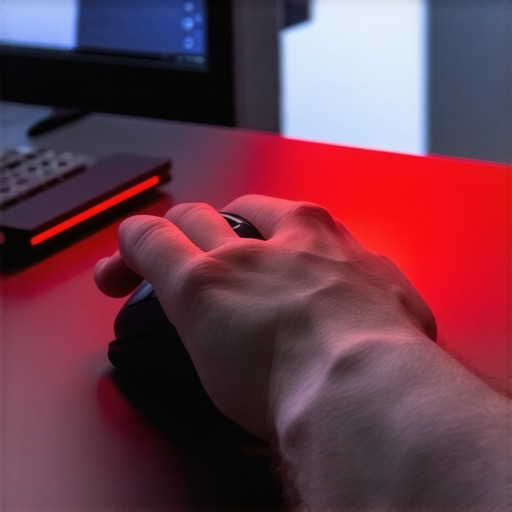
I’ll never forget the Tuesday my right arm finally quit on me. I was three hours into a project, clicking through files, when a white-hot spark flared up right under my shoulder blade. I froze. It wasn’t just a cramp; it was my body’s way of screaming ‘enough!’ For months, I’d been ignoring that dull, heavy sensation that started at my wrist and crept up to my neck by lunchtime. I’d try to stretch it out, but within minutes of grabbing that mouse again, the fire returned. I felt like I was losing a fight against a plastic peripheral, and frankly, I was. [image]
Stop Blaming the Mouse and Start Looking at Your Mechanics
Most of us treat our computer mouse like a tool, but our bodies treat it like a low-grade workout that never ends. When you hold a mouse, your shoulder isn’t just resting; it’s performing a ‘static hold.’ Your muscles are fired up just to keep your hand hovering and ready to click. I made the classic rookie mistake of thinking a fancy, $120 ergonomic vertical mouse would be my savior. I bought the gadget, plugged it in, and… nothing changed. My shoulder still throbbed. I eventually realized that where to place your mouse to stop wrist tingling is only half the battle. If your shoulder is rolled forward and your elbow is flaring out, no mouse in the world is going to save you from that sharp pinch in your shoulder blade. The real culprit is often the way we lock our upper body into a ‘closed’ position, cutting off the natural mobility of the joint. It is a slow-motion injury that we rarely notice until we can’t even lift a coffee mug without a wince.
Will a New Desk Setup Actually Stop the Pain?
I know what you’re thinking because I thought it too: ‘Do I really need to spend thousands on a new office or see a specialist just to click a button?’ It’s a valid fear. Nobody wants to feel like their livelihood depends on a perfectly calibrated cockpit. However, the fix is usually much cheaper and simpler than you’d expect. It’s not about the gear; it’s about the alignment. I spent way too long trying to solve a structural problem with a software mindset. According to research published in the Journal of Physical Therapy Science, prolonged mouse use leads to significant increases in upper trapezius muscle activity because the arm is constantly held in a state of minor abduction. That’s why I recommend learning the 10-second move to reset your shoulders at work. It’s a game-changer for breaking that cycle of tension before it turns into a full-blown flare-up. Have you ever felt that weird numbness or ‘heavy arm’ feeling after a long day at the screen? I’d love to know what your biggest struggle is when it comes to staying comfortable at your desk—tell me about it in the comments. We are going to dive into how to fix your posture without losing your mind, starting with some drills for better overhead shoulder mobility that actually translate to your desk work. Before you go out and buy another ‘ergonomic’ fix, let’s look at why your body is reacting this way in the first place.
Reclaim Your Range of Motion Without Buying New Gear
The first step to stopping the ache is to realize that your shoulder is likely ‘floating.’ Most office workers unconsciously shrug their shoulders toward their ears when they concentrate. This creates a massive amount of tension in the upper trapezius muscle, turning a simple task into a recipe for a tension headache. To counter this, you need to engage in active scapular depression. Think of it like sliding your shoulder blades into your back pockets rather than letting them ride up toward your jaw. This simple shift moves the weight of your arm from the small, delicate muscles of your neck to the larger, stronger muscles of your back. This is why improving posture through mobility is the foundation of any long-term fix for chronic desk pain.

Tuck Your Shoulder Blade Into Your Back Pocket
I remember when I first tried to implement this change; I felt like I was trying to move a muscle I didn’t know existed. I spent an entire afternoon at my desk literally taping a small piece of athletic tape from my right shoulder to my mid-back. Every time I slouched or rolled forward, the tape would tug sharply on my skin, reminding me to reset. It felt messy and annoying for the first hour, but by the end of the day, that white-hot spark in my shoulder was just a dull hum. You can achieve the same result by performing the 10-second move to reset your shoulders at work every time you finish a task or send an email. If you don’t reset, your dominant side will eventually lock up, explaining why your dominant side always feels tighter than the other.
The 90-Degree Rule for Pain-Free Clicking
Your elbow is the bridge between your shoulder and your mouse. If your elbow is hovering in mid-air, your shoulder has to work ten times harder to stabilize your hand. Ensure your chair armrests are at a height where your elbows can rest comfortably at a 90-degree angle while your shoulders remain relaxed and dropped. This setup prevents the forearm muscles from overworking, which is often the real reason your wrist hurts that isnt carpal tunnel. When your arm is fully supported, the nerves traveling from your neck to your hand have a clear, uncompressed path. If you find yourself reaching too far forward to click, you are likely committing the biggest mistake people make when using a standing desk by overextending the reach and straining the rotator cuff. Pull the mouse closer to your body so your elbow stays tucked by your ribs.
Unlock Your Chest to Free Your Shoulders
If you spend all day hunched over a keyboard, your pectoral muscles shorten and tighten. This acts like a tight rubber band pulling your shoulders forward into a permanent slump. You cannot fix your back pain until you address the front of your body. Using mobility hacks and simple adjustments, such as the doorway stretch, can help peel those shoulders back into their natural position. I’ve seen people try to push through the pain with more expensive ergonomic gadgets, but without opening the chest, you’re just putting a band-aid on a structural collapse. Remember that your torso stability is also tied directly to your breath; why your breathing pattern determines your lower back stability applies just as much to your upper body. If you breathe shallowly into your upper chest, you’re fueling the very tension you’re trying to escape, keeping those neck muscles on high alert.
We’ve been conditioned to think that ‘tightness’ is a physical length issue, but in my years of looking at movement patterns, I’ve found it’s usually a neurological SOS signal. Everyone says you need to stretch more, but in my experience, building stability works better for long-term relief than endless tugging on your tendons. When you feel that ‘knot’ in your shoulder, your brain is likely locking that area down to protect a joint that feels unstable. This is the ‘Oops’ factor most people miss: if you stretch a muscle that is already over-lengthened from slouching, you are essentially weakening your body’s only remaining defense mechanism. This explains why stretching your neck is making your headaches worse and why your gentle stretching is actually causing more inflammation rather than fixing the root cause. Have you ever fallen into this trap of stretching for hours only to feel tighter the next day? Let me know in the comments.
Why does your neck still feel stiff after an hour of yoga?
The answer often lies in regional interdependence. A study published in the Journal of Orthopaedic & Sports Physical Therapy highlights how impairments in one region—like a stiff mid-back or even a locked jaw—can lead to compensatory pain in another area, like the cervical spine. This is why the link between mobility and posture is so much more nuanced than just standing up straight. You can’t just rub the spot that hurts; you have to look at the ‘upstream’ and ‘downstream’ neighbors. For instance, why stretching your hamstrings wont fix your tight back is a classic example of how neural tension originating in the spine mimics muscle tightness in the legs. 
The trap of chasing the perfect neutral spine
Another common myth is the pursuit of a perfectly static, straight back. The reality is that the truth about perfect posture and why it doesnt exist is centered on the idea that the best posture is your ‘next’ posture. Rigidity is the enemy of recovery. This is where how chiropractic adjustments enhance posture and mobility becomes a secret weapon. It’s not just about ‘popping’ a bone back into place; it’s about restoring the sensory input to your brain so it stops perceiving movement as a threat. When your nervous system feels safe, the muscles naturally let go of that protective guarding. If you only focus on the ergonomics of your mouse and ignore the underlying joint mechanics, you’re just rearranging deck chairs on a sinking ship.
The Split Keyboard is the Only Way Out
Once I realized my standard keyboard was forcing my wrists into an unnatural ‘ulnar deviation’—that awkward outward bend—I knew I had to go further than just a mouse upgrade. I switched to a fully split keyboard, which allowed my shoulders to stay wide and my chest to remain open. This isn’t just about comfort; it’s about biomechanics. Dr. Alan Hedge, an ergonomics expert from Cornell University, emphasizes that the ‘neutral zone’ for the wrists and shoulders is incredibly narrow, and most standard office equipment forces us far outside that safe window. If you ignore this, you’ll eventually start wondering the reason your neck clicks when you look over your shoulder every time you check your blind spot. It’s all connected. If your hardware is creating a bottleneck for your nerves, your muscles will stay in a state of permanent guard.
How do I maintain these posture gains over the long haul?
Consistency beats intensity every single time. You can have the best desk in the world, but if your joints aren’t moving correctly, the pain will return. This is why I view why chiropractic care is your secret weapon for better posture. I think of it like an alignment for my car; I might be a great driver, but if the wheels are crooked, the tires are going to wear out. Getting regular mobility boosts for posture through professional adjustments ensures that my nervous system isn’t ‘misfiring’ and creating that protective tension we talked about earlier. When you combine structural care with targeted mobility exercises, you stop fighting against your own body and start working with it.
Stop Guessing and Start Monitoring
We are entering an era where your computer will know you’re slouching before you do. I’m already seeing a shift toward AI-integrated posture trackers—software that uses your webcam to monitor your shoulder height and pings you the moment you start to drift toward your screen. I predict that in the next few years, this will be standard in every home office. For now, I rely on the ultimate guide to improving mobility and posture in 2025 to keep my self-correction techniques sharp. My advanced tip for you today is to perform a ‘scapular squeeze’ while sitting on the edge of your chair every 30 minutes to reactivate your mid-back. This one move can prevent hours of shoulder grinding. If you’ve been struggling with that persistent ache, I want you to try moving your keyboard six inches further apart today and see how your shoulders feel by the end of the day.
What No One Tells You About Healing Years of Slouching
After years of experimenting on my own body, I’ve realized that the ‘white-hot spark’ wasn’t the problem—it was the warning light. One major lightbulb moment was discovering that fatigue often mimics injury. Sometimes your shoulder doesn’t need a massage; it needs a different way to move. I also learned that the hidden connection between wrist pain and your neck means that local fixes rarely work for long. Another realization? You can’t ‘stretch’ your way out of a nervous system that feels unsafe. If your brain thinks you’re going to fall forward, it will tighten your neck muscles to hold you up, regardless of how many yoga classes you attend.
Gear and Guidance That Actually Moved the Needle
I don’t believe in buying every gadget on the market, but a few things changed my life. First, the Kinesis Freestyle2 split keyboard allowed my chest to finally breathe and my shoulders to relax. Second, a simple lacrosse ball for ‘tack and stretch’ work on my pecs did more than any $100 massage tool ever could. Finally, I rely heavily on the ultimate guide to improving mobility and posture in 2025 to stay ahead of the curve. These tools work because they address the structural reality of our lives, not just the symptoms. If you want to see how these pieces fit together, looking into how to enhance your posture with expert chiropractic techniques in 2025 provides a roadmap for the coming year.
Your Body Deserves a New Narrative
Recovery isn’t a straight line, and it certainly isn’t about achieving a rigid, military-style posture. It’s about building a body that is adaptable and resilient. By integrating regular movement and understanding why chiropractic care is your secret weapon for better posture, you take the pressure off your small muscles and let your structure do the work. You don’t have to live with that ‘heavy arm’ feeling forever. Improving your chiropractic adjustments posture mobility is a marathon, but the relief is worth every step. Have you ever noticed your shoulder pain flares up more during stressful meetings than during actual typing? Let me know in the comments below—I’d love to hear your experience!