
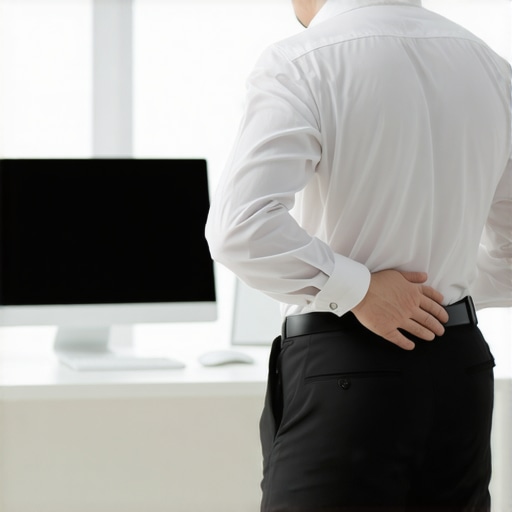
I was mid-sentence in a high-stakes meeting when my lower back decided to stage a violent protest. A sharp, white-hot zip shot across my pelvis, and suddenly, I was paralyzed in my ergonomic chair. I tried to shift my weight, but my muscles felt like they had been replaced by rusted iron cables. It is a visceral, lonely kind of panic when your body quits while you are on the clock. You are stuck between needing to finish a project and wondering if you will actually be able to walk to your car. For years, I made the mistake of trying to ‘tough it out’ or performing aggressive, frantic stretches in the breakroom that only made things worse. I learned the hard way that why your gentle stretching is actually causing more inflammation rather than fixing the root cause. Today, I am going to show you the exact survival protocol I use to calm the storm, regain my mobility, and keep the workday from becoming a total disaster. Have you ever felt that sudden, sharp catch in your spine and wondered if you were going to be stuck in that position forever?
Stop the Panic When Your Spine Shuts Down
When that familiar ache turns into a full-blown flare-up, your brain goes into survival mode. My biggest early mistake was thinking I needed to ‘crack’ my way out of it or fold myself into a pretzel. Instead, I had to learn how to handle a sudden back spasm without panicking to avoid triggering even more muscle guarding. Back pain is not just a personal nuisance; it is a massive public health issue. According to the Health Policy Institute at Georgetown University, back pain is one of the most common reasons for missed work days and the leading cause of job-related disability. You are not just ‘getting old’—you are dealing with a complex physiological reaction to static loading.
Is it even worth trying to finish the day?
You might be tempted to call an Uber and go straight to bed, but complete immobilization is often the worst thing you can do. The secret lies in subtle adjustments. I used to think I needed a whole new office setup, but often, just knowing how to use a lumbar roll correctly in an office chair can be enough to decompress the area while you finish your emails. We are going to look at how to move without fear and how to manage the immediate inflammation without looking like a maniac in the office.
Don’t move until you breathe
Your first instinct when your back ‘goes’ is to jerk away from the pain or frantically rub the area. Stop. Think of your muscles like an over-sensitive car alarm; if you keep kicking the door, the siren never stops. You need to give your nervous system a chance to realize there is no actual predator in the room. This starts with your diaphragm. I have found that why your breathing pattern determines your lower back stability is the single most overlooked factor in acute pain management. Instead of short, shallow gasps, pull air deep into your belly. This creates internal pressure that acts like a natural weight belt, stabilizing the spine from the inside out. Once you have managed the breath, you can start to distinguish what is actually happening. You need to identify the difference between nerve pain and muscle soreness before you try any movement. If it is a sharp, electric zing, stay still. If it is a dull, heavy ache, we can start the reset.
The robotic squat that saved my career
I remember a presentation three years ago where I dropped a stack of handouts right as the CEO walked in. Usually, I would have bent over at the waist like a folding chair—a move that would have locked my lumbar spine for a week. Instead, I used a technique I call the ‘Robotic Piston.’ I kept my torso completely vertical, gripped the edge of the table for balance, and lowered myself using only my knees and hips. It looked slightly mechanical, but by avoiding that forward hinge, I bypassed the pain triggers entirely. It is essentially about learning the best way to lift heavy boxes without throwing out your back, even when that ‘heavy box’ is just a fallen pen or your own laptop bag.
Unlock your hips while the printer is running
If you are stuck at the office, you likely cannot drop to the floor for a full yoga session. You need stealth moves. When I am flared up, I head to the breakroom. While waiting for my coffee, I perform the 30-second move that opens up tight hips in seconds by simply placing one foot slightly behind the other and tucking my tailbone. This ‘tuck’ is crucial. Most of us walk around with an arched back that pinches the facet joints of the spine. By flattening that curve for just a moment, you give those joints a ‘breather.’ This is a simplified version of learning how to fix a tilted pelvis with three simple moves without needing to change into gym clothes.
Recenter your gravity with a quick reset
Often, the pain in your lower back is actually a result of your upper body being ‘off the rails.’ If your head is jutting forward to read a spreadsheet, your lower back has to act like a crane cable holding up a heavy weight. I use the 10-second move to reset your shoulders at work to shift my center of gravity back over my hips. Gently pull your shoulder blades down toward your back pockets—not together, but down. This decompression trick takes the ‘tug-of-war’ tension off your mid-back and allows your lumbar spine to settle into a more neutral, less inflamed position. If you can do this three times every hour, you change the mechanical load on your discs entirely.Most ergonomics ‘experts’ will tell you to sit with 90-degree angles at your knees and elbows, back straight as a board. In my experience, that is the fastest way to fatigue your stabilizing muscles. The reality is that the truth about perfect posture and why it doesnt exist boils down to one thing: movement. Your body craves variety, not a rigid, idealized position. A study published in Musculoskeletal Science and Practice by Korakakis et al. found that even healthcare professionals cannot agree on what ‘neutral’ posture looks like. The takeaway? Your ‘next’ posture is actually your best posture. If you try to force a ‘perfect’ shape, you just create new patterns of tension.
Stop pulling your hamstrings to save your back
Here is the biggest trap I see: the ‘hamstring obsession.’ When your lower back feels tight, you instinctively reach for your toes. But here is the nuance most people miss: why stretching your hamstrings wont fix your tight back is often because that ‘tightness’ isn’t a muscle length issue—it is your sciatic nerve being put under tension. If you keep yanking on it, you are just aggravating the nerve, which makes the back muscles tighten even more as a protective reflex. This is what I call the ‘false mobility trap.’ You feel like you are doing something good because it burns, but that burn is neural irritation, not muscle growth. Have you ever fallen into this trap? Let me know in the comments.
Why does your dominant side always feel tighter than the other?
If you are right-handed, you likely lean slightly to the right to use your mouse or reach for your phone. Over thousands of hours, this creates a functional asymmetry that a simple stretch won’t fix. This is why your dominant side always feels tighter than the other; it is doing the heavy lifting of your daily micro-movements, essentially acting as a primary stabilizer for your entire torso. You do not need to be perfectly symmetrical—very few athletes are—but you do need to ‘clear’ that tension regularly. This is where chiropractic adjustments unlock a pain-free lifestyle today by resetting the joint mechanoreceptors that tell your brain how to hold your body in space. It is less about ‘fixing a crooked spine’ and more about cleaning up the communication lines between your brain and your muscles. By integrating mobility boosts for posture expert tips for daily adjustments into your routine, you tackle the mechanical bias of your dominant side before it turns into a chronic misalignment. The goal isn’t a static statue-like pose; it’s the ability to move into and out of various positions without your nervous system sounding the alarm bells of a flare-up. When you stop fighting your anatomy and start working with your nervous system’s need for safety, the chronic aches begin to dissolve.
The gear that actually stays in my bag
I have spent thousands on ergonomic chairs that promised to save my life, but the most effective tools I own cost less than a lunch at Chipotle. My “holy trinity” of back maintenance starts with a high-density lacrosse ball for pinpoint myofascial release. When my low back feels like it is seizing, I do not just roll aimlessly; I target the gluteus medius to take the pull off the sacroiliac joint. Secondly, I use a vertical mouse. This might seem minor, but the traditional “palm-down” position forces your radius and ulna to cross, creating a chain reaction of tension that travels up to your shoulder blade and neck. Research by Dr. Alan Hedge at Cornell University suggests that rotating the hand to a more natural “handshake” position significantly reduces the risk of musculoskeletal disorders. Finally, I never work without a laptop riser. If you are looking down at your screen, you are essentially hanging a 12-pound bowling ball off your neck ligaments for eight hours. This is why your eyes might be the hidden cause of your neck pain—your spine follows your gaze.
How do I maintain these spinal gains over the long haul?
Maintenance is not about doing a 60-minute yoga flow every morning; it is about the micro-adjustments you make when no one is looking. I look at it as “spinal hygiene.” Just like you brush your teeth to prevent cavities, you need a daily strategy to prevent disc compression. This starts with the 3-minute evening routine for a less stiff morning. By decompressing before you sleep, you allow the discs to rehydrate properly overnight. I also make it a point to see my chiropractor once a month, even when I feel “fine.” This is why chiropractic care is your secret weapon for better posture; it catches the minor joint restrictions before they manifest as a painful spasm. Think of it as a front-end alignment for your body. By understanding how chiropractic adjustments enhance posture and mobility, you shift from reactive “pain management” to proactive performance optimization.
Why real-time haptics are the next big win for your spine
Looking ahead, I predict a massive shift toward wearable biofeedback. We are moving away from passive furniture and toward smart clothing that gently vibrates when your shoulders begin to round or your pelvis tilts too far forward. This “active coaching” will make the ultimate guide to improving mobility and posture in 2025 look like ancient history. We will not have to remember to sit up straight; our gear will remind us. Until then, the burden of awareness is on us. You have to be the architect of your own environment. Start by incorporating the best exercises for building a spine that doesnt ache into your weekly gym sessions to build the structural integrity needed to support your workday. My challenge for you today is simple: raise your phone to eye level every single time you use it for the next 24 hours. Your neck will thank you.
The Hardest Lesson I Learned About Chasing the ‘Perfect’ Pose
I spent years trying to sit like a statue because I thought ‘neutral’ was a static destination. I was wrong. The biggest shift occurred when I realized that the link between mobility and posture is actually about fluidity, not rigidity. If you feel stuck, your body isn’t broken; it’s just asking for a new input. I also stopped treating every ache as a muscle tear. Learning the difference between a sore muscle and a misaligned joint changed how I approached my recovery. Sometimes you don’t need a massage; you need a reset. This lesson saved me from weeks of unnecessary inflammation and helped me realize that mobility is the language of a healthy spine.
Gear That Earned a Permanent Spot on My Desk
Beyond the high-tech gadgets, I’ve found that mobility hacks simple adjustments for a more active life are far more effective than an expensive chair. I swear by my simple laptop riser and a daily check-in with my movement patterns. If you’re looking for a deeper dive, I highly recommend checking out enhance your posture with expert chiropractic techniques in 2025 to see where the science of spinal health is headed. These resources shifted my perspective from ‘fixing’ a problem to ‘optimizing’ a system. #IMAGE_PLACE_HOLDER_E#
The Future of Your Spine Starts with a Single Breath
You have the tools now to stop a flare-up before it anchors you to the floor. Remember, revolutionize your posture with targeted mobility exercises isn’t a weekend project; it’s a lifelong conversation with your nervous system. You deserve to work without the constant shadow of pain. Take that first step, trust your body’s ability to heal, and keep moving forward. Have you ever tried a specific movement that immediately silenced a back spasm? Let me know in the comments below.