
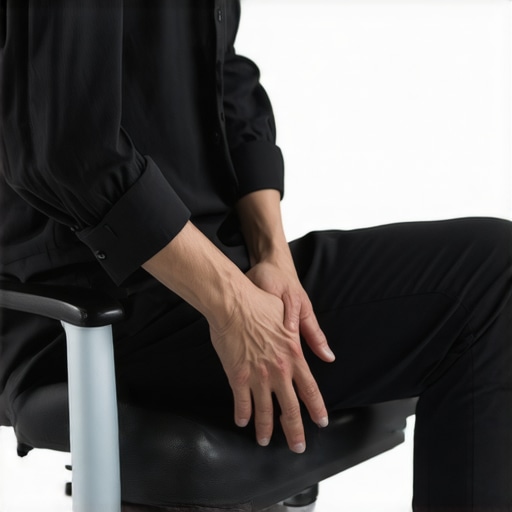
I was halfway through a flight to Chicago when I realized I couldn’t feel my left kneecap anymore. It wasn’t a sharp pain, but a dull, pressurized throb that made me want to stand up and scream in the middle of the cabin. I tried to shift. I tried to stretch my leg into the aisle. Nothing worked. It felt like my knee joint was filled with wet cement that had finally hardened. For years, I told myself I was just getting older, or maybe I’d played too much soccer in high school. But the truth was much simpler and, honestly, a bit more frustrating. My body was reacting to the way I lived, not just the years on the calendar. If you’ve ever sat through a movie or a long dinner and felt that desperate urge to ‘pop’ your knee just to get some relief, you aren’t alone. We are going to solve that nagging ache today by looking at why your joints feel like they are under siege the moment you stop moving.
Your Knees Aren’t Actually Aging, They Are Just Starving for Movement
The biggest mistake I made early on was assuming my knees were weak. I spent months pounding out heavy squats and lunges, thinking that more muscle would magically fix the ache. It didn’t. In fact, it made it worse because I was adding more compression to a joint that was already suffocating. What I didn’t realize back then is that our joints don’t have their own blood supply; they rely on a process called ‘imbibition’ to get nutrients. When you sit still for more than 30 minutes, that nutrient exchange practically stops. You aren’t ‘wearing out’ your knees; you are literally starving them of the lubrication they need to glide. This is often tied to how we hold ourselves, though the truth about perfect posture and why it doesn’t exist might surprise you—it’s more about your next posture than your ‘perfect’ one. According to the Arthritis Foundation, movement is actually the ‘biological WD-40’ for your joints, and prolonged stillness allows inflammatory proteins to settle in the joint space.
Is this just something I have to live with now?
It is easy to get cynical when every chair feels like a torture device. You might worry that your cartilage is gone or that you’re headed for a replacement. But most ‘theater knee’ isn’t about structural damage; it’s about a lack of mobility and posture. I used to think I was a lost cause until I started using the simple hip reset for people who sit all day. Once I stopped focused on ‘strengthening’ and started focusing on ‘unsticking’ my hips and ankles, the knee pain vanished. Have you ever felt that sharp, localized pinch the second you try to stand up after a long meeting? That is your signal that your alignment is off. We need to stop blaming our age and start looking at the mechanics of our daily lives. If you are tired of hobbling for the first ten steps every time you get out of a car, we need to talk about how chiropractic adjustments enhance posture and mobility by clearing the path for your nerves and joints to communicate. Have you found yourself avoiding certain chairs or movies because you dread the ‘stiff knee’ walk afterward? Let me know, because I’ve been there, and I promise there is a way out that doesn’t involve a bottle of ibuprofen.
Stop treating the symptom and start fixing the chain
The knee is essentially a middle child; it gets pushed around by the behavior of the hip above it and the ankle below it. If your ankle is locked up like a rusty hinge, the force from every step you take has to go somewhere, and it usually shoots straight into the knee joint. I remember trying to perform a basic bodyweight squat in my living room after that flight to Chicago. I got halfway down and almost tipped over backward because my ankles wouldn’t bend. I was so focused on my ‘bad’ knee that I completely missed the fact that my lower leg was stiff as a board. Learning how to fix stiff ankles that limit your squat depth was the first time I felt actual space in my knee joint again.
The ankle is your primary shock absorber
Think of your ankle as the suspension system on a mountain bike. When you hit a bump—or just walk down a sidewalk—the ankle should soak up that energy. If the ankle doesn’t move, the knee has to compensate by shearing and twisting. Most of us spend our lives in shoes that act like casts, turning our feet into blocks. You can test this right now: stand up and try to bring your knee four inches past your toes without your heel lifting. If you can’t do it, your knees are doomed to take the brunt of every movement. You need mobility boosts for posture that prioritize these small, forgotten ranges of motion. #IMAGE_PLACE_HOLDER_B#
Your hips control the steering wheel
When your glutes ‘turn off’ from sitting, your femur—the big thigh bone—starts to rotate inward. This puts a massive ‘torsion’ or twisting force on the knee ligaments. It’s like trying to drive a car with the alignment pulled hard to the left. I spent years stretching my hamstrings, not realizing that why stretching your hamstrings won’t fix your tight back or your knee pain is because the hip is actually the one failing to stabilize. I started using the 30-second move that opens up tight hips in seconds before every long drive, and the ‘theater knee’ ache simply stopped showing up.
Clear the static in your nervous system
Sometimes the mechanics are okay, but the signal is fuzzy. This is where the spine comes in. If your lower back is slightly out of alignment, the nerves that tell your leg muscles how to fire get ‘noisy.’ It is like trying to listen to the radio through a storm. This is why chiropractic care is your secret weapon for better posture and joint health; it removes that interference. When I finally went in for an adjustment, I realized my pelvis had been tilted for months. No amount of stretching could fix a bone that was sitting in the wrong spot, blocking the communication between my brain and my knees.
The Big Lie About Stretching and Why You Might Be Hurting Yourself
We’ve been told for decades that if something feels tight, we should pull on it until it lets go. In my early days of trying to fix my own joints, I was a stretching zealot. I’d spend twenty minutes a night yanking on my hamstrings and hip flexors, only to wake up the next morning feeling like a rusted gate. Here is the nuance most people miss: stiffness is often a protective response from your nervous system, not a physical shortening of the muscle. If your brain perceives that a joint is unstable or out of alignment, it will literally ‘clamp down’ the surrounding muscles to act as a natural splint. When you perform aggressive passive stretching on a joint that is already unstable, you aren’t fixing the problem—you are actually triggering a survival reflex. This is why your gentle stretching is actually causing more inflammation rather than relief. A study published in the Journal of Athletic Training suggests that while stretching may increase ‘stretch tolerance,’ it does very little to change the actual structural length of the tissue if the underlying neurological ‘guarding’ isn’t addressed.
Why does the same spot keep locking up every single morning?
If you find yourself needing to ‘reset’ the same joint every few hours, you aren’t dealing with a mobility issue; you are dealing with a stability or alignment issue. Your body is smart. If your pelvis is tilted or a vertebra is restricted, your muscles will tighten up to prevent further damage. I see this all the time with people who try to use a foam roller to solve everything. While it feels good in the moment, the truth about foam rolling your lower back is that you might be smashing the very tissues that are trying to protect your spine. To break the cycle, you have to move beyond just ‘opening up’ and start improving posture through mobility by teaching your brain that the new range of motion is safe to inhabit. Have you ever fallen into this trap of stretching the same spot for years without any real change? Let me know in the comments, because once I stopped stretching and started stabilizing, everything changed.
The Dangerous Trap of Chasing the Crack
We have all done it. You feel a dull pressure in your neck or mid-back, and you twist or pull until you hear that satisfying ‘pop.’ You get a temporary rush of endorphins and a moment of relief, and you think you’ve fixed it. But here is the ‘oops’ factor: when you self-adjust, you are almost never hitting the joint that is actually stuck. Instead, you are forcing movement into the segments above and below the restriction—the ones that are already moving too much. By ‘chasing the crack,’ you are creating hypermobility in the wrong places, which actually makes the stuck joint even more jammed over time. This is the truth about cracking your own back for relief: it’s a short-term chemical hit that creates long-term instability. #IMAGE_PLACE_HOLDER_C# True mobility and posture improvement requires a precise adjustment to the segment that isn’t moving, allowing the over-worked muscles to finally relax. Understanding the difference between a sore muscle and a misaligned joint is the first step in stopping the self-sabotage. If you want a permanent fix, we need to focus on targeted input that tells your nervous system it’s okay to let go of the tension.
Stop buying every gadget on your social feed
I spent a small fortune on posture correctors that looked like medieval harnesses and vibrating foam rollers that cost more than my first car. Most of it was useless clutter. If you want to keep your joints moving smoothly, you need tools that speak to your nervous system, not just your muscles. My daily toolkit is remarkably simple: a firm lacrosse ball, a resistance band, and a lumbar roll. I found that learning how to use a lumbar roll correctly in an office chair did more for my chronic lower back throb than any ‘ergonomic’ chair ever could. It’s not about forcing your body into a rigid, ‘perfect’ shape; it’s about giving your spine a tactile cue so your brain knows it’s safe to relax the surrounding muscles.
How do I keep my spine healthy over time?
Consistency beats intensity every single time. You don’t need a grueling hour-long mobility session to see results. I swear by the 3-minute evening routine for a less stiff morning because it resets the tension from the day before it has a chance to ‘set’ while you sleep. A study published in the Journal of Bodywork and Movement Therapies found that ‘micro-breaks’ involving low-intensity movement were significantly more effective at reducing spinal disc pressure than longer, infrequent bouts of exercise. I call these ‘movement snacks.’ If you are still struggling to find a rhythm, it might be time to look into how to choose an Omaha chiropractor that actually listens to your wellness goals, as having a professional eye on your alignment can prevent small imbalances from becoming permanent roadblocks. #IMAGE_PLACE_HOLDER_D#
The future of posture is probably wearable
I predict we are about to see a massive shift toward bio-feedback technology. We are moving away from simple standing desks and toward wearable sensors that analyze joint shearing forces in real-time, alerting you before the pain even starts. But until those devices are perfected, you have to be your own sensor. If you’re serious about long-term results, you must transition from reactive fixes to proactive mobility hacks for a more active life. The goal is to make movement so integrated into your day that you don’t even realize you’re doing it. My advanced tip for you today: The next time you are on a long Zoom call, try ‘seated cat-cows’ by tilting your pelvis forward and back every ten minutes. It keeps the spinal fluid moving and prevents the ‘cement knee’ feeling I used to get. Give it a shot during your next meeting and see how much lighter your legs feel when you finally stand up.
The Hard Truths About Joint Health I Had to Accept
After years of trying every quick fix on the market, I realized that my knees were never the real problem—they were just the ones screaming the loudest. First, I had to accept that pain is a messenger, not an enemy. When my joints felt tight, it was a signal that my alignment was off, not that I was ‘aging out’ of a mobile life. Second, I learned that you cannot stretch your way out of a stability problem. If your brain doesn’t feel safe, it will keep those muscles locked tight no matter how hard you pull. This is why the ultimate guide to improving mobility and posture in 2025 focuses so much on the neurological side of movement.
The most important lesson was realizing that professional help isn’t just for when you can’t walk. Waiting for a crisis is a recipe for long-term damage. Regular sessions to ensure chiropractic adjustments unlock a pain-free lifestyle today acted as the preventative maintenance that kept me off the surgery table and back on the hiking trails.
My Non-Negotiable Tools for Staying Mobile
I don’t leave for a trip without my ‘mobility survival kit.’ It isn’t complex, but it works because it targets the root causes of stiffness. #IMAGE_PLACE_HOLDER_E# My toolkit includes a high-density lacrosse ball for pinpointing glute tension, a set of resistance bands for activating my stabilizers, and a dedicated routine of the best exercises for building a spine that doesn’t ache. I trust these tools because they don’t just mask the pain; they change how my body interacts with gravity. If you spend hours in a car or at a desk, these simple additions can be the difference between standing up with ease or hobbling like a rusted machine.
Building a Body That Can Keep Up with You
You aren’t a lost cause, and those ‘creaky’ joints don’t have to be your permanent reality. Your body is incredibly adaptive, and even small, consistent changes can lead to massive shifts in how you feel. By integrating practical mobility hacks for a more active life, you’re taking ownership of your health rather than being a passenger to your symptoms. It’s time to stop dreading the long flight or the two-hour movie and start trusting that your body can handle whatever you throw at it. Have you ever felt like your knees were ‘locked’ after sitting for a long time? What was the first thing you tried to find relief? Let me know in the comments below!