
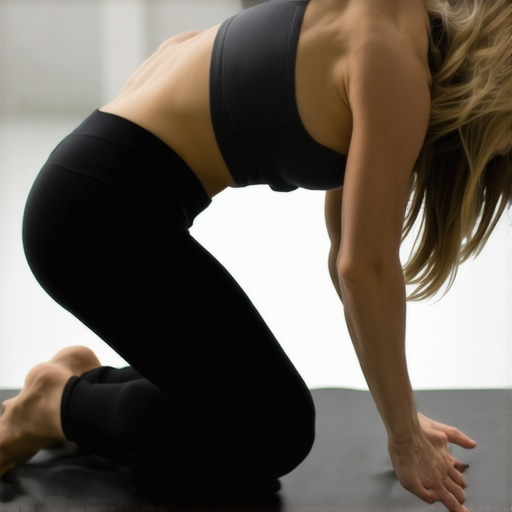
I remember the morning my neck seized up so hard I couldn’t even check my blind spot while driving to work. I had just finished a ‘relaxing’ session of yoga, where I spent five minutes aggressively cranking my spine through Cat-Cow. I thought the bigger the arch, the better the result. Boy, was I wrong. I was treating my spine like a rusty hinge that just needed more force, rather than the delicate, segmented chain it actually is. Most of us think we are loosening up, but in reality, we are just jamming our vertebrae together. Today, I am going to show you how to stop the ‘hinging’ and start the ‘flowing’ so you can actually revolutionize your posture with targeted mobility exercises that don’t leave you in pain.
If you have ever wondered why your neck hurts after a session at the gym, even when you are just doing basic stretches, you are in the right place. Have you ever felt a sharp pinch instead of a gentle release while arching your back? If so, tell me in the comments—I want to know if I am not the only one who learned this the hard way.
Stop Treating Your Spine Like a Hinged Door
Early in my journey, I made the classic mistake of moving only from the spots that were already flexible—my neck and my lower back. I would sag my belly toward the floor and throw my head back until I saw the wall behind me. I was completely bypassing my mid-back, which is the area that actually needs the movement! This ‘hinging’ creates a massive amount of pressure on just two or three joints. Experts at the Journal of Manipulative and Physiological Therapeutics have noted that localized spinal mobilization is significantly more effective than global, un-targeted movement for restoring healthy range of motion. When you just flop up and down, you aren’t doing a 2-minute drill for better spinal rotation; you are just irritating your discs.
Does This Simple Stretch Actually Risk My Disc Health?
It is a fair question to ask because, if done with too much ‘ego,’ any stretch can be counterproductive. The fear of a ‘slipped disc’ is real, but the Cat-Cow isn’t the enemy—your technique is. If you find yourself foam rolling your lower back constantly because it feels tight after stretching, that is a huge red flag that you are over-extending in the wrong places. We need to move away from the idea of ‘stretching’ and toward the idea of ‘segmenting.’ We are going to break down how to move one vertebra at a time, starting from the tailbone, to ensure every inch of your spine gets the blood flow it deserves without the dangerous pinching.
Master the Segmented Wave
Imagine your spine is not a single rod, but a string of thirty-three individual pearls. Most of us move our backs like we’re trying to bend a frozen garden hose—forced, clunky, and prone to snapping. To fix this, you need to implement segmented movement. This isn’t just about moving; it’s about choosing exactly which bone moves and when. By slowing down, you are essentially providing mobility boosts for posture expert tips for daily adjustments that stay with you long after the stretch is over. Start on all fours with your hands directly under your shoulders. Keep your arms locked straight—the moment you bend your elbows, you’ve stopped moving your spine and started moving your shoulders. This foundational setup is key to improving posture through mobility practical chiropractor strategies that actually yield results.
Start with Your Tailbone to Protect Your Neck
The biggest mistake in a Cat-Cow is leading with the head. Instead, think of your tailbone as the engine and your head as the caboose of a train. Begin in the ‘Cat’ position, arched like a Halloween cat. To transition into ‘Cow,’ start by slowly tilting only your pelvis. Try to feel your lowest lumbar vertebra drop toward the floor, then the next, then the next. This controlled descent is the core move that prevents lumbar disc bulges because it distributes the load across the entire chain. If you feel a sharp pinch, you’ve likely skipped a few pearls and gone straight to a ‘hinge.’ Understanding this nuance is vital to knowing the difference between a sore muscle and a slipped disc. #IMAGE_PLACE_HOLDER_B#
Unfreeze Your Mid-Back with the Rib-Cage Lift
I’ll never forget the day I realized my mid-back was effectively a ‘dead zone.’ During a workshop, an instructor asked me to arch just between my shoulder blades. I physically couldn’t do it. My neck would crane and my lower back would sag, but that middle section stayed as flat as a pancake. This is why many of us struggle with how to fix a rib that feels out of place; we simply aren’t moving the ribs through their full range. To wake this area up, as you push into the ‘Cat’ arch, focus on pulling your belly button toward your spine and spreading your shoulder blades as wide as possible. You should feel a stretch deep between the blades. If you can’t feel it yet, you might need to learn how to breathe into your back to relieve rib tension. Sending air into that ‘dead zone’ while you’re arched helps create space from the inside out. This is the only way to solve why your traps are always tight even after a massage—you’re finally giving the supporting structures the movement they’ve been starving for.
Let’s dig deeper into why simply ‘moving more’ isn’t always the solution you think it is. One of the most persistent myths I hear in the wellness community is the idea that we need to find that one ‘perfect’ seated position and hold it like a statue. But here is the contrarian truth: why your perfect posture is actually causing muscle fatigue is often due to the sheer lack of variety in your movement. Your body is designed to be dynamic, not a mannequin. When you force yourself into a rigid, upright position for hours on end, you are essentially asking your muscles to perform a low-grade isometric contraction that eventually leads to cellular fatigue and localized stiffness.
Stop Chasing the Ghost of Perfect Posture
Research published in the Journal of Physical Therapy Science emphasizes that dynamic postural control—your body’s ability to maintain balance and stability during movement—is a much stronger predictor of long-term spinal health than any static seated position. This challenges the entire philosophy behind most rigid ergonomic setups. Instead of trying to sit perfectly, we need to move toward a model of constant, micro-adjustments. If you aren’t careful, you might fall into the common trap of ‘over-correcting’ your alignment, which leads to increased tension in the paraspinal muscles. Have you ever fallen into the trap of trying to sit ‘perfectly’ only to end up in more pain by the end of the day? Let me know in the comments—I’ve been there, and I want to help you avoid the same mistakes.
Stretch for Stability and Save Your Nerves
Then there is the ‘Oops’ factor that nearly sidelined my own progress for months. I used to think that if a muscle felt tight, I simply needed to pull on it harder. But often, tightness is a protective mechanism from your nervous system. If your hamstrings feel like steel cables despite daily stretching, it might be the real reason your hamstrings stay tight despite stretching: your brain is tightening them to protect a pelvis that lacks stability. Stretching through that ‘electric’ tightness doesn’t release the muscle; it just irritates the nerve. This is how many people accidentally cross the line and lose the ability to tell the difference between a pulled muscle and a slipped disc until the pain becomes chronic.
#IMAGE_PLACE_HOLDER_C#
Can a single adjustment really reset your nervous system?
Many people view a professional visit as a way to ‘pop’ or ‘crack’ bones back into place, but that is a major oversimplification of how chiropractic adjustments enhance posture and mobility. It isn’t just about the architecture of the bone; it is about the neurological feedback loop. When a joint is restricted, the sensory data sent to your brain becomes ‘noisy’ or distorted. This is where the link between mobility and posture a chiropractors guide becomes so vital for advanced recovery. An adjustment clears that neurological static, allowing for better motor control and muscle activation. It is the primary reason chiropractic adjustments unlock a pain-free lifestyle today—not because they move a bone an inch to the left, but because they restore the conversation between your brain and your body. Stop looking at your spine as a stack of bricks and start seeing it as a high-speed data cable that needs a clear signal to function properly.
The Gear That Finally Ended My Morning Stiffness
If I had a dollar for every time someone told me they bought a five-hundred-dollar ergonomic chair only to still have a ‘pinched’ feeling in their lower back, I’d be writing this from a yacht. The truth is, even the best chair can’t fix a lack of active engagement. Personally, I stopped relying on ‘smart’ furniture and started using a simple, firm lumbar roll. I use it because it forces my spine to maintain its natural lordotic curve without me having to think about it. If you aren’t sure where to put it, check out the proper way to use a lumbar roll in your office chair to avoid making your stiffness worse. I also swear by a standard lacrosse ball for ‘mashing’ my glutes and traps—it’s the most cost-effective way to handle localized tension before it turns into a full-blown headache. I’ve found that the morning routine that stops your back from clicking is only as good as the tools you use to support it throughout the day.
Your Expensive Ergonomic Chair Might Be Failing You
We are currently living through a transition in workplace ergonomics. I predict that within the next five years, we will see a shift from static furniture to AI-integrated posture trackers that provide haptic feedback directly to your phone the moment your spine begins to slump. Until then, you have to be your own feedback loop. Most of us fail because we set our equipment up once and never touch it again. For example, why most standing desks are set at the wrong height is a classic case of ‘set it and forget it’ leading to shoulder impingement. Even if you are working from home, you need to know how to keep your spine healthy while working from the sofa by using cushions to create a makeshift neutral spine. #IMAGE_PLACE_HOLDER_D#
How can I maintain these mobility gains for the next decade?
Maintenance isn’t about doing more; it’s about being more intentional. Dr. Stuart McGill, a world-renowned spine biomechanist at the University of Waterloo, emphasizes that ‘spinal hygiene’—the way you move in between your workouts—is actually more important than the workout itself. If you spend twenty minutes on mobility boosts for posture expert tips for daily adjustments but then spend eight hours slumped like a question mark, you are fighting a losing battle. You have to commit to the ultimate guide to improving mobility and posture in 2025 by integrating micro-movements every single hour to ensure your joints don’t fuse into a stagnant position.
Brace for Impact Even During Mundane Tasks
One advanced tip I live by is the ‘bracing’ concept. Most people only brace their core when they are at the gym, but you should be doing it when you pick up a laundry basket or reach for a heavy bag. Learning the bracing technique that protects your spine during heavy yard work can save you from an accidental disc flare-up during mundane tasks. By mastering this, you’re not just ‘stretching’—you’re building a bulletproof jacket around your vertebrae. I want you to try this right now: lightly stiffen your midsection as if someone is about to poke you in the stomach, and then take a deep breath. If you can maintain that tension while breathing, you’ve just mastered the first step of long-term spinal protection. For those looking to go deeper, enhance your posture with expert chiropractic techniques in 2025 to ensure your foundation is solid before you start scaling your intensity.
The Hard Lessons That Finally Saved My Lower Back
Over the years, I’ve realized that the biggest barrier to progress isn’t a lack of effort, but a lack of awareness. I used to think that a loud ‘pop’ meant I was fixed, but the truth about cracking your own knuckles and neck at home is that it’s often just a temporary release of gas, not a structural change. Here are the lightbulb moments that changed everything for me:
- The ‘Ego Stretch’ is a Trap: Pushing further into a stretch doesn’t mean you’re getting more mobile; it often just means you’re forcing your joints to hinge in ways they weren’t designed to.
- Consistency Trumps Intensity: Five minutes of intentional, segmented movement is worth more than an hour of mindless stretching.
- Listen to the ‘Whispers’: Your body whispers before it screams. That tiny twinge is a signal to adjust your form. You should really learn why you should stop cracking your own back every hour and start focusing on stabilizing those segments instead.
The Simple Gear That Changed My Daily Comfort
I don’t believe in expensive gadgets that promise a quick fix. Instead, I rely on a few specific tools and resources that offer mobility hacks simple adjustments for a more active life without breaking the bank. My toolkit includes a standard lacrosse ball for pinpointing tension in the glutes and traps, and a firm lumbar roll for maintaining my curve during office hours. I also schedule regular professional assessments because why chiropractic care is your secret weapon for better posture lies in the expert’s ability to see what you can’t feel. #IMAGE_PLACE_HOLDER_E#
Take Control of Your Movement Today
Your journey toward better mobility and posture is not a sprint; it’s a lifelong relationship with your body. By integrating these small, intentional shifts, you are doing more than just avoiding pain—you are investing in your future self. Remember that chiropractic adjustments unlock a pain-free lifestyle today by clearing the way for your body to heal itself. Don’t be afraid to slow down, breathe, and move with purpose. You have the tools; now it’s time to use them. Have you ever felt that ‘stuck’ sensation in your mid-back during a stretch? Let me know below—I’d love to hear your story.